

How monitoring solar panel installations works
Your solar panels may look perfectly fine at first glance and yet yield less than they should. An inverter that frequently shuts down, a defective panel, or dirt often go unnoticed on your energy bill. With monitoring of solar panel installations, you track performance continuously. This way, a deviation becomes visible before it costs months of unnecessary yield.
For those who own solar panels, monitoring isn’t just about having another app on their smartphone. It’s about certainty: is your installation working as expected, and is action taken when it isn’t?
What does monitoring of solar panel installations do?
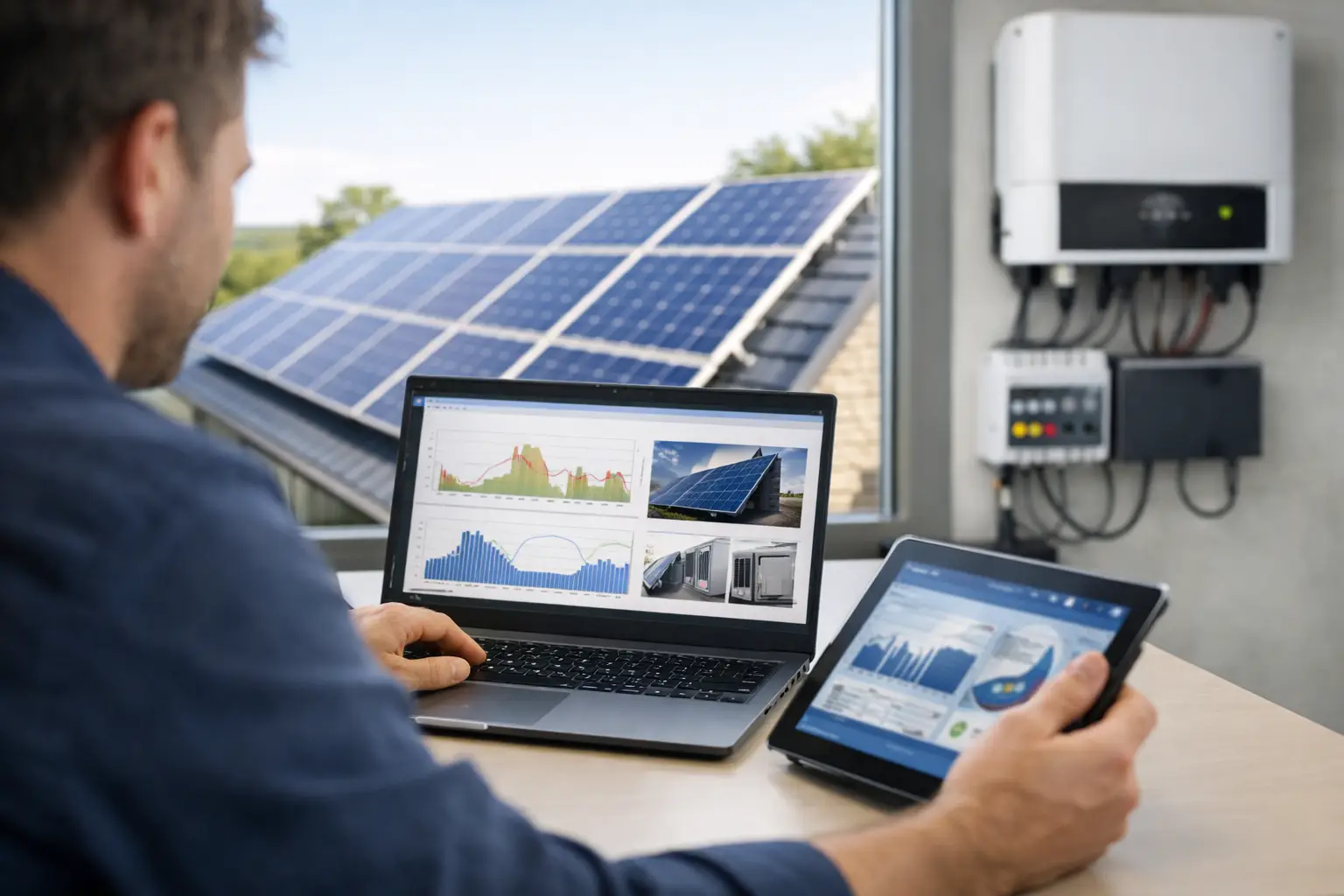
A monitoring system collects data from your inverter and, depending on the installation, also from individual panels or strings. A string is a series of solar panels connected together. This data shows how much electricity your system produces and how that production evolves.
Effective follow-up looks at more than just the total. The yield is compared with what is logical for the season, the weather, the location, and the capacity of your installation. Is an installation producing significantly less than on comparable days? Then that is a signal to look further.
That difference is important. A sunny day naturally yields more than a grey winter day. A decrease is therefore not automatically a malfunction. Monitoring specifically helps to distinguish normal fluctuations from a technical problem that requires attention.
Why checking the app only occasionally isn’t enough
Many owners check their production whenever they think of it. That is better than not looking at all, but it does not offer full protection. You might see that the yield is lower, but not always when the problem started or what the cause is.
For example, an inverter can briefly switch off during the day due to a grid problem. On an annual basis, this can cause a noticeable loss, while the app still shows a good total production. A defective string also sometimes goes unnoticed for a long time: the installation still produces, but only at a fraction of its capacity.
Professional monitoring therefore looks for deviations, recurring error messages, and interruptions. You don’t have to interpret graphs or look up technical codes yourself. This provides peace of mind, especially if your installer is no longer reachable or if you don’t know who to call in the event of a malfunction.
Which problems does monitoring make visible faster?
Monitoring does not prevent every defect, but it does reduce the time between a problem occurring and its detection. The sooner you know what is going wrong, the smaller the chance of long-term yield loss.
Common signals include an inverter that no longer registers production, an unexpected drop in yield, loss of communication with the inverter, or a difference between strings. For installations with optimizers or panel-level monitoring, deviating panels can sometimes be detected even more specifically.
Dirt can also play a role. Dust, pollen, leaves, or bird droppings can restrict light. Monitoring doesn’t always literally say that cleaning is necessary, but a gradual decline can be a reason to have the installation checked. A targeted check, combined with professional maintenance or cleaning, prevents you from having to guess the cause.
Birds deserve extra attention in this regard. Nests under solar panels can damage cables and cause dirt accumulation. When a performance problem coincides with visible bird activity, an inspection is wise. Preventive bird protection protects not only your yield but also the components under the panels.
Monitoring is more than just a malfunction notification
The greatest value lies in the follow-up after the notification. A notification without a clear analysis still leaves you as an owner with questions. Is there really a malfunction? Does someone need to come by? Can you safely check something yourself? And how much yield are you potentially missing out on?
An experienced service partner first assesses the available data. Sometimes a problem can be solved remotely, for example by checking settings, communication, or a restart. In the event of a technical fault, an intervention is necessary. A clear diagnosis then ensures that the technician can work in a targeted manner and does not arrive on-site without preparation.
For individual owners, this means less wasted time and less uncertainty. For companies, the impact is often even greater. With a large roof installation, downtime can directly affect the return and the planned energy production. Monitoring and rapid technical assistance help to limit that downtime as much as possible.
When is monitoring extra useful?
Actually, every solar panel installation deserves some form of follow-up. However, the importance is greater in certain situations. Think of older installations, systems where the original installer is no longer active, installations with multiple inverters, or roofs that are difficult to inspect yourself.
Follow-up is also wise for newer systems. A modern inverter has a lot of data available, but that data only yields results when someone recognizes deviations in time. Those who want to protect their investment should not wait until the annual bill makes it clear that production was disappointing.
For companies, agricultural businesses, and property managers, monitoring is a foundation for professional operational management. The person in charge gains insight into performance and incidents without having to open every portal daily. This makes reporting easier and keeps the focus on what counts: an installation that continues to produce reliably.
How to get more out of your installation’s data
Monitoring works best as part of a broader approach. The data tells you where to look. A technical inspection then determines what is actually going on. By combining the two, you act purposefully instead of on gut feeling.
In addition, plan periodic maintenance. This includes checking the inverter, cabling, mountings, and visible defects. Not every installation requires the same maintenance frequency. Location, age, environment, and history of error messages make a difference. An installation near trees, farmland, or many birds usually requires more attention than a clean, easily accessible roof.
Also keep important data: the original capacity, the date of commissioning, warranty documents, serial numbers, and previous interventions. This information speeds up a diagnosis if a problem occurs later. When taking over an existing home or commercial building, this is often an underestimated point of attention.
Watch for these signals, even without technical knowledge
You don’t have to be a specialist to stay alert. Occasionally check if the inverter shows error codes, if production is at zero for a long time, and if there is visible damage, loose cables, or heavy dirt. Do not work on the roof yourself and do not open any electrical components. This is unsafe and can affect warranties.
If you notice a deviation, note when it started and, if possible, take a screenshot of the notification in your app. This helps with the initial assessment. Don’t wait weeks in the hope that it will resolve itself. Especially in the sunny months, every lost production day can count.
Solar Assistance monitors more than 10,000 installations and combines 24/7 monitoring with technical expertise throughout Belgium. As a result, a notification is not limited to a number on a screen but can lead to a concrete next step: remote analysis, a targeted check, or a quick intervention.
Choose insight into performance, not guesswork
The yield from solar panels is too valuable to assess only after the fact. Monitoring gives you insight into what is happening, while preventive maintenance and targeted repairs help to keep problems small. This extends the lifespan of your installation and limits unnecessary downtime.
Therefore, don’t just let your installation produce, but also have it monitored. Those who see deviations in time and have them professionally assessed maintain more control over their return and have much less to worry about regarding what happens on the roof.