

News

What a drone scan reveals about your solar panels

A solar panel that has stopped producing is invisible to the naked eye. At best, you will notice it months later on your energy bill. With a thermographic drone scan, we detect such panels in a single flight, without anyone having to go onto the roof.

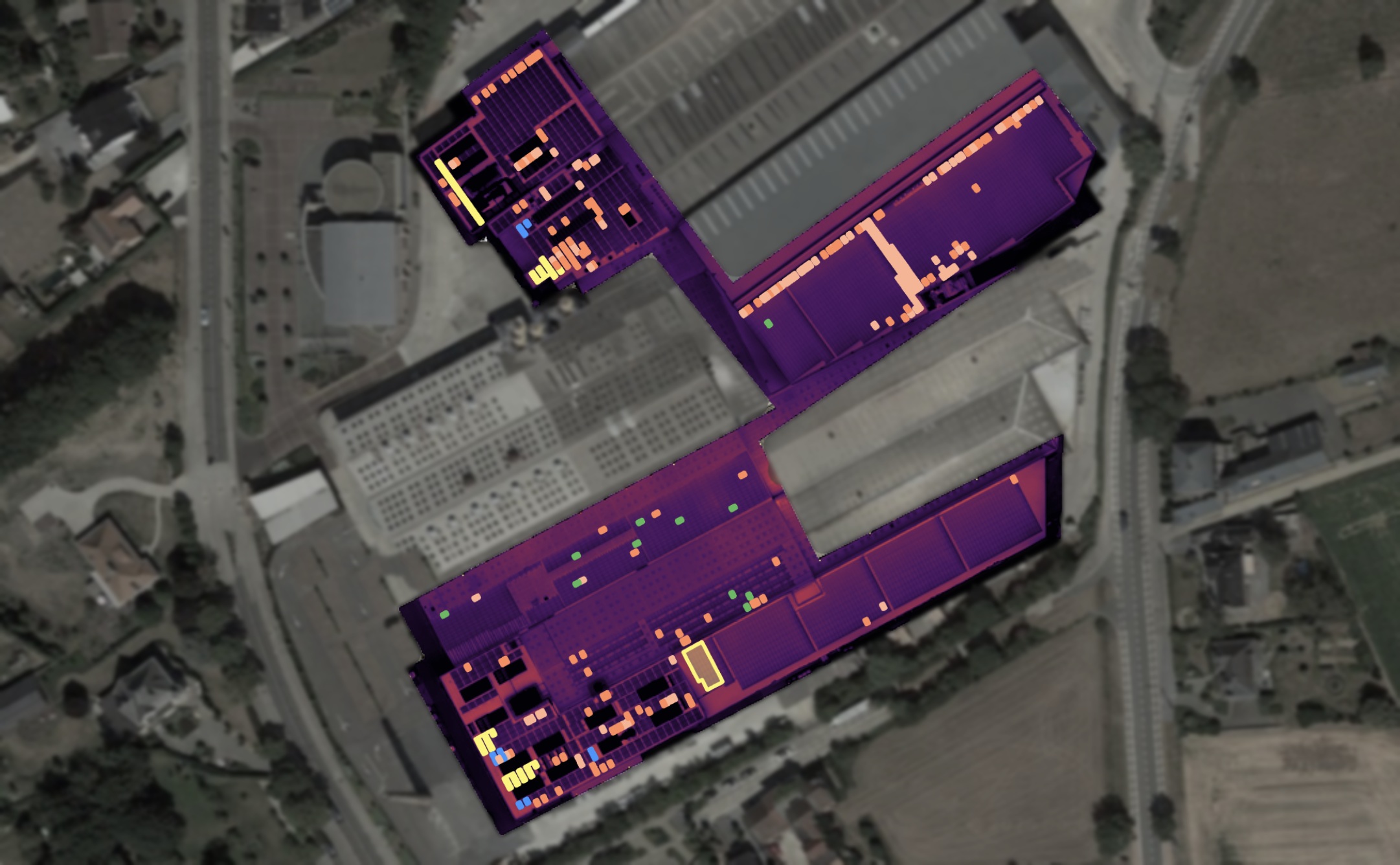
Thermal image of a commercial roof with solar panels where deviating panels are marked in color

Why we scan solar panels with a drone

A solar panel converts sunlight into electricity. If that fails somewhere, that energy remains in the panel as heat. A defective panel is therefore literally warmer than its neighbors, and a thermal imaging camera captures that difference.

On a commercial roof with thousands of panels, measuring each panel individually is an impossible task. A drone maps the entire roof, including areas that are difficult or unsafe to access. We fly when there is sufficient sun and with the installation in operation, as only then do deviations become visible.

The software then overlays the thermal images onto the roof as one large map and marks every panel that deviates. This way, our technician knows exactly which panel to check beforehand.

What you see on the image

Thermal image of a commercial roof with solar panels where deviating panels are marked in color
Heat map of a commercial roof. Purple is normal; each colored block is a panel that deviates.

The image above is the heat map of a commercial roof of over two hectares. Purple is the normal state: panels that are working as they should and are all approximately the same temperature. The lighter the color, the warmer the surface.

The colored blocks are the deviations. Each block represents one panel that is warmer than it should be, and the color indicates the type of deviation. If many blocks are next to each other in a straight line, the cause usually lies not with the panels themselves but with the cabling or the connection behind them.

What the deviations mean

A scan distinguishes between five types. They differ greatly in impact: a hotspot costs you a small amount of yield from one panel, while an interrupted string shuts down an entire row of panels.

Hotspot
One cell in the panel is clearly warmer than the rest. Often caused by dirt, bird droppings, shade, or a damaged cell.
Consequence: The panel delivers less and ages faster in that spot.
Multiple hotspots
Several cells in the same panel are too warm. Indicates stubborn fouling, shade, or an internal defect.
Consequence: Greater loss per panel. Cleaning or replacement is required, depending on the cause.
Bypass diode active
One-third of the panel is switched off. The diode reroutes the current around a problem zone.
Consequence: The panel delivers approximately one-third less.
Panel without production
The entire panel is uniformly warmer and delivers no power. Usually a loose connector or a defective junction box.
Consequence: Total loss of that panel.
Interrupted string
An entire series of panels is disconnected from the inverter, for example due to a fuse, a cable, or a connector.
Consequence: All panels in that series deliver nothing.

On this roof, the majority of the deviations were hotspots, but the greatest gain was found elsewhere: in the interrupted strings.

279
deviations found on one roof
5
interrupted strings
83
panels that yielded nothing

Not every deviation is a defect. For some hotspots, the cause is simply dirt or shade, in which case cleaning is sufficient. That is why we link a suspected cause to every deviation.

What happens after the scan

1

Report

You receive a report with every deviation, the exact location on the roof, and a concrete recommendation.
2

Targeted repair

Our technicians reconnect strings, replace defective panels or connectors, and schedule cleaning where dirt is the cause.
3

Baseline measurement

The scan is the starting point for targeted maintenance and a baseline measurement against which you can compare a subsequent inspection.

Do you want to know the status of your installation?

Solar Assistance performs thermographic drone scans as part of maintenance for businesses. Request a quote or call us at 02 828 90 01.

Request a quote →

Solar Assistance in the spotlight

Check out the latest news

Thousands of families without power: does a home battery actually do anything?

In early September, a high-voltage substation in Alken failed. Thousands of families were without electricity for about an hour. Do your solar panels keep working then?

FusionSolar becomes EnergyOrb Europe: what does this mean for you?

FusionSolar is moving to EnergyOrb Europe. Your installation and data will normally be preserved.

What is the best orientation for solar panels? We tested it ourselves

South, east, or west. Everyone has an opinion about it. But which orientation actually delivers the highest yield in practice?

Milestone: 2 millionth for Jurgen and Emanuel

Solar Assistance cleans an average of 150,000 solar panels annually.

Investing in care and sustainable energy

Installing solar panels is one thing, ensuring they continue to perform efficiently is another.