



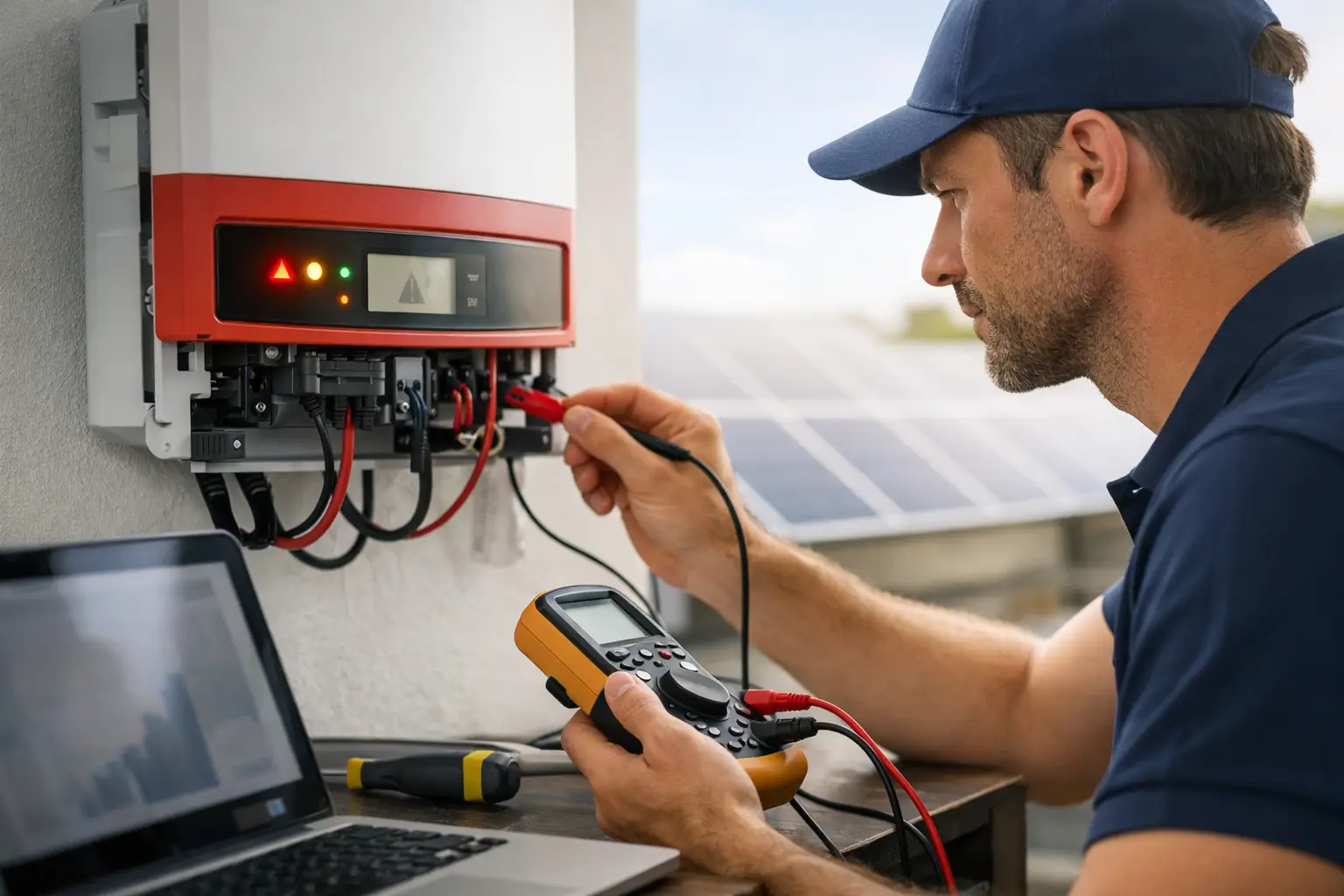
What exactly does an inverter do when error codes occur?
An error code on your inverter often appears right on a sunny day, when your installation should normally be producing a lot of energy. What does an inverter do when error codes occur? It first checks whether the installation can still operate safely. In the event of a deviation, it reduces production, temporarily halts it, or disconnects from the power grid. This protects your installation, your home, and the grid, but it can also cost you yield as long as the cause remains unresolved.
What does an inverter do when error codes occur?
The inverter is the control point of your solar installation. It converts the direct current (DC) from your solar panels into alternating current (AC) that you use at home or supply to the grid. At the same time, it constantly measures voltages, currents, temperature, insulation values, and the quality of the electricity grid.
If it detects a value that falls outside the safe limit, it registers an error code. What happens next depends on the severity of the notification. Some codes are warnings; the inverter continues to operate but indicates that attention is needed. Other codes cause the installation to stop automatically. This is not a defect in itself, but a safety response.
In the event of a brief grid deviation, the inverter usually waits a moment and then attempts to restart automatically. If the problem persists, it remains in a fault state. You will then often see a code, a red light, or a message such as ‘grid fault’, ‘isolation error’, or ‘overtemperature’ on the screen, in the app, or in the online portal.
The code does not always immediately tell you which part is broken. It primarily indicates where the inverter is measuring a deviation. The actual cause could lie within the inverter itself, in the cabling, with a panel, in the meter cupboard, or in the public electricity grid.
Why does an inverter sometimes stop completely?
An inverter must not continue producing when it is unsafe to do so. That is why it switches itself off in the event of certain errors. This prevents damage to components and limits risks such as overheating or electrical faults.
A common cause is deviating grid voltage. On bright days, many solar panels in the same street produce power simultaneously. This can cause the voltage on the local grid to rise. If the limit is exceeded, the inverter stops feeding back. It will try to reconnect later. If the same error keeps recurring, you earn less from your installation at those times, and further investigation is advisable.
An insulation fault also often leads to a shutdown. The inverter then measures that current may be leaking through an unintended path, for example due to damaged cabling, moisture in a connector, or a problem in a solar panel. In such cases, continuing to operate is not an option.
In the event of overheating, an inverter sometimes first reduces its power. If cooling is unsuccessful, it switches off. A dirty fan, insufficient free space around the device, direct sunlight, or a warm technical room can all play a role. Especially with older installations, a minor cause can lead to recurring production loss unnoticed.
Not every error code requires the same action
The brand name and type of inverter determine which code you see. A code that signifies a temporary grid notification for one brand may indicate an internal fault for another. Therefore, do not just search for the error code number. Also look at the full message, the time, and how often it recurs.
A one-time notification after a power outage or heavy thunderstorm is usually less concerning than the same error appearing every afternoon. The behavior of the installation also matters. Does the inverter restart after a few minutes and production recover? Then it may be a temporary grid deviation. If it remains switched off or fails several times a day, you may be facing a structural loss of yield.
An error message does not automatically mean your inverter needs to be replaced. Sometimes a check of the connection, ventilation, or settings is sufficient. In the event of a defective internal component, repair or replacement is necessary. A proper diagnosis prevents you from paying for the wrong intervention.
Common types of error messages
Error codes usually fall into four groups. With grid faults, the inverter measures a grid voltage that is too high, too low, or unstable. With DC faults, the cause lies on the side of the solar panels, cables, or connectors. Insulation faults indicate unwanted leakage current, often due to moisture or damage. Internal faults relate to components within the inverter itself, such as electronics, cooling, or communication.
Additionally, there are communication notifications. Your installation may still be producing, but it is no longer sending data to the app or monitoring platform. This may seem less urgent, but you lose visibility of your yield. It is precisely then that a real fault can go unnoticed for longer.
What can you safely check yourself?
Start by recording the notification. Note the exact error code, take a photo of the display, and write down when the fault began. Also check if the inverter is still making noise, if any lights are on, and if other electrical appliances in the house are working normally. This information helps a technician find the problem more quickly and effectively.
Next, only check what you can see without risk. Is the space around the inverter clear? Are the ventilation openings visibly dusty? Has there been a recent power failure? Is the main switch of the house still on? Do not touch any DC cables, connectors, or opened electrical cabinets. These can be under voltage, even when the inverter is not producing.
Do not keep restarting the inverter without knowing why it failed. A one-time restart according to the manual may be appropriate for a temporary notification. Repeated resetting sometimes masks the problem and rarely provides a lasting solution. Especially in the case of an insulation fault, fire alarm, strange smell, discoloration, or visibly damaged cables, do not switch any components on or off yourself. Have the installation checked.
When should you call in a technician?
Seek technical assistance when an error code recurs, the inverter does not produce for more than a day, or your yield is clearly lower than normal. Also, do not wait if the error relates to insulation, earth leakage, internal hardware, or temperature. The longer a fault persists, the more solar energy you miss out on.
During a visit, a technician does not only check the inverter. They also measure the DC side of the installation, inspect connectors and cabling, check the grid connection, and compare production data with previous periods. This distinction is important. An inverter that stops due to a grid problem requires a different approach than an inverter with an internal fault.
Solar Assistance can provide an independent assessment of which intervention is required. This is particularly valuable if the original installer is no longer reachable or if you do not have a clear point of contact. The goal is not just to make the error code disappear, but to ensure your installation produces reliably again.
Monitoring makes the difference between an incident and downtime
Without monitoring, you might only notice a fault during the annual settlement. By that time, an inverter could have been producing less for days, weeks, or even longer. With active follow-up, you can see more quickly when production deviates, an error message recurs, or communication is lost.
This is especially useful for errors that seem to disappear on their own. An inverter may restart automatically after a grid fault, but if that fault occurs every sunny afternoon, yield continues to be lost. By looking at production patterns and error messages together, it becomes clear whether it is an isolated incident or a recurring problem.
Preventive maintenance also helps. Checking ventilation, connections, housing, and performance data reduces the chance that small deviations will grow into long-term downtime. For you, this means more certainty, fewer surprises, and a longer lifespan for the installation.
An error code is therefore primarily a signal that your installation is monitoring itself. Take that signal seriously, but do not panic immediately. With the right information and timely technical inspection, you prevent a short safety stop from turning into unnecessary loss of yield.