

How to identify faulty solar panel cables?
A cable problem isn’t always visible from the ground, but you often notice the consequences on your energy bill or in your inverter’s app. Anyone wanting to know how to identify faulty solar panel cables should therefore look beyond visible damage. Unexpected yield loss, recurring error messages, and an inverter that shuts down can also indicate a problem in the cabling.
Cables are a small part of your solar installation, but they connect everything that generates a return. If a cable, connector, or connection no longer functions properly, an entire string of solar panels may deliver less or even no power. Intervening quickly limits downtime, prevents further damage, and restores certainty about the operation of your installation.
Why solar panel cables have such a major impact on your yield
Solar panels produce direct current (DC). This current flows through cables and connectors to the inverter, which converts it into usable alternating current (AC) for your home. Is the connection interrupted, damaged, or poorly connected somewhere? Then less energy reaches the inverter.
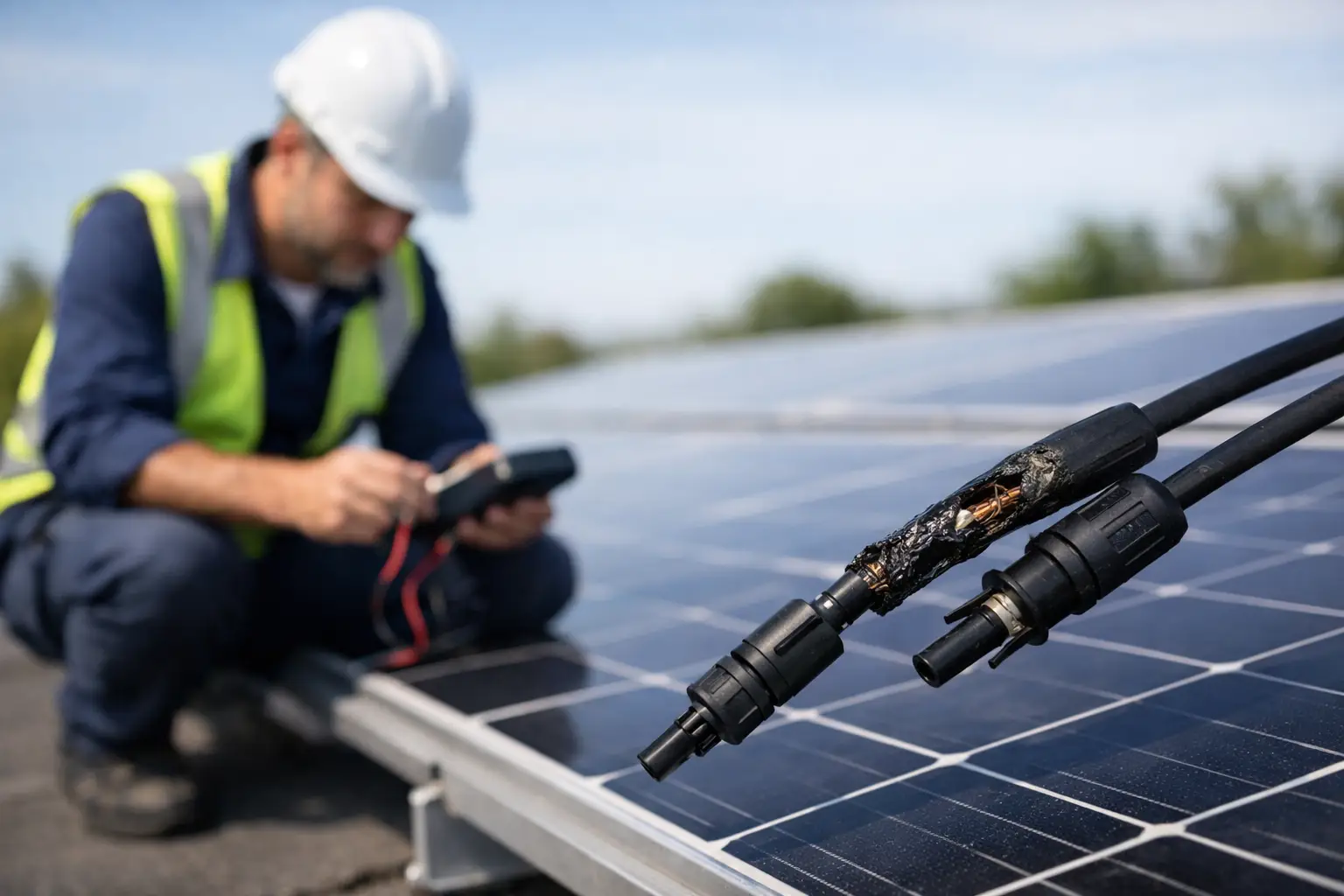
A small problem can become a big one. For example, a loose connector can generate heat. Damaged insulation can let moisture in. And a cable gnawed by animals can lead to a malfunction that only occurs during rain or humid air. Your panels may still look fine on the outside, while the yield is secretly lagging behind.
This makes preventive solar panel maintenance valuable. During a targeted check, a technician looks not only at the panels and inverter but also at connections, cabling, and potential wear points.
How to identify faulty solar panel cables by signals
The clearest indication is a yield that drops without a logical explanation. A few percent difference due to clouds, seasons, or a hot summer day is normal. A sudden, permanent drop deserves attention, especially when comparable days in previous years showed higher production.
Also, inverter error messages are a serious signal. Messages about insulation faults, earth faults, string problems, or voltage that is too low can be related to the cables. The exact cause may also lie elsewhere, but ignoring such a message is not a good idea. Note the error code and have it assessed.
In addition, look out for the following visible or practical signals:
- An inverter that regularly shuts down and later restarts automatically.
- Difference in yield between strings, if your inverter displays that data separately.
- Visible cracks, discoloration, flat spots, or loose cables near panels and the inverter.
- Connectors that are discolored, deformed, or remarkably warm.
- Gnaw marks, nesting material, or damage under the panels.
With an installation on a flat roof, cables are sometimes visible from a safe spot. On a pitched roof, they are usually difficult to reach. Do not climb onto the roof yourself or pull connectors loose. The DC side of a solar installation is live as soon as light hits the panels. Even if the inverter is switched off, dangerous voltage may still be present.
Yield loss is not always a cable problem
Lower production does not automatically mean the cabling is faulty. Dirt, shade, an inverter malfunction, a defective panel, or a problem with the power grid can cause the same complaint. That is why measuring is better than guessing.
With solar panel monitoring, you can see more quickly when production deviates from the normal pattern. This helps to signal a problem early, before your installation delivers less yield for weeks. For systems that report per string or per panel, the source of the problem can often be investigated more specifically.
Where cable damage usually occurs
Solar panel cables are made for outdoor use, but for years they deal with UV radiation, temperature fluctuations, wind, moisture, and mechanical stress. Damage often occurs in places where a cable rubs, kinks, or hangs loose.
Under panels, for example, a cable can move against a sharp edge or roofing material. In strong winds, it rubs a little further each time. On flat roofs, standing water around cables and connections can pose an extra risk, especially if the insulation is already damaged.
Animals are another common cause. Birds build nests under solar panels and can move or damage cables. Rodents also seek shelter and can gnaw on insulation material. Do you see a lot of nesting material or hear birds under your panels? Then it is wise to have both the cabling and the mounting checked. With bird protection under solar panels, you reduce the chance of this problem recurring.
Human error also plays a role. Connectors that are not fully clicked into place, parts from different brands that do not fit together properly, or cables that are mounted too tightly may only cause problems years later. Especially with older installations or when the original installer is no longer active, an independent inspection provides clarity.
What you can safely check yourself
You don’t have to be a technician to notice deviations. First, check the app or the inverter display. Compare the yield with the same period last year and see if there are any error messages or warnings. Take a screenshot if necessary. This information helps with a technical diagnosis.
Next, look from the ground or from a safe, accessible place for loose cables, hanging parts, visible nesting material, and damage around the inverter. Do you smell a burning odor, hear a ticking sound at the inverter, or see charred spots? Then do not touch cables or connectors yourself. Limit the use of the installation according to your inverter’s instructions and request technical assistance immediately.
Do not open junction boxes and do not measure the DC cables yourself with a standard multimeter. A reliable and safe check requires the right measuring equipment, knowledge of DC voltage, and experience with solar installations. A technician can assess insulation resistance, string voltage, connectors, and thermal deviations, among other things.
When a quick intervention is needed
Some signals can wait for a planned inspection. Others require quick action. Contact a specialist quickly if your inverter repeatedly reports an insulation or earth fault, when an entire string shows no production, or when you notice visible damage, heat, or a burning smell.
An inspection is also wise after storm damage, roof work, or work near the panels. A cable can shift or become pinched without you seeing it immediately. By having it checked in time, you prevent a small defect from leading to longer downtime or additional repairs.
With technical assistance for solar panels, a qualified technician can specifically investigate and repair the cause. Solar Assistance has been working on the yield and continuity of existing installations since 2012, with its own technicians and quick intervention when necessary.
Prevention is better than cure
You cannot completely rule out cable damage, but you can significantly reduce the risk. Ensure that inspection, monitoring, and maintenance are not a one-off action after a malfunction. An installation that is regularly followed up shows deviations more quickly. As a result, the yield remains more predictable and you reduce the risk of unpleasant surprises.
During an inspection, also explicitly ask about the state of cables, connectors, and mounting points. This is particularly relevant for installations that have been running for several years, for roofs with many birds, or when it is difficult to compare yield due to a lack of historical data.
A solar installation does not have to be a source of concern. Those who have small signals investigated in time protect not only the cables but especially the yield and lifespan of the entire installation.