


Solar panel service company: what should you look for?
You often only notice late when your solar panels are underperforming. The inverter doesn’t show an error message, the app seems to be working, and yet part of your yield is being lost. That is exactly why a good solar panel service company is not a luxury, but a logical step if you want to be sure of yield, continuity, and fast assistance with problems.
Many owners still think in terms of purchase and installation. After that, the system should supposedly run by itself for years. In practice, it works differently. Solar panels are not a device that you hang up and then forget about. Soiling, wear and tear, malfunctions, cable problems, failing optimizers, or communication issues can gradually depress the yield without you seeing it immediately.
What exactly does a solar panel service company do?
A solar panel service company primarily does not sell extra panels. The focus is on making what you already have work well. This means: monitoring performance, detecting defects, solving technical problems, and intervening before small issues become major losses.
For individuals, it is mainly about peace of mind. You don’t want to figure out yourself why your installation is yielding less or which error code belongs to which inverter. For companies, the emphasis is more on continuity. A stalled installation there means not only less yield, but also less control over energy planning and operational costs.
A service partner therefore looks broader than just a one-off repair. It involves maintenance, monitoring, cleaning, inspections, technical interventions, and sometimes repowering if components are outdated. That broader picture makes the difference between reacting to problems and staying ahead of them.
Why just installing is not enough
The weak spot of many solar installations is not in the panels themselves, but in what is missing afterwards. Those who do not provide follow-up often notice defects too late. And if the original installer is no longer active or remains difficult to reach, you as the owner are on your own.
This happens more often than you think. Installers change focus, quit, or offer hardly any aftercare. Then you are not looking for a salesperson, but for a party that can quickly assess what is technically going on and can actually intervene.
There is also an important difference there. An installer usually focuses on placement. A service company focuses on long-term performance. That requires a different organization, in-house technicians, clear processes, and the capacity to monitor many installations simultaneously.
What should you look for in a solar panel service company?
Not every service company offers the same level of support. Therefore, look beyond general promises. The real value lies in how quickly problems are spotted, how smoothly they are handled, and how much knowledge is present regarding different brands and types of installations.
1. Monitoring must be more than just an app
Many owners think that monitoring is the same as occasionally logging into a portal. That is too limited. Real follow-up means that deviations are actively detected and assessed. Not just total downtime, but also subtle yield losses.
With professional monitoring of solar panels, you gain faster insight into defective strings, communication problems, or an inverter that is underperforming. This prevents a problem from dragging on for months.
2. Technical help must actually be available
A helpdesk is useful, but ultimately you want to know if someone can come on-site if necessary. Speed is especially important during malfunctions. The longer a defect persists, the greater the loss of yield.
So always ask how interventions are handled. Is there an in-house technical department? Do they work with certified technicians? Do you get a clear diagnosis and a concrete proposal? Anyone who wants to act quickly during a breakdown benefits most from direct technical assistance for solar panels and not from long waiting times or referrals.
3. Prevention is often more profitable than repair
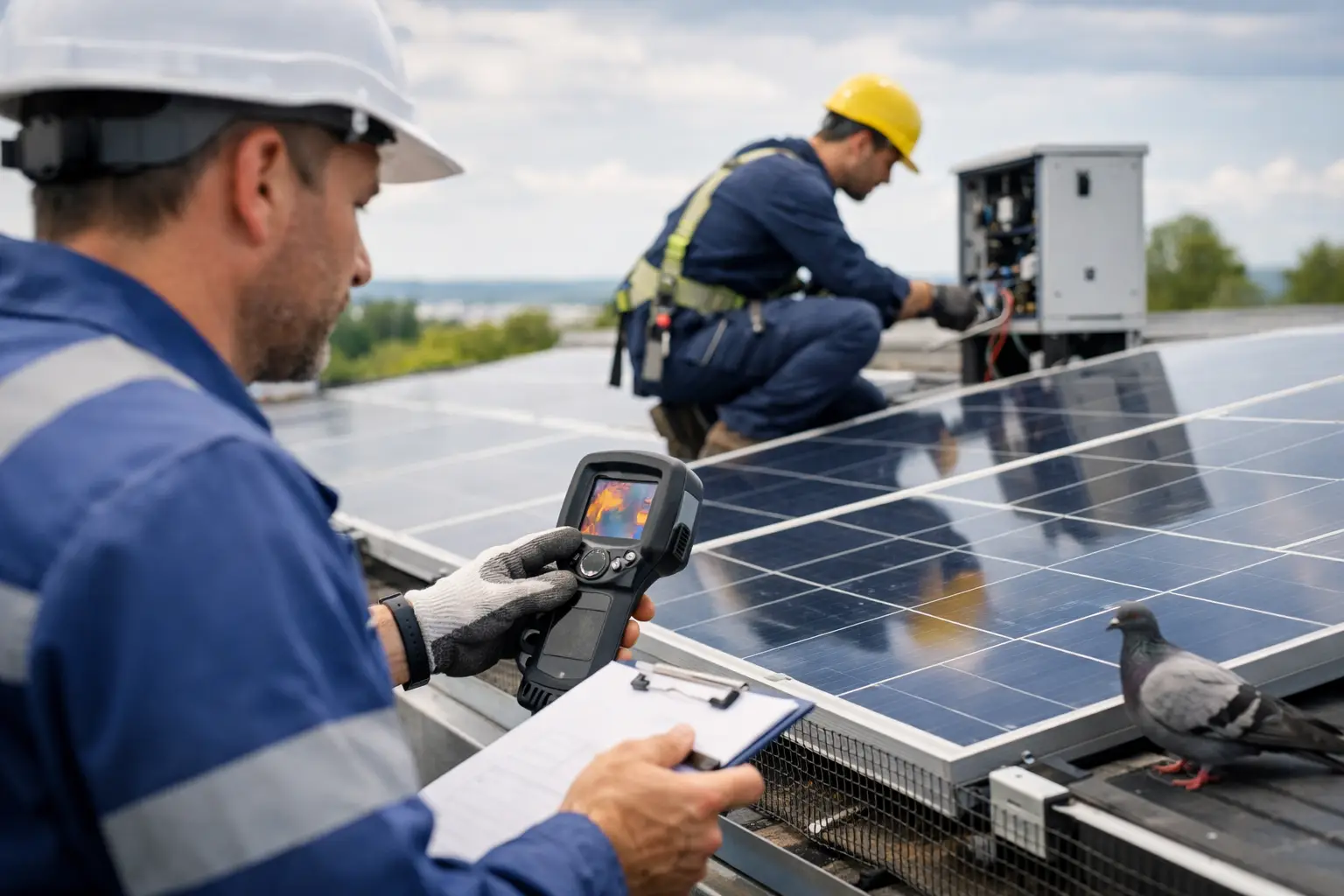
Many problems start small. A connector that heats up, a loose contact, dirt that builds up, moisture seepage, or damage caused by birds. If you discover this in time, the impact remains limited. If you wait too long, it often becomes more expensive.
That is why periodic maintenance of solar panels is useful, even for installations that seem to be functioning normally at first glance. Maintenance extends the lifespan and reduces the chance of unexpected downtime.
4. Cleaning is not a detail
Some roofs stay reasonably clean. Other installations lose noticeable yield due to dust, pollen, moss, traffic pollution, or agricultural residues. It depends on the location, angle of inclination, and surroundings.
Professional cleaning of solar panels is then not a cosmetic intervention, but a way to maintain energy yield. Especially with larger installations, the difference can add up quickly. At the same time, the same applies here: not every roof needs to be cleaned as often. A good service partner looks at the actual situation, not at standard advice.
A good solar panel service company thinks in terms of yield
Yield sounds technical, but it is actually very concrete. You have invested in an installation with an expected return. Anything that lowers that return costs money or extends your payback period.
A good service company therefore does not just look at whether something is defective or not. It looks at performance loss. An installation can still be running and yet remain below its potential. You can’t always see that with the naked eye. You need data, experience, and technical interpretation to get that clear.
For individuals, that primarily means the certainty that the installation is doing what it should do. For professional owners, it often goes even further. Reporting, scalability, and structural management play a role there. A single point of contact is then not a detail, but a practical necessity.
Even small problems deserve attention
Not every problem requires an immediate major repair. Sometimes it’s a broken optimizer, a malfunctioning data logger, damage to cabling, or nuisance caused by birds under the panels. Yet those very things can cause a lot of trouble in the long run.
Bird nests, for example, do not only cause noise or pollution. They can also damage cables and disrupt air circulation under the panels. In such cases, installing bird protection is often a simple way to limit further damage and extra maintenance.
The same applies to administration and insurance. After damage or a technical incident, you don’t want to start searching for which documents, inspections, or evidence are needed. A service partner who also offers support in this regard takes work off your hands and speeds up the process.
For whom is a service company particularly interesting?
The most obvious group are owners of an existing installation whose installer is no longer reachable. But even those who experience no problems can benefit from service. Precisely because much yield loss occurs unnoticed, prevention is often smarter than waiting.
For individuals, it is especially interesting if you have little technical knowledge, don’t want to lose time on troubleshooting, and want certainty about the operation of your system. You are mainly buying peace of mind.
For companies, farmers, property managers, and organizations, it is different. There, it is not just the technical state of the installation that counts, but also the impact of downtime on budgets and planning. Then you want follow-up that is professionally organized and grows with the size of your portfolio.
When switching to a specialized service partner makes sense
If you doubt whether your current situation is still sufficient, pay attention to a few signals. You get slow responses to malfunctions. Your yield fluctuates without a clear explanation. Monitoring is limited or unclear. Maintenance is not done or only reactively. Or you have multiple installations and lack an overview.
At that point, a specialized partner is often the better choice. Not because everything is suddenly going wrong, but because you want to regain control. A party such as Solar Assistance starts from exactly that point: making existing installations perform better, solving problems faster, and unburdening owners with a service-oriented approach.
That requires more than technical knowledge alone. You also need processes, national coverage, experience with different types of installations, and sufficient capacity to follow up effectively. Otherwise, service remains a promise without execution.
Choose not the cheapest, but the most reliable
In service, the comparison is rarely about the lowest price. Cheap follow-up that misses problems or postpones interventions can ultimately cost more than a solid contract. Especially with installations that need to yield a lot, reliability pays off faster than people often think.
So don’t just ask what something costs, but especially what you get for it. How quickly is there a response? How are deviations signaled? Is there preventive advice? Is there proactive thinking about lifespan and performance? That is where the real value of a solar panel service company lies.
Anyone who has solar panels actually wants something very simple: for the installation to do what it promised, without any hassle. That is exactly why good service is not a side issue, but a wise way to protect your investment and keep your yield up to par.