



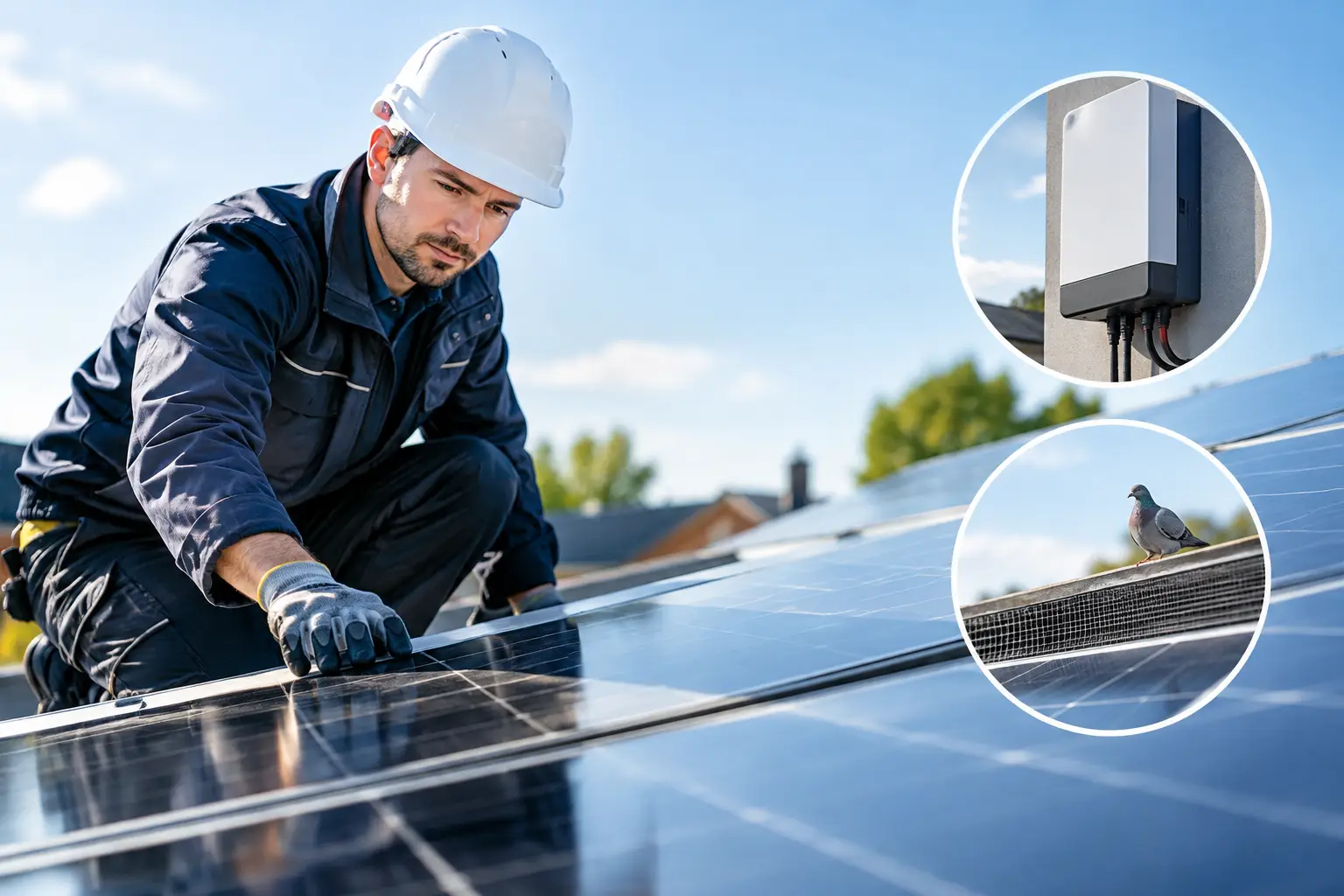
Service contract versus manufacturer’s warranty for solar panels
An inverter that fails, a notification in the app, or a yield that is gradually decreasing: that is when you want to know who will take action. With a service contract versus manufacturer’s warranty, that is exactly where the difference lies. A manufacturer’s warranty may cover a defective part, but it does not automatically provide monitoring, a diagnosis, a quick repair, or follow-up for your entire installation.
For owners of solar panels, this distinction is important. Your installation must produce energy for years. Every day that a malfunction goes unnoticed costs yield. A good service contract is therefore not just about repairing when something is broken, but primarily about identifying problems faster and limiting downtime.
Service contract versus manufacturer’s warranty: the core difference
A manufacturer’s warranty is a promise from the manufacturer of a component, such as solar panels, an inverter, or a home battery. This warranty usually applies for a predetermined period and under specific conditions. In the event of a valid manufacturing or material defect, the manufacturer can repair, replace, or reimburse the component according to its warranty terms.
A service contract is something else. It is an agreement with a service partner regarding the management and maintenance of your solar installation. The content varies per formula but can include monitoring, periodic checks, fault diagnosis, technical assistance, and preventive maintenance. You are not buying a warranty on a product, but support to keep your installation working properly.
The manufacturer’s warranty primarily looks at the question: is this part defective due to a production or material error? A service contract starts from a broader question: is your installation working as it should, and what is needed to prevent or limit loss of yield?
What does a manufacturer’s warranty typically cover?
Warranty terms vary greatly by brand and product. Solar panels often have a product warranty on material and manufacturing defects, as well as a power warranty. That power warranty states that after a number of years, the panel must still achieve a certain percentage of its original power. This is not a promise regarding the yield of your entire installation.
An inverter usually has a shorter manufacturer’s warranty than solar panels. The duration depends on the brand and any warranty extensions. Optimizers, charging stations, and batteries also each have their own terms, exclusions, and procedures.
A manufacturer’s warranty usually does not simply cover all costs surrounding a problem. Think of identifying the cause, travel costs, labor hours, disassembly, transport, shipping, or the recommissioning of the installation. Sometimes these costs are covered by the installer or a supplementary agreement, but do not assume this automatically.
Damage caused by external factors also often falls outside the manufacturer’s warranty. Examples include lightning, storms, fire, rodents, bird nuisance, incorrect installation, lack of maintenance, or damage during work on the roof. Therefore, it is wise to check your policy and coverage for solar panels carefully.
Why a warranty is not the same as quick assistance
Suppose your inverter no longer registers production. The cause could be a defective part, but you will only know that after a check. It could also be a lost internet connection, a tripped safety switch, a fault in the cabling, or a problem with the grid voltage.
In such cases, the manufacturer usually does not come to the site themselves to inspect your installation. First, it must be clear which component is causing the problem and whether it is covered under warranty. Without a diagnosis, a warranty claim can be delayed. Meanwhile, your installation may be producing little or no energy.
That is the practical limitation of a manufacturer’s warranty: it offers potential coverage after a defect has been established, but does not necessarily organize the entire process leading up to it. A service partner can guide that process, from the first report and technical check to repair and administrative follow-up.
Especially when your original installer no longer exists or is difficult to reach, this difference becomes tangible. You don’t want a discussion about who is responsible. You want someone to assess your installation and indicate the next step.
What does a service contract add?
A service contract primarily gives you continuity. The exact coverage must always be clearly stated on paper, but a good formula focuses on prevention, rapid detection, and smooth intervention when necessary.
With professional monitoring of solar panels, deviations in production become visible faster. This does not mean that every small difference is immediately a defect. Solar radiation, temperature, shade, and seasons influence the yield. Monitoring does help to recognize patterns that are not right, such as an inverter that does not report production for a long period or an installation that remains significantly below its normal performance.
Preventive maintenance of solar panels can also bring problems to light before they lead to a major shutdown. During a check, a technician can, for example, look at the general condition of the installation, visible damage, connections, error messages, and the operation of crucial components. This gives you a realistic picture of the health of your installation.
In the event of a malfunction, accessibility also counts. A service contract provides a clear point of contact. You don’t have to figure out for yourself whether you should call the inverter brand, the former installer, the insurer, or an electrician. This saves time and prevents a small problem from dragging on for days.
When do you need both?
In practice, a service contract and manufacturer’s warranty complement each other. The manufacturer’s warranty can provide financial protection when a component is demonstrably defective. The service contract helps to identify the defect in time, limit the consequences, and organize the process practically.
This is especially valuable for installations that are still fully under warranty. Many owners then think that extra service is unnecessary. But a warranty period does not protect you against all causes of production loss. It also does not guarantee that someone is watching daily, reacts immediately, or follows up on the administration surrounding a claim for you.
With an older installation, a service contract often becomes even more relevant. As the years pass, the chance of wear and tear, communication problems, defective parts, or damage to cables and connections increases. You don’t want to wait until production drops off completely.
For companies, the trade-off is even sharper. With a larger installation, a malfunction can quickly lead to a noticeable loss of yield. A fixed partner for inspection, reporting, and interventions then helps to keep risks manageable. For private owners, this follow-up also provides peace of mind, without needing technical knowledge yourself.
Pay attention to these conditions before you sign
When looking at a manufacturer’s warranty, read not only the duration but also the conditions. Check who handles the warranty, which documents are required, and which costs fall outside the coverage. Keep invoices, serial numbers, inspection documents, and any intervention reports. This information may be needed for an application.
With a service contract, ask exactly what is included. Is there monitoring? How are malfunctions reported? What is the expected response time? Are travel costs and labor hours included? Is an intervention included, or are parts and repairs invoiced separately? Clear agreements avoid disappointment when you need help.
Also look at the situation on your roof. Dirt, leaves, and bird protection are not manufacturing defects, but they can influence performance and safety. In the case of persistent dirt, professional cleaning of solar panels can be useful, provided that the cause and the correct approach are assessed first. Cleaning is not a standard solution for every yield problem.
Do you have an acute error message, damage, or an installation that suddenly stops producing? Then quick technical assistance for solar panels is often more valuable than continuing to search for the cause yourself. Working on electrical components yourself carries risks and can affect the warranty terms.
Choose based on your risk, not just based on the price
A cheap contract is not always the best choice if the response is slow or the coverage remains unclear. Conversely, not every installation needs the same intensive follow-up. The right formula depends on the age, size, complexity, and accessibility of your installation, but also on how much certainty you want yourself.
If you have little time or technical knowledge, a fixed point of contact is often a great reassurance. If you want to actively monitor your yield, monitoring is essential. If you have a commercial installation or multiple locations, clear reporting and predictable interventions are even more important.
A manufacturer’s warranty remains valuable, but it is not a maintenance plan and not an alarm service. Those who treat their solar panels as a long-term investment therefore ensure not only good warranty papers but also follow-up. This way, you notice problems sooner, limit downtime, and give your installation the best chance of maximum energy yield.