


24/7 solar panels monitoring for greater peace of mind
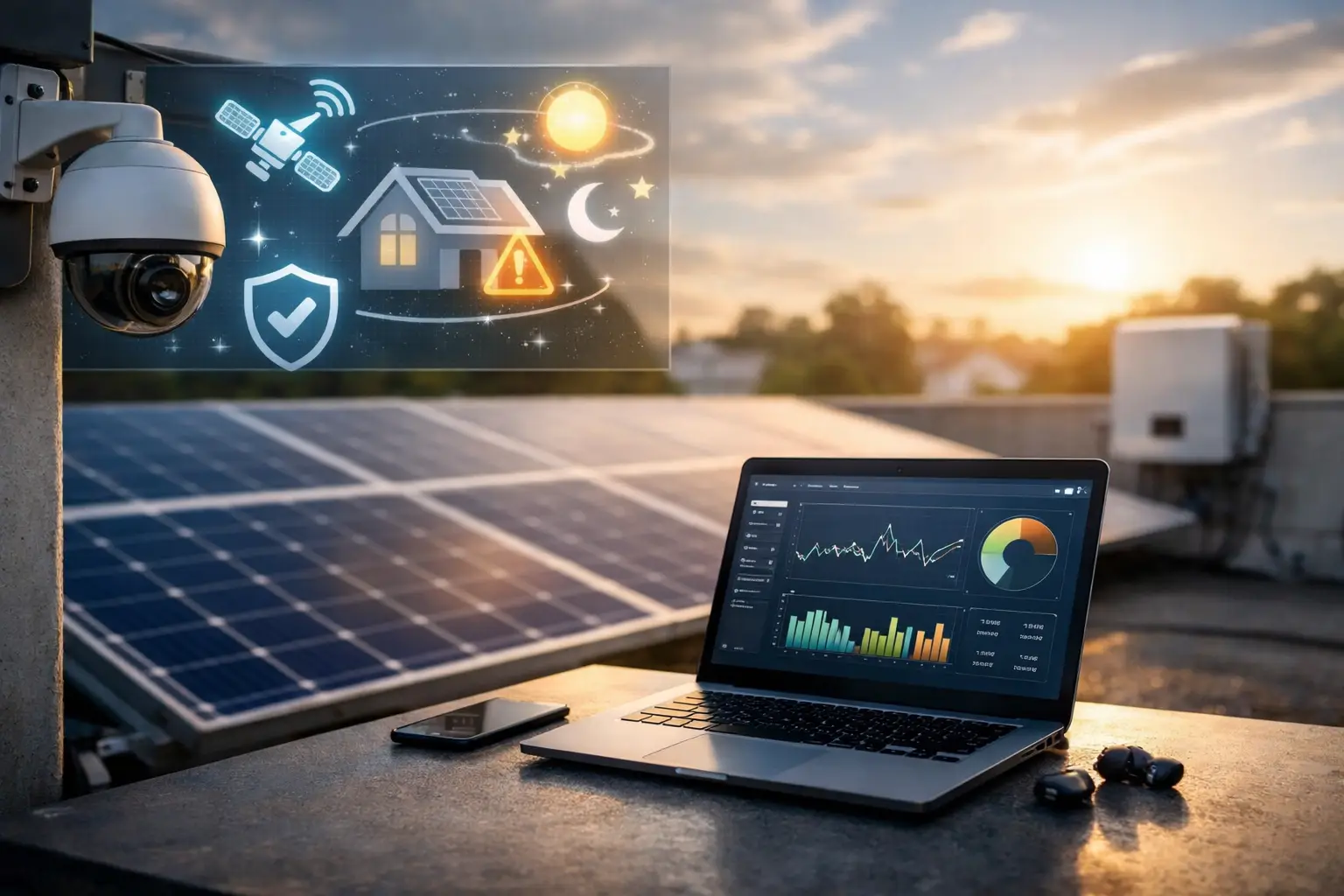
An inverter that fails on a sunny Saturday doesn’t always leave a clear alarm signal. At best, you only notice afterwards that the yield was lower than expected. By then, energy and therefore returns have already been lost. With 24/7 solar panels monitoring, you continuously track the performance of your installation, so that deviations become visible sooner and a problem does not drag on unnecessarily.
For many owners, monitoring is primarily a matter of peace of mind. You don’t have to check an app every day or interpret graphs yourself. Above all, you want to know that your installation is producing when the sun is shining and that action is taken quickly if it isn’t.
What does 24/7 monitoring of solar panels mean?
24/7 monitoring does not mean that someone is constantly staring at a single screen. It does mean that the production data and technical signals of your installation are continuously tracked. The system compares current performance with what is logical for your installation, the time of day, and the conditions.
When a deviation is noticed, it can be investigated further. This is fundamentally different from checking the inverter yourself every now and then. An installation screen may indicate that everything is connected, while some of the panels are still producing less than they should.
Good monitoring therefore doesn’t just focus on whether power is being generated. It also looks at the quality and continuity of that yield. This gives you a quicker view of production losses that might otherwise go unnoticed.
Why a malfunction is often discovered too late
Solar panels operate silently. This is a major advantage, but it also makes a problem less visible. You notice a central heating boiler failing immediately. With solar panels, you often only notice a defect during a final bill, a monthly report, or a chance look at the app.
Furthermore, a low yield is not always easy to assess. Less sun, shade from a growing tree, dirt, or a technical defect can all have an influence. Without a comparison to previous performance and expected production, it is difficult to determine what is normal yourself.
Rapid detection limits the period during which your installation underperforms. This is not only relevant in the event of a total failure. A faulty string, a communication error, or an inverter that works irregularly can also lower your yield without the installation shutting down completely.
Signals that monitoring can help detect
Monitoring can point to, among other things, unexpectedly low production, an inverter that is no longer communicating, deviating performance between parts of the installation, and recurring error messages. Production that drops off at unusual times also deserves attention.
Not every notification immediately means a major defect. A temporary internet outage requires a different approach than a technical fault in the inverter. This is precisely why a correct assessment is important. You don’t want an unnecessary intervention, but you also don’t want a warning that sits ignored for weeks.
From notification to targeted action
A notification is only valuable when something is done with it. With professional monitoring, the first step is to determine exactly what might be going on. Is the inverter online? Is there an actual loss of production? Is it a technical malfunction or a problem with the data connection?
Sometimes a problem can be solved remotely, for example by checking settings or restoring communication. If a visit is necessary, the technician knows better what to look for beforehand. This saves time on-site and increases the chance of a targeted repair during the first visit.
For owners, this follow-up is particularly convenient. You don’t have to figure out which error code is on your inverter yourself or call a manufacturer who isn’t familiar with your installation. You get clarity on the situation and the next step.
Solar Assistance manages more than 10,000 monitored installations in Belgium. This experience helps to assess technical signals in their context and quickly determine the right action. In the event of a malfunction, the goal is simple: to keep downtime as short as possible and protect your yield.
Monitoring is not a substitute for maintenance
24/7 solar panels monitoring is a strong foundation for prevention, but it doesn’t solve every problem. Monitoring sees that the yield is deviating. It doesn’t remove dirt, repair damaged cabling, or keep birds from under your panels.
That’s why monitoring works best alongside periodic maintenance. During an inspection, connections, mountings, the inverter, and visible wear can be checked. A small deviation noticed in the data can thus be linked to what a technician observes on the roof or in the technical room.
Location also plays a role. Installations in a rural environment, near trees, industry, or heavy traffic suffer more often from dust, pollen, leaves, or bird droppings. If production gradually decreases, a professional cleaning may be necessary. If birds nest under the panels, cables, ventilation, and yield can suffer as a result.
Monitoring therefore tells you where attention is needed. Maintenance and technical assistance ensure that the problem is actually addressed. This combination extends the lifespan of your installation and prevents small defects from becoming larger costs.
Which installation benefits most from continuous follow-up?
In practice, every solar installation benefits from reliable follow-up. For a residential installation, it’s about the certainty that your investment continues to pay off. Especially if you are not technically inclined, you don’t want to depend on a chance check.
For companies, the impact is often greater. A malfunction on a large roof can quickly lead to significant production loss. Facility managers and energy officers therefore want clear reporting, an overview of deviations, and a single point of contact for follow-up. Even with multiple locations, central monitoring is a practical way to maintain control without checking each installation individually.
Still, the right approach depends on your installation. An older system with an inverter that transmits limited data sometimes requires a technical assessment first. Also, if your original installer no longer exists or no longer offers service, it is wise to check what monitoring is still possible.
Note these conditions for reliable monitoring
The quality of monitoring depends on the data available. The inverter must be able to communicate, and there usually needs to be a stable internet connection. If the connection is lost, production can sometimes still continue locally, but it is no longer transmitted for follow-up.
Correct basic information is also important. Think of the capacity of the installation, the orientation of the panels, and the configuration in different strings. This allows a deviation to be better assessed. For a complex installation, a thorough commissioning is therefore not an unnecessary step.
Furthermore, ask what happens after a notification. Do you only get an automatic message, or does a specialist assess the deviation? Is there a clear contact person? And how quickly can action be taken if a visit is necessary? Monitoring without follow-up provides information, but not yet true peace of mind.
Higher returns start with less invisible downtime
The yield of solar panels consists of many ordinary production days. That is precisely why every day a defect goes unnoticed counts. A short-term problem doesn’t have to become a major loss, as long as it is seen quickly and addressed correctly.
With continuous monitoring, you don’t get a guarantee that a malfunction will never occur. You do, however, reduce the chance that a malfunction will affect your yield unnoticed for weeks or months. This provides peace of mind, protects your investment, and helps your installation continue to do what it was installed for: producing reliable energy.
Those who don’t just want to own their solar panels but also want them to perform well are therefore best off choosing follow-up that goes beyond an app on their phone. Certainty lies in knowing that deviations are seen, assessed, and turned into action.