


Self-monitoring or outsourcing? Make an informed choice
A loss in production isn’t always immediately visible on your energy bill. An inverter can fail while you’re on holiday, a string might underperform, or an error message could go unnoticed. That is why the question of self-monitoring or outsourcing is more than just a practical choice. It’s about how much time, knowledge, and certainty you want to provide yourself to keep your solar installation working optimally.
Checking the output yourself can work perfectly for a small, recent installation that you know well. However, monitoring is only valuable when action follows a discrepancy. Those who don’t just want to see the problem but also want it resolved quickly often choose professional follow-up.
What does self-monitoring involve?
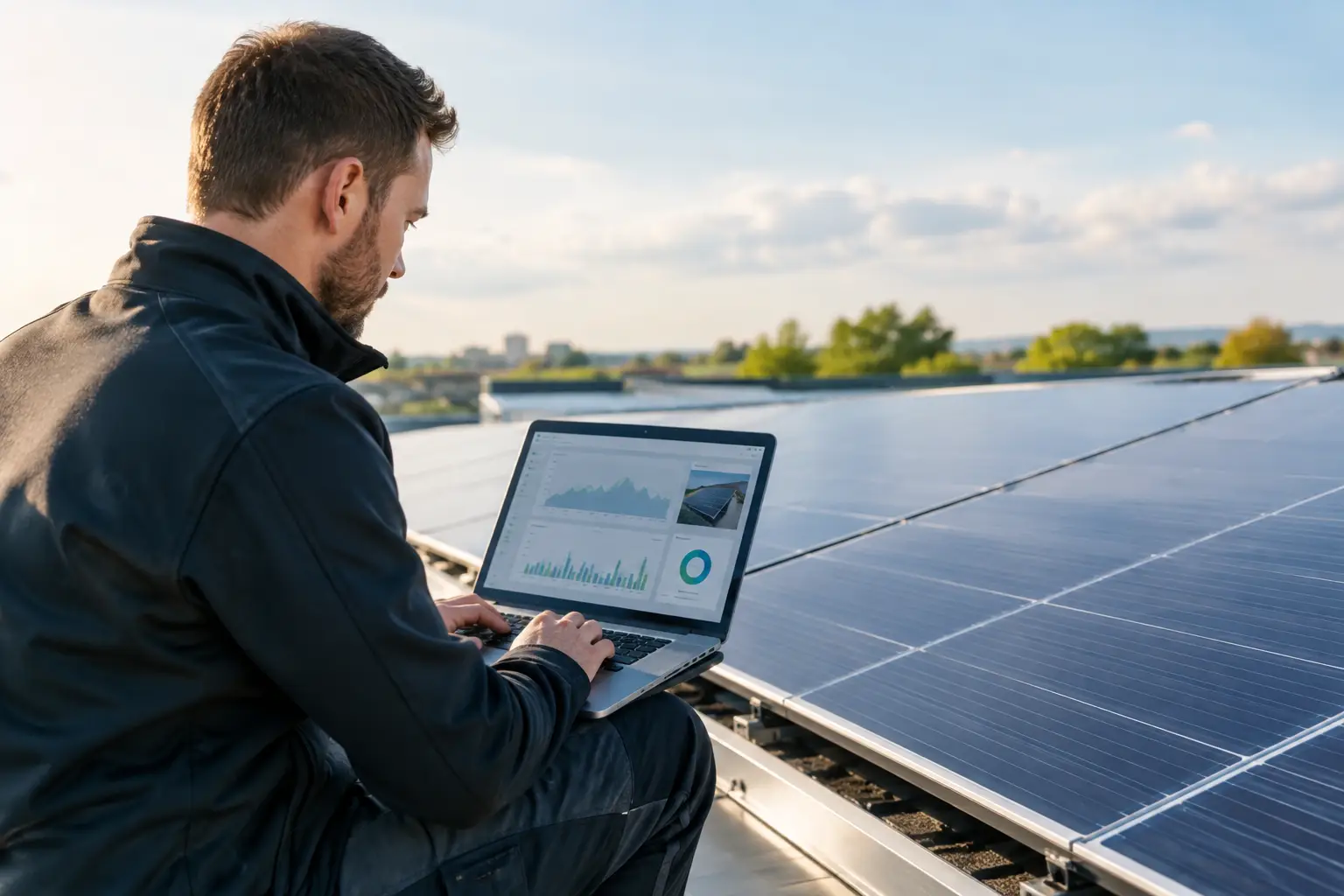
With self-monitoring, you track the data from your inverter or energy app yourself. You regularly check the daily, monthly, or annual yield and compare it with previous periods. Some systems also send a notification in the event of a fault or when production is unexpectedly low.
This gives you a good baseline. For example, you might notice that the installation produces very little on a sunny day, or that one inverter is no longer transmitting data. This is particularly useful if you like to stay personally involved in your energy consumption.
The limitation usually isn’t the app, but the subsequent follow-up. A notification doesn’t always tell you exactly what is going wrong. Is there a communication problem? Has the inverter stopped? Is there an issue with a panel, a cable, or the protection system? Without technical knowledge, it is difficult to correctly assess the cause.
Furthermore, you must check the data consistently. Not looking for a week might seem harmless, but in the event of a total failure, it could mean a week without solar production. The loss is smaller in winter, but during high-yield months, downtime can quickly become costly.
When is self-monitoring sufficient?
Self-monitoring is a good fit if your installation is straightforward and you are willing to set aside time for it regularly. You know how to interpret the production data, you receive error messages, and you have a reliable partner you can contact quickly when something goes wrong.
It also helps if you have clear reference data. You know the normal production level of your installation and take into account the season, weather, shade, and your energy consumption. A lower yield in November is normal. A strikingly low yield on a clear day in June, however, deserves attention.
For many owners, however, it remains difficult to determine when a discrepancy is truly a problem. An installation rarely produces exactly as expected every single day. Reacting too quickly leads to unnecessary worry. Reacting too late costs yield. This is precisely where experience makes the difference.
Self-monitoring or outsourcing: what changes?
With outsourced monitoring, a specialized team keeps an eye on your installation’s performance. The focus is not just on receiving alarms, but on timely recognition of discrepancies that could limit your yield.
Professional follow-up brings three things together: technical interpretation, clear communication, and a plan of action. If a problem is identified, you aren’t just told there is an alarm. You also receive an assessment of the severity and, where necessary, a proposal for intervention.
This is especially important for faults that are not fully visible in a standard app. Think of a string that is underperforming, recurring error codes, an inverter that fails occasionally, or limited production due to soiling. The installation may still be working, but not at its full capacity.
Those who outsource monitoring still maintain a view of their yield. You aren’t giving up control. Instead, you are ensuring that an expert party is watching along, so that problems are picked up faster and you have to figure out less for yourself.
The difference lies in the response to a fault
An alarm is only useful if someone acts on it. With self-monitoring, a notification might arrive at a busy time, during a holiday, or at a moment when you don’t know what step is needed. In those cases, the problem sometimes persists longer than expected.
With professional monitoring, a discrepancy can be assessed before it turns into long-term downtime. Sometimes a remote check is enough. Sometimes a restart is required. And sometimes a visit from a technician is the best solution. By performing a targeted analysis first, you also avoid unnecessary interventions.
For owners, speed is the most important factor. Every day an inverter is down, potential solar energy is lost. A quick intervention limits that loss and protects the return on your investment.
Solar Assistance monitors more than 10,000 installations in Belgium, 24 hours a day, 7 days a week. When technical assistance is required, you receive clear follow-up and a response time of maximum 48 hours. This way, you know exactly where you stand without having to chase error codes or different contact persons yourself.
Monitoring alone doesn’t solve every yield problem
Monitoring is a strong foundation for prevention, but it is no substitute for maintenance. The data can indicate that your installation is underperforming, but the cause can vary widely.
Dirt, moss, pollen, or bird droppings can restrict light intake. This can be particularly noticeable at low tilt angles or in environments with agriculture, industry, or many trees. A targeted cleaning can then help to get more energy out of the same panels again.
Physical checks also remain necessary. Loose cabling, damaged connectors, wear and tear on the inverter, or problems with the mounting structure aren’t always immediately visible in a graph. Regular maintenance and a technical inspection extend the lifespan of the installation and reduce the chance of unexpected failure.
Birds are another point of concern. Nests under the panels can damage cables and cause soiling. Monitoring can signal a drop in production, but it doesn’t prevent nesting. A suitable bird deterrent tackles the cause before it causes damage.
For which installation is outsourcing most worthwhile?
For a residential installation, outsourced monitoring is particularly interesting if you want certainty without having to check constantly yourself. It is also a logical choice when the original installer is no longer active, when you receive insufficient support, or when you have previously experienced a loss in yield that was discovered too late.
For larger installations, professional follow-up is often even more relevant. A fault on a commercial roof can cause significant production losses. Furthermore, facility managers and energy officers need oversight, reporting, and a single technical point of contact. They don’t want to check individual inverter portals every day.
Yet the right choice doesn’t just depend on size. The age of your installation, the accessibility of the roof, the complexity of the setup, and your own available time also play a role. A small installation with recurring faults often deserves more attention than a larger installation that has been running stably for years.
How to make a realistic choice
Don’t just ask yourself if you can open an app. Ask especially what happens when you see a discrepancy. Can you assess it correctly? Do you know who to call? Can you get a technician to come quickly? And do you also check at times when you aren’t at home?
Choose self-monitoring if you have the time, understand the data, and can act quickly in case of problems. Choose outsourcing if you want to combine maximum energy yield with less follow-up, faster help, and more peace of mind.
Ultimately, the best monitoring doesn’t feel like extra work. It ensures that your installation keeps doing what you had it installed for: producing as much energy as possible, with as little worry as possible.