


Reactive repair versus periodic inspection
An inverter that shuts down on a sunny day, a loose contact under a panel, or an error message you only notice weeks later: reactive repair versus periodic inspection determines how long such a problem continues to cost you yield. Waiting until something visibly goes wrong often seems cheaper. In practice, it usually means you only intervene after yield has already been lost.
A simple rule applies to solar panels: a malfunction doesn’t just cost money at the time of repair. Every day your installation produces less or no energy, the lost yield continues to mount. Periodic checks help to spot deviations earlier, while reactive repair remains necessary when an unexpected defect occurs anyway.
What is reactive repair?
Reactive repair means taking action after a problem occurs. For example, you notice that the inverter is off, that a circuit breaker regularly trips, or that production is remarkably low. A technician then comes on-site to find the cause and repair the defect.
This is sometimes unavoidable. Damage from a storm, a defective part, or a sudden malfunction cannot always be prevented. In such situations, a fast, targeted intervention is what counts most. The faster the diagnosis is correct and the problem is solved, the shorter the downtime for your installation.
The pitfall is that many malfunctions are not immediately visible. An installation may still produce energy, but significantly less than possible. Think of a string that partially fails, a connector that gets hot, or dirt that slowly reduces the yield. Without checks, you often only notice this with a high energy bill, an annual settlement, or a serious malfunction.
Periodic inspection prevents silent yield losses
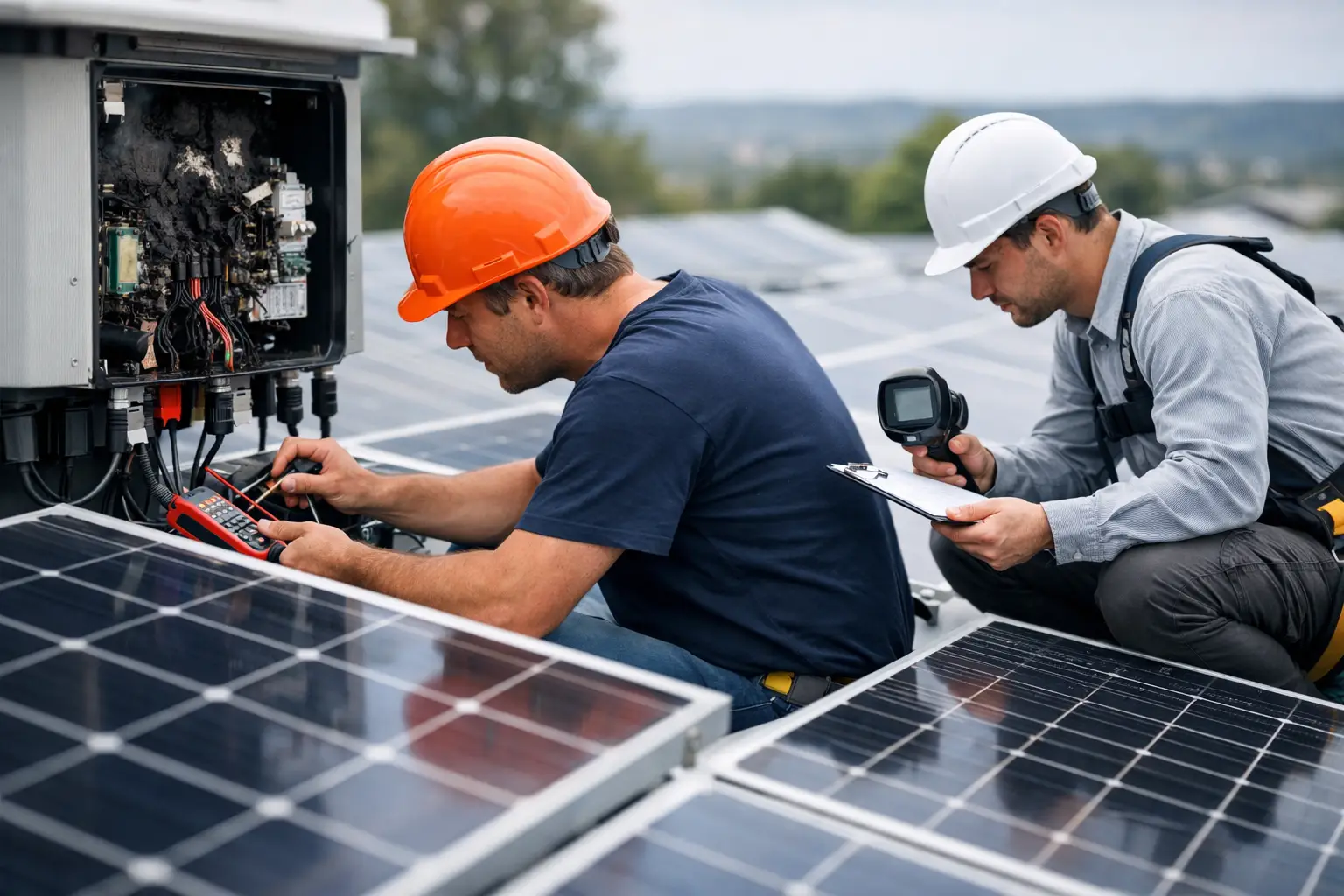
A periodic inspection is a planned technical check of your solar panel installation. It doesn’t just look at whether the installation is still working, but also whether it is performing safely, stably, and as expected. The technician assesses the panels, cabling, connections, mounting, inverter, and electrical protections, among other things.
The goal is not to carry out work for every small detail immediately. The goal is to recognize risks and emerging deviations in time. A cable with a damaged sheath, a loose connector, or traces of moisture in a connection may seem small. If left unaddressed, they can lead to production loss, safety risks, or a more expensive repair.
For a residential installation, an inspection is primarily a way to maintain certainty about your investment. For a company, it goes even further. There, a limited malfunction across multiple roofs, inverters, or strings can impact total production. With planned maintenance, you limit unexpected downtime and maintain better visibility of performance.
Reactive repair versus periodic inspection: the real difference
The difference lies mainly in when you incur costs. With reactive repair, you wait until there is a defect, alarm, or clear loss of yield. With a periodic inspection, you invest upfront in monitoring and prevention. That approach can prevent problems, but of course, it does not guarantee that nothing will ever break.
Reactive repair is therefore not an alternative to inspection. It is the necessary solution when a malfunction does occur. Periodic inspection actually reduces the chance that a small problem grows into an urgent intervention. Both are part of responsible management of a solar installation.
An example makes this clear. Suppose the inverter regularly shuts down briefly due to an electrical problem. If you only look at the total production, everything might seem normal. Yet you lose energy during sunny moments and the fault can get worse. An inspection or proper follow-up can signal such a pattern before the inverter fails completely. If you wait, the diagnosis may take more time and your yield remains under pressure for longer.
When is only reacting sufficient?
For a new, small installation without alerts, it can be tempting to only react when something goes wrong. Especially if you regularly check the yield yourself and the installation is easily accessible. A reactive intervention is also logical after a clearly defined incident, such as hail damage or a defective inverter.
But only reacting only works well if you notice a problem quickly. That is exactly the limitation. Most owners do not look at the inverter or production app every day. Moreover, a total production figure does not always tell you where the loss is. An installation can still perform reasonably well on an annual basis, while one part structurally lags behind.
Reactive action is therefore mainly suited to a concrete, visible problem. It is less suitable as a strategy for long-term monitoring of yield and lifespan.
What does a periodic inspection provide?
First and foremost, an inspection gives you clarity. You know if the installation is technically sound, which parts require attention, and if there are indications of lower yield. This makes maintenance plannable instead of urgent.
Furthermore, a check helps to limit safety risks. Solar panels are outside for years and are exposed to wind, rain, heat, frost, and temperature fluctuations. The panels themselves are strong, but cabling, mounting materials, connectors, and electrical components deserve attention. This is especially relevant for older installations, roofs with a lot of dirt, or locations with birds.
Yield is also an important point. Dirt, emerging shading, defective parts, or deviations in a string can affect your production. An inspection makes it clear whether further action is needed, such as cleaning, repair, or replacing a part. This prevents you from losing yield for no reason.
Monitoring makes the difference between guessing and knowing
Periodic inspections are valuable, but they are snapshots. Monitoring complements this by continuously tracking performance. If your production deviates from what is expected, it can come to light faster. This way, you don’t have to wait for an annual check or for an alert that you happen to see yourself.
Monitoring is particularly strong in combination with an inspection. The inspection checks the physical and electrical state of the installation. Monitoring then tracks daily behavior. If you see a recurring deviation, a technician can search much more specifically. This shortens the diagnosis and limits downtime.
Solar Assistance manages more than 10,000 monitored installations and therefore sees how often small deviations otherwise go unnoticed. For you, this follow-up primarily means peace of mind: performance is not just assumed, but verified.
How often should you have solar panels inspected?
There is no identical frequency for every installation. Age, size, location, and technical state all play a role. An installation on a detached house with little shade and limited pollution has a different risk profile than a large commercial roof near trees, agricultural activities, or industry.
As a practical guideline, a periodic inspection every few years is wise, supplemented by a check after exceptional circumstances. Think of heavy storms, hail, roof work, damage by animals, or repeated error messages. For older installations or systems that must deliver high yields, more frequent checks are often useful.
Also, watch for signals between inspections. Unexpectedly low production, a red light on the inverter, recurring malfunctions, visible damage, or increased electricity consumption deserve quick attention. Don’t wait for the problem to disappear on its own. Malfunctions in a solar installation rarely resolve themselves without intervention.
Choose a plan that fits your installation
The best approach is usually not choosing between repairing or inspecting. You combine prevention with fast help when needed. A good service partner maps out the technical state, monitors performance if desired, and intervenes as soon as a deviation requires action.
Always ask for clear reporting. You want to know what has been checked, what the findings are, and which works are truly necessary. Transparency prevents surprises and helps you plan maintenance costs. For companies, this reporting is also useful to support internal yield, risks, and choices made.
A periodic inspection does not have to be an invasive process. It is a practical check that helps you keep your installation in good condition. Reactive repair remains available for the unexpected, but preventive attention ensures you face unpleasant surprises less often.
Those who have their solar panels checked regularly and follow up on performance primarily buy certainty. Not the certainty that nothing will ever break, but the certainty that a problem has less chance of reducing your yield unnoticed for months.