


Managing a solar installation after an installer’s bankruptcy
Your solar panels are still there, the inverter might still be working, and yet you have questions. Who do you call in the event of a fault? Who has access to the monitoring? And what happens to warranties if your installer is bankrupt? Managing a solar installation after an installer’s bankruptcy primarily requires an overview. Don’t wait until the yield drops noticeably or the inverter fails completely. With the right data, follow-up, and technical partner, you can keep the installation profitable and prevent unnecessary downtime.
Start with a technical and administrative inventory
A bankruptcy does not mean your solar panels are unprotected. The installation remains yours. However, the fixed point of contact often disappears, along with practical information you need for maintenance, repairs, and warranties.
Therefore, first collect everything you still have: the quote, invoices, the inspection report, the single-line diagram, product sheets, and any manuals. Also note the brand, type, and serial number of the inverter, solar panels, battery, and charging station if present. This data makes it much easier to investigate a fault specifically or to file a warranty claim.
In addition, check which warranties are still valid. Manufacturer warranties on solar panels and inverters typically run through the manufacturer, not the installer. However, the warranty on the installation work or cabling may be harder to enforce if the installation company no longer exists. Therefore, you should also keep photos of the original installation and previous intervention reports.
Are you missing documents? That is annoying, but rarely a reason to be unable to do anything. An experienced technician can map out the most important components during an inspection and assess whether the installation is safely and correctly connected.
Ensure you have access to your installation yourself
Many owners only discover it after a bankruptcy: the monitoring portal is in the installer’s name. Sometimes no one knows the password. Sometimes the inverter is online, but as the owner, you don’t see any notifications or yield data.
Therefore, take over access as soon as possible. Check via the app or the inverter manufacturer’s online portal who is registered as the owner and administrator. Request a reset or transfer of ownership when necessary. For this, the manufacturer usually asks for a serial number, proof of purchase, and address details of the installation.
If that doesn’t work, an independent technical partner can often help to set up the communication again. In some cases, the datalogger needs to be reconfigured or replaced. That costs money, but it gives you insight again into what the installation is actually doing.
Monitoring is more than a graph with beautiful sunny days. Good monitoring of solar panels compares the expected and actual production, signals deviations, and enables a quick intervention. Especially an inverter that stops working can unnoticed cost days or weeks of yield if no one sees the notifications.
Have the current state professionally checked
When your installer disappears, an independent inspection is a wise starting point. Not because every installation has problems, but because you don’t want to gamble on the state of an investment that must perform for many years to come.
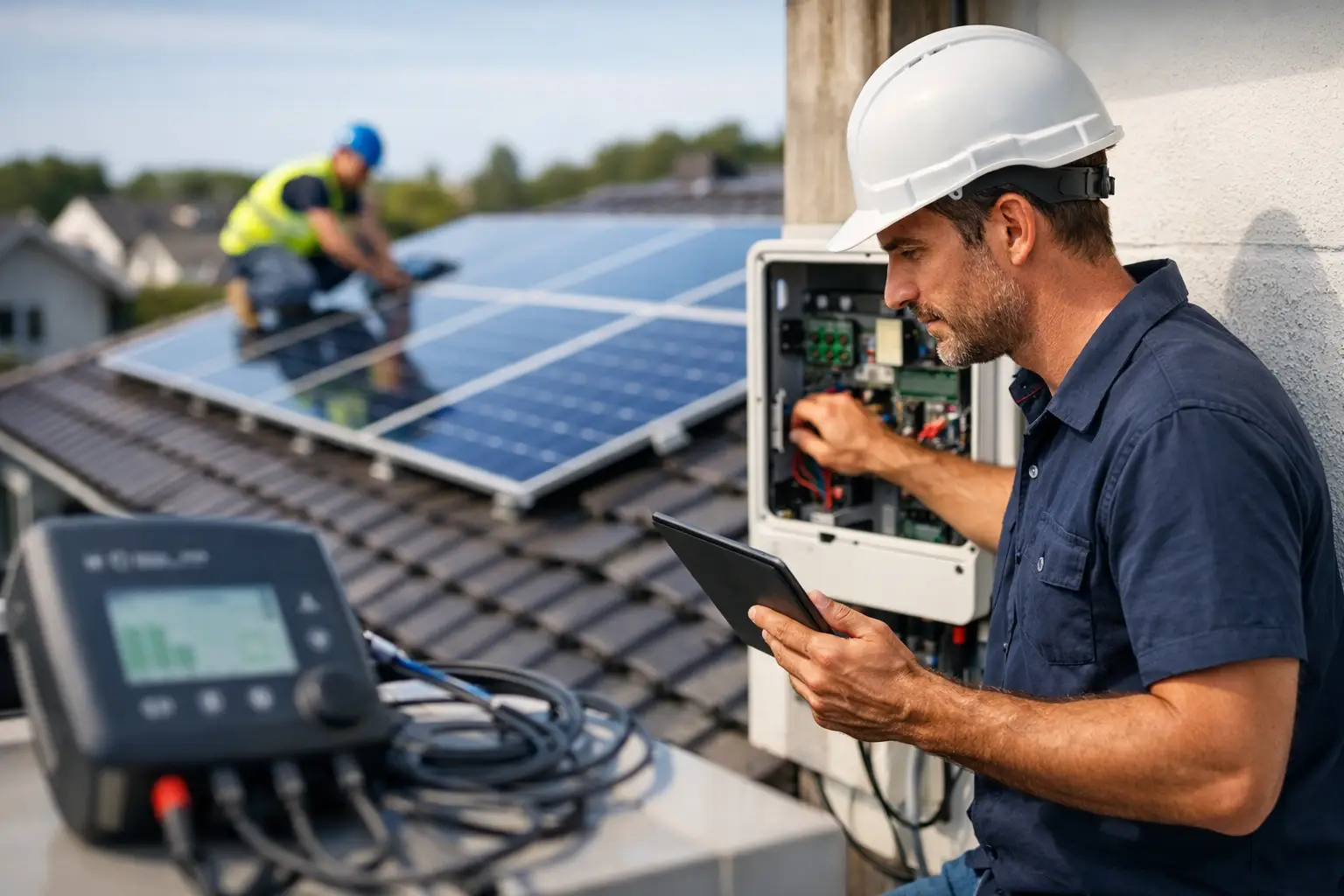
A check goes further than just looking at the inverter. A technician assesses, among other things, the mounting of the panels, the cabling, connectors, grounding, fuses, inverter settings, and communication connection. Visible damage from weather, animals, or wear and tear also comes to light.
This provides clarity. Perhaps everything is working excellently and periodic follow-up is sufficient. Perhaps a connector turns out to be poorly connected, a group of panels is producing less, or the inverter is no longer optimally set. Small defects are often faster and cheaper to repair than problems that go unnoticed for years.
With an older installation, it is also useful to look at the remaining lifespan of the inverter. Solar panels generally last a long time, but an inverter often needs replacement sooner. By planning this ahead, you prevent a long period without production when the device unexpectedly fails.
Manage maintenance based on risk, not on gut feeling
Not every solar installation needs the same maintenance. An installation on an open, clean roof requires something different than panels at a farm, under trees, or in an environment with a lot of dust. The goal is always the same: maximum energy yield with as few surprises as possible.
Preventive maintenance helps to spot defects and safety risks earlier. Think of loose cables, outdated connectors, a dirty inverter, traces of moisture, or beginning damage to the roof penetration. A visual check from the ground is useful, but does not replace a technical assessment of the parts you cannot see.
Cleaning also requires nuance. Rain washes away a lot of common dirt, so cleaning is not necessary every year on every roof. With bird droppings, agricultural dust, soot, pollen, or local pollution, cleaning can indeed make a difference. Always have it assessed first whether pollution is actually affecting the yield. This way, you only pay for work that contributes to the return.
Birds deserve extra attention. Nests under the panels can damage cables, hinder ventilation, and cause noise nuisance. Bird protection is especially useful when there is already clear activity or when the roof proves sensitive to it. Early action limits damage and prevents a small problem from becoming a recurring cost.
Know what to do in the event of a fault
A red light on the inverter calls for action, but not for panic. First, note the error message and take a photo of the screen. Then check if the circuit breakers and RCD are still switched on. Do not repeatedly turn anything on and off if you don’t know why it failed. With an electrical fault, that can worsen the problem.
Next, compare the current production with similar days, taking the weather and season into account. A low yield is not always a defect. Shade, snow, exceptionally gloomy weather, or temporary grid limitations can play a role. A production of zero during a sunny day is, however, a clear signal to call in technical help.
In case of visible damage, a smell of burning, water infiltration, loose cables, or a recurring error code, call a specialist immediately. Only switch off the installation according to the available safety instructions. Never try to open connectors, panels, or inverter covers yourself.
A technical service with experience in various brands can usually assess faults faster when you send the serial number, error code, photos, and available documents in advance. Solar Assistance has been working as an independent service partner for existing installations since 2012 and can, if necessary, coordinate the technical state, monitoring, and follow-up steps.
Choose a new partner for continuity
After a bankruptcy, the temptation is great to only seek help when something is broken. That can be fine for a small, simple installation that performs well. But those who want certainty about yield and safety benefit more from a partner who also follows up on the installation between two faults.
Don’t just look at the price of an intervention. Ask how the partner works with unknown installations, whether their own technicians are available, how notifications are followed up, and what reporting you receive. For a residential installation, you primarily want a clear answer and quick help. For a company, less downtime, clear reporting, and a single point of contact also count.
A maintenance appointment doesn’t have to be overly extensive. The right formula depends on the age, size, location, and critical role of the installation. For a home, periodic checks with monitoring may be sufficient. For a company with many panels or high energy costs, structural operational management is often wiser.
Managing a solar installation after an installer’s bankruptcy without worries
You don’t have to become a technical expert because your original installer has disappeared. However, you would do well to become the owner of your data, your monitoring, and your maintenance plan. This prevents a small defect from only becoming visible at the moment the energy bill turns out higher.
It’s better to plan a check-up at a quiet moment than an emergency intervention during a fault. This way, you keep a grip on your installation, protect the lifespan of the components, and give your solar panels the best chance of a stable yield. That is ultimately what your investment is intended for: return without constant worries.