


Improving solar panels yield: what works?
You often only notice it too late: the yield of your solar panels is decreasing, but you don’t see any obvious problem on the roof. Yet a small defect, dirt, or a poorly performing inverter can cost energy for months. Anyone who wants to improve solar panels yield should therefore look further than just the daily output in the app.
Improving solar panels yield starts with measuring
Many owners assume that their installation is working well as long as the panels are producing power. That is understandable, but also risky. An installation can partially fail without you noticing immediately. A string that performs less, an inverter with error messages, or a drop due to lingering dirt is not always visible to the naked eye.
That is why yield always starts with insight into performance. Without measurement, it remains guesswork. You won’t know if a lower yield is normal due to the weather, or if something is going wrong technically. With good monitoring, you see deviations faster and can intervene before the loss increases. For many installations, professional monitoring solar panels is therefore not a luxury, but a way to limit downtime and yield loss.
The biggest causes of yield loss
Those who want to increase the yield of solar panels often think of extra panels first. In practice, the gain usually lies elsewhere. Existing installations mainly lose yield due to dirt, defects, aging parts, and lack of follow-up.
Dirt is a classic example. Dust, moss, pollen, and bird droppings can partially block sunlight. This effect is not the same on every roof. On a steep roof with a lot of rain, dirt washes away faster. On a flat roof, in an agricultural environment, or near trees, the loss can increase noticeably.
Defects also often go unnoticed for too long. A connector with poor contact, a broken optimizer, or an inverter that no longer works at full capacity does not always cause a complete failure. And that is exactly what makes it treacherous. Your installation is still working, but not as it should.
In addition, aging plays a role. This is normal. Solar panels still provide power after years, but parts such as inverters and cabling deserve follow-up. Those who never have a check-up carried out usually only discover problems when the bill gets higher or the yield drops significantly.
Cleaning helps, but not as much on every roof
A frequently asked question is whether cleaning really pays off. The honest answer is: it depends on your situation. Cleaning can improve solar panels yield, but not every roof will benefit equally.
In locations with a lot of dust, ammonia, traffic pollution, or bird nuisance, the difference can be clear. Especially when dirt accumulates at the edges or in strips on the panels. With stubborn dirt, it is not just about less yield, but also about a higher chance of hotspots and faster wear.
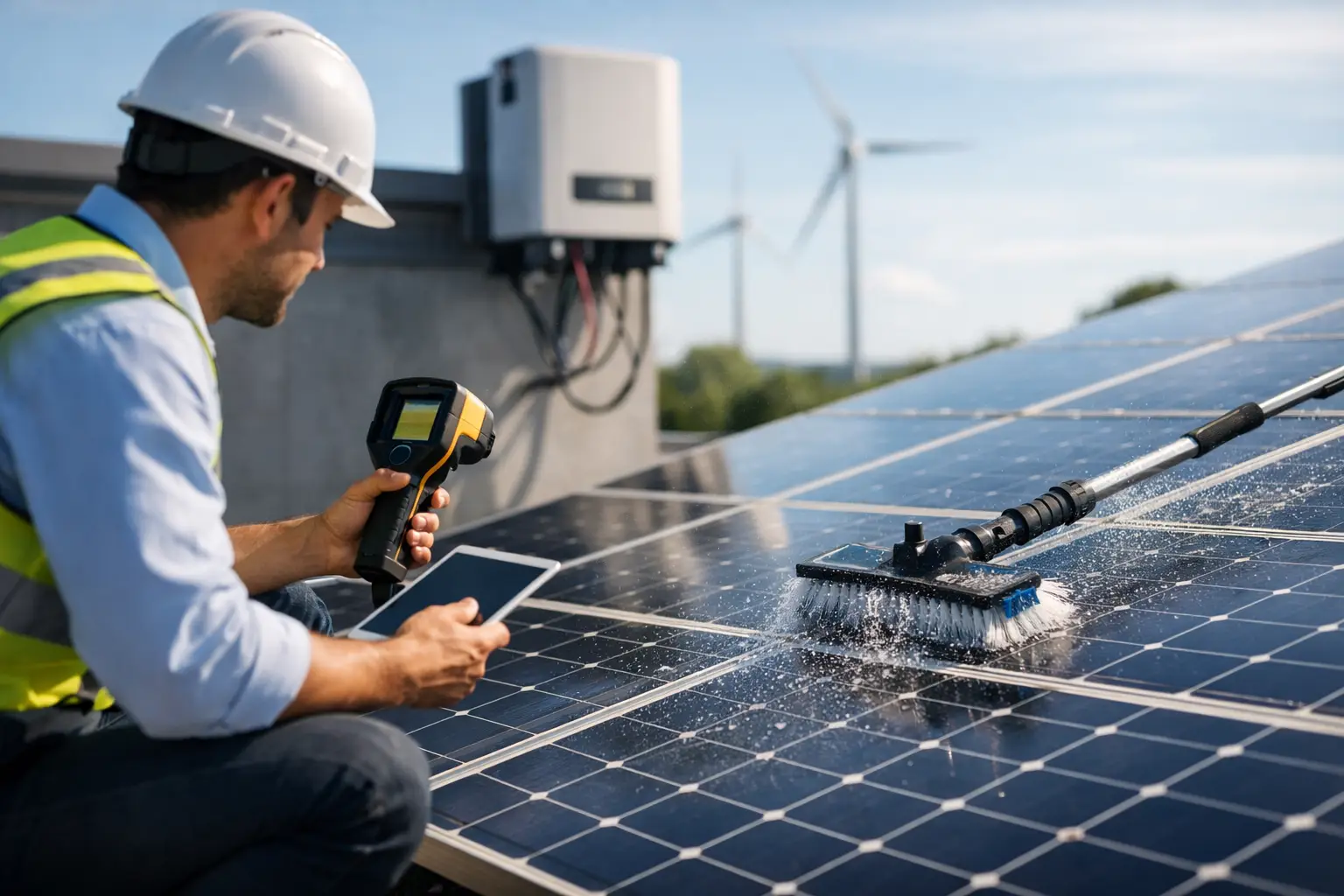
On well-sloped roofs in a clean environment, the effect is sometimes more limited. In those cases, cleaning does not have to be done excessively often. It is therefore not about standard cleaning every year just because it’s expected, but about cleaning when it makes technical and financial sense. Professional cleaning solar panels is especially interesting when you have visible dirt, when monitoring shows a drop, or when your installation is located in a pollution-prone area.
What is important, however, is how that cleaning is done. The wrong products, brushes that are too hard, or unsafe work at height can do more harm than good. A professional approach prevents damage and immediately gives you an extra check of the visible state of the installation.
Maintenance prevents small problems with big consequences
Many people think that solar panels are maintenance-free. In reality, they are low-maintenance, not maintenance-free. That difference is important. An installation that runs for years without a check-up runs more risk of hidden defects and unexpected failure.
Preventive maintenance is not just about cleaning. It is also about checking cabling, mountings, inverters, connectors, and safety components. This way, you track down wear or deviations before they lead to yield loss or a malfunction.
For individuals, this primarily means peace of mind. You don’t have to be able to technically assess whether everything is still working correctly yourself. For companies, the impact is even greater, because downtime on larger installations weighs more heavily on the yield. Regular maintenance solar panels helps to keep performance stable and extend the lifespan of your installation.
An inverter often determines more than you think
While solar panels capture the sunlight, the inverter is the component that makes that energy usable. If it doesn’t perform well, you feel it immediately in your yield. Yet inverters often receive too little attention, especially when they don’t fail completely.
An inverter can overheat, give error codes, fail temporarily, or simply work less efficiently due to age. Sometimes you notice this through irregular production. Sometimes you don’t. That is why checking is so important.
With older installations, repowering can be interesting. This means replacing certain parts to perform better again, without renewing your entire installation. Think of a worn-out inverter or outdated components that slow down the rest of the system. This is not necessary in every situation, but it can be an effective way to get more energy out of your existing installation again.
Shadow, birds, and small disturbances add up
Not every yield loss is due to a technical defect. External factors also play a role. Shadow from a chimney, growing trees, or new buildings can suppress your production. Especially if one part of the installation structurally receives less sun.
Birds are another underestimated problem. Nests under the panels cause dirt, extra wear on cables, and sometimes even malfunctions. Installing bird protection is then not a detail, but a targeted measure to prevent damage and yield loss. Especially on homes where pigeons or other birds often return.
The same applies to small disturbances that seem limited in themselves, but together certainly weigh in. Think of loose cabling, outdated fuses, or an optimizer that no longer communicates correctly. Viewed separately, these seem like details. On an annual basis, they can make a noticeable difference.
You can check yourself, but only to a certain extent
You don’t have to go up on the roof immediately to make an initial assessment. There are a few signals you can follow up on yourself. A lower yield than in comparable periods, error messages on the inverter, visible dirt, or an app that no longer shows data are clear indications that a check-up is useful.
Yet there is a limit to what you can safely and correctly assess yourself. An installation can deviate technically without visible damage. And working at height or on electrical components requires experience. If you are in doubt, technical assistance for solar panels is the safest choice. This way you get clarity quickly and avoid a small problem becoming bigger.
For companies, loss is often greater than expected
With a home, it is usually about lower own production and a missed saving. For companies, the same problem can weigh much harder. A large installation that is partially underperforming loses quite a bit of yield unnoticed. Especially if there is no active follow-up.
That is why professional management for commercial installations is more than a technical check. It is about continuity, reporting, and fast intervention. One malfunction that drags on for weeks costs more than just energy. You also lose predictability and control. For facility managers and energy managers, that is exactly what you want to avoid.
What really works to increase your yield?
If you look honestly at existing installations, you see that extra yield usually comes from four things: better follow-up, timely cleaning, preventive maintenance, and quick intervention in case of deviations. Not every measure yields the same on every roof, but together they make the difference between an installation that is just present and an installation that really performs.
The right approach depends on your roof, your environment, the age of your installation, and the way it is followed up today. Do you have a lot of dirt? Then the gain is more likely to be found in cleaning. Do you see irregular data or error messages? Then monitoring and technical control are more important. Have you not had a check-up for years? Then maintenance is the logical first step.
Solar Assistance sees this every day with existing installations: not the biggest intervention, but the right intervention at the right time yields the most. This gives not only more energy, but also more certainty that your installation continues to do what it should do.
Anyone who wants to improve solar panels yield does not have to start with replacement or expansion. Start by knowing how your installation is really performing. From there, you make choices that increase your yield and take away worries. And you will feel that every month, not only on your meter, but also in your peace of mind.