


How to recognize solar panel yield loss yourself
You often don’t notice it in a single day. But after a few months, you see that your inverter shows fewer kWh than before, even though the weather feels similar. That is exactly where recognizing solar panel yield loss yourself begins: not with complicated measurements, but by being alert to small signals that point to a larger problem.
Anyone with solar panels primarily wants certainty. Your investment must continue to perform without you having to become a technician yourself. Still, it pays to know a few simple checks. This way, you’ll notice more quickly when a temporary dip is normal and when your installation needs attention.
Recognizing solar panel yield loss yourself starts with comparison
The most reliable first step is comparison. Not with the neighbors’ installation, but with your own previous figures. Look at the yield from the same month last year and compare it to current production. A difference of a few percent is not immediately alarming. Weather, temperature, cloud cover, and seasonal fluctuations always play a role.
If the difference increases and persists for several weeks, there is more going on. Especially if you have no clear explanation, such as exceptionally bad weather or a period with a lot of snow. A lasting drop of 10 to 15 percent deserves attention. Not because every loss immediately means a defect, but because small deviations are often the precursor to a major shutdown.
If you have access to your inverter’s app or portal, actually use it. Many owners only look at it on the day of installation. That’s a shame, because that data is exactly what helps you spot deviations early. With good monitoring of solar panels, you gain insight more quickly into recurring errors, lower daily peaks, or a string that is lagging behind.
Which signals indicate yield loss?
You don’t always see yield loss on the panels themselves. Often, the clue lies in the behavior of the installation. An inverter that frequently shuts down, shows error codes, or restarts at strange times can suppress production without you noticing immediately. A strikingly low daily yield on sunny days is also a classic signal.
Sometimes it’s even simpler. Your energy bill rises while your consumption hasn’t changed. Or you notice that your self-consumption is dropping, while your habits remain the same. In that case, your installation might be producing less than it should.
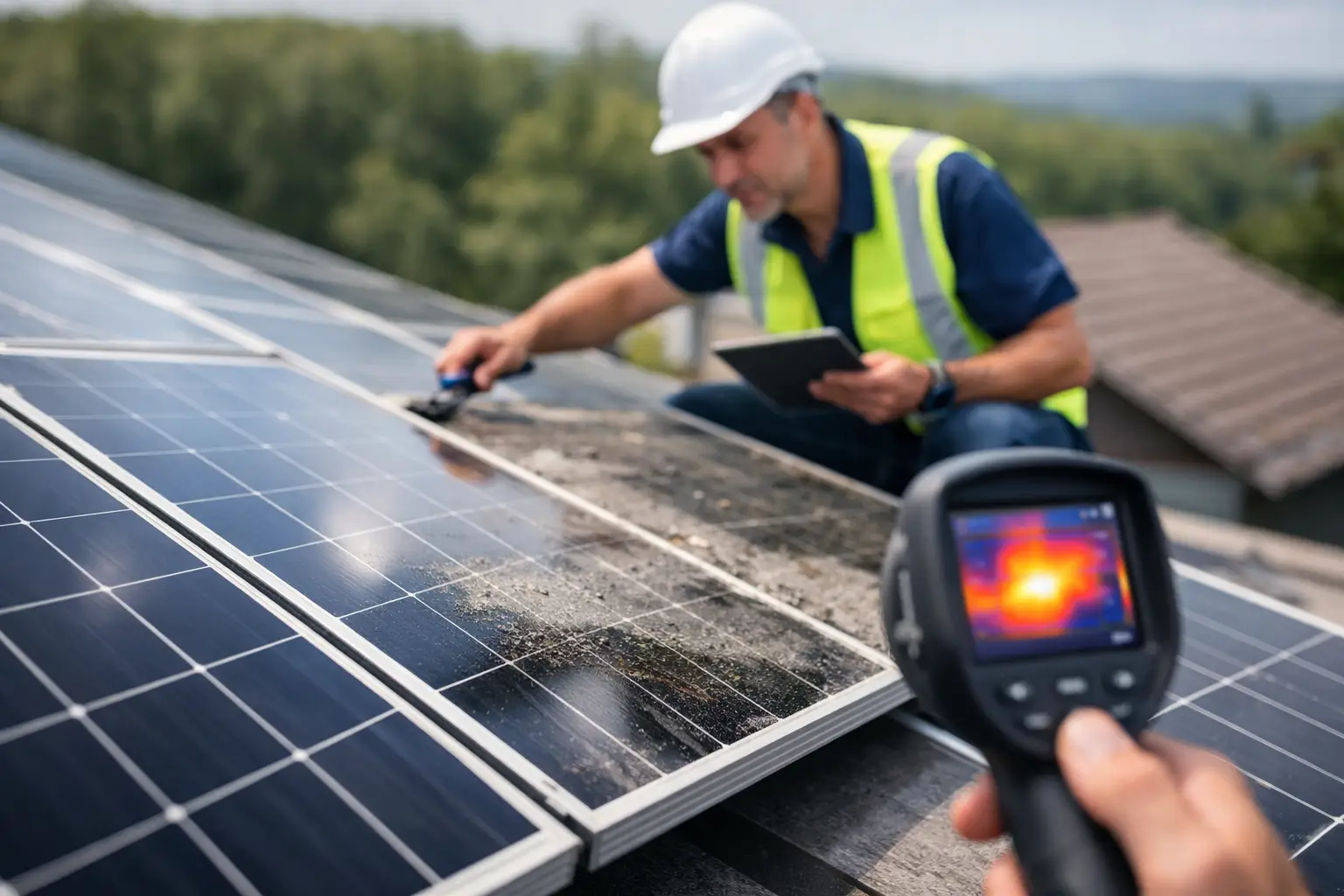
Visual signals also count. Think of dirt, leaves, moss growth, stubborn dust, or bird droppings. A thin layer of dirt seems harmless, but if it accumulates on the bottom edge or on multiple panels, it can certainly cost efficiency. Especially on roofs with little pitch or in locations with agricultural dust, traffic, or many trees nearby, this is no minor detail. In such cases, targeted cleaning of solar panels can release extra yield once again.
What is normal, and what isn’t
Not every difference in yield is a problem. Solar panels age gradually. A limited decline over the years is therefore normal. Also, hot summer days don’t always produce more power than cool spring days. Panels love light, but not overheating. Those who only look at the outside temperature sometimes draw the wrong conclusion.
Shadow is another factor. A tree that has grown taller over the years, a new dormer window at the neighbors’, or an antenna positioned slightly differently can cause extra loss at certain hours. You notice this especially when the yield on sunny days unexpectedly lags behind. Temporary morning or evening shadow doesn’t have to be a disaster. Structural shadow on the same panel or the same string does.
What is less normal is a sharp and sudden drop without a clear reason. Also, panels that are visibly dirty, an inverter with error messages, or production that remains strikingly low for days do not belong to normal aging. In those cases, waiting is usually more expensive than checking.
Common causes of loss
In residential installations, we often see the same causes recurring. Dirt is one of them, but certainly not the only one. Faulty connectors, outdated cabling, a poorly functioning inverter, or a string that fails also occur regularly. You can’t see that with the naked eye from the ground.
In addition, there are mechanical problems. Loose fixings, damaged panels, or water ingress can affect performance. Sometimes the problem is small and local. Sometimes it drags the whole system down. This is precisely why preventive checks are so valuable.
Birds are also often underestimated. Nests under the panels don’t just cause noise nuisance. They can damage cables, hinder ventilation, and cause dirt. In the long run, this leads to malfunctions and loss. To prevent this, it’s best to opt for bird protection under solar panels in time.
Checking yourself without risk
Checking yourself can remain simple. You don’t have to climb onto the roof or touch electrical components. Start with the yield data from your inverter. See if the daily curves follow a logical pattern. On a clear day, you expect a nice build-up in the morning, a peak around noon, and then a gradual decline. If you see strange interruptions or a much lower peak than normal, that is a useful signal.
Then check visually from the ground. Is there dirt on the panels? Do you see clear shadows from branches or new obstacles? Are there traces of birds under the installation? Do you hear the inverter buzzing strangely or does it display error codes? Note down what you see. This helps later during a targeted intervention.
What you should not do is dismantle panels yourself, check cables, or work at heights without suitable protection. The risk is greater than the gain. Especially with electrical faults, professional technical assistance for solar panels is the safest and fastest choice.
When intervention cannot be delayed
Some signals require quick action. Think of an inverter that is completely idle, an installation that shows zero production for days, a burning smell, visible cable damage, or panels with cracks. A check is also wise after a storm, hailstorm, or work on the roof. Damage is not always immediately visible, but it can cause yield loss or safety problems later.
If you no longer have an installer who is reachable, that is extra annoying. Many owners only notice how dependent they are on good service when a fault occurs. That is precisely why more and more people are choosing an independent partner to handle monitoring, maintenance, and intervention. Solar Assistance has been doing this since 2012 for existing installations throughout Belgium, with a focus on yield and peace of mind.
Prevention is cheaper than downtime
Those who only notice yield loss after a long time lose production unnoticed. You don’t always see this immediately on your bill, but over months or years, the difference adds up. Preventive maintenance helps to find small deviations in time. Think of checking the inverter, cabling, fixings, dirt, and the general condition of the installation.
For many owners, this is primarily a matter of comfort. You don’t want to have to guess every time whether everything is still working well. With periodic maintenance of solar panels, you limit the risk of surprises and simultaneously extend the lifespan of your installation. Especially with older systems or when your installer is no longer active, this provides extra certainty.
Recognizing solar panel yield loss yourself is not the end point
Recognizing it yourself is useful, but it’s no replacement for a good diagnosis. You don’t have to solve the problem yourself to be on time. That is exactly the benefit. Once you know what to look for, you can act faster and prevent a small defect from dragging on for months.
Look at it this way: you don’t have to be a specialist to notice that your car isn’t driving as well. But you also don’t wait until it breaks down by the side of the road. It’s no different with solar panels. A little attention to figures, error messages, dirt, and shadow already makes a big difference.
Those who consciously check their installation from time to time choose more yield and fewer worries. And that is ultimately what it’s all about: not being constantly occupied with technology, but knowing for sure that your solar panels continue to do what they are supposed to do.