


How often should you check your inverter for optimal performance?
A sunny day without any yield is rarely immediately obvious. Your solar panels are on the roof, but the inverter often works out of sight. Yet, this device determines whether the generated power actually becomes usable. How often to check the inverter is therefore not a minor detail, but a regular habit that helps limit loss of performance and unexpected downtime.
For most residential installations, a brief check every month is wise. You don’t need to be a technician for this. Look at the display or the app, compare the yield with previous periods, and watch for error messages. It is best to have a more thorough check carried out annually, especially as the installation gets older or if you have doubts about its performance.
Why the inverter is so crucial
The inverter converts the direct current (DC) from your solar panels into alternating current (AC) for your home and the power grid. If it stops working, your panels might still be producing energy, but you won’t be using it as intended. Every day with a malfunction costs you yield.
The tricky part is that an inverter problem doesn’t always start spectacularly. Sometimes production drops gradually. Sometimes only part of the installation fails. A small warning in the app or an unusual light can be the first signal. Those who only look at their annual bill often discover a problem months later.
Regular checking therefore primarily provides certainty. You can see more quickly if the installation is performing as expected and can intervene before a minor fault grows into long-term loss of yield.
How often should you check your inverter?
The correct frequency depends on the age, capacity, and monitoring of your installation. However, for most homes, there is a practical rhythm that works well.
Every month: a quick look at status and yield
Plan one fixed moment per month. Check if the inverter is working normally, without a red fault light or error code. Also, view the production in the app, the online portal, or on the display. Don’t just compare it with a sunny month from last year. Look at a similar period and take the weather into account.
Pay particular attention to striking differences. For example, did your installation yield significantly more in April last year than now, even though the weather was similar? Then it is wise to look further. Zero production on a clear day also requires quick action.
A monthly check usually only takes a few minutes. The benefit lies in the regularity. You don’t need to know what every technical value means. It’s about noticing deviations and not leaving them for months.
After an error message or power outage: check immediately
Always check the inverter after an error message, a grid failure, heavy thunderstorms, or work on the electrical installation. Many inverters restart automatically, but not every fault disappears on its own.
Do you see an error code? Note it down first and do not randomly switch the device off and on again. An error code helps a technician find the cause faster. It could be a problem with the power grid, cabling, optimizers, solar panels, or the inverter itself.
Also, when you notice that consumption from the grid is rising unexpectedly, a quick check is wise. This could mean that your solar panels are producing less or not at all.
Once a year: have the installation technically inspected
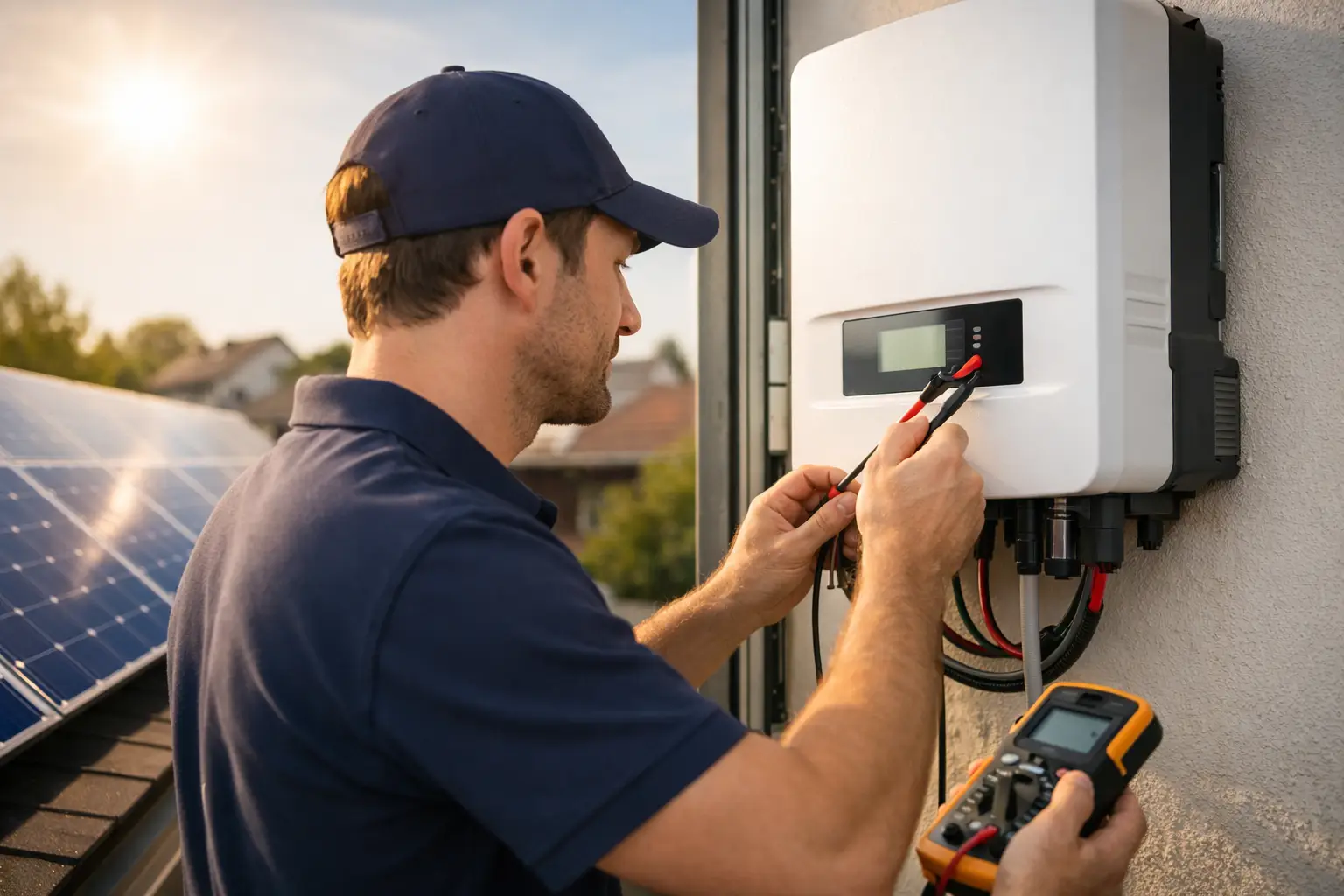
An annual inspection is a good basis for preventive maintenance. This involves looking not only at the inverter but also at connections, cabling, protections, and the general operation of the installation. This way, loose connections, wear, traces of moisture, and emerging faults are discovered earlier.
For a relatively new installation without any alerts, an annual check may be sufficient. Is your installation more than ten years old, has it had regular faults, or is the yield difficult to track? Then more intensive follow-up may be wise. This also applies if the original installer is no longer reachable.
Professional monitoring makes the difference between finding out after the fact and acting in time. Performance is continuously monitored, making deviations visible faster. This limits downtime and provides peace of mind, even if you don’t want to look at an app every day.
What can you safely check yourself?
You can recognize many signals without opening a cabinet. Check if the status light is green or if the display shows normal production. Check the app for error messages and compare the yield with previous weeks or years. Also, listen for unusual sounds, such as persistent loud humming, clicking, or a fan making an unusual amount of noise.
Additionally, look at the space around the inverter. It must be dry, clean, and sufficiently ventilated. An inverter located in an environment that is too hot, dusty, or damp may perform less well and wear out faster. Do not place items against the device and do not cover ventilation openings.
Never open the inverter, fuse box, or connectors yourself. These are under voltage, even when the sun is not shining. In case of visible damage, a burning smell, moisture, discoloration, or loose cables, call in a certified technician. Safety always comes before a quick DIY solution.
When is a drop in yield really a problem?
Not every lower yield indicates a defect. Solar panels produce less during cloudy weather, short winter days, snow, shade, and high temperatures. An installation that is a few years older can also lose a limited amount of power. This normally happens gradually, not suddenly.
A clear drop without a logical explanation does deserve investigation. Think of production that stays at zero for days, a significant deviation compared to similar periods, repeated error messages, or an inverter that restarts regularly. In such cases, waiting is usually more expensive than having it checked.
Soiling of the panels can also influence production. Especially pollen, bird droppings, dust, and deposits can cause local loss. The inverter might be working fine, while the yield still lags behind. Therefore, it is best to look at the installation as a whole and not just at one device.
The most common causes of inverter problems
Inverters have a long, but not unlimited, lifespan. Heat is a major factor. A device that hangs in a poorly ventilated attic for years will endure more than an inverter in a cool, dry place. Dust accumulation and faulty fans can also cause overheating.
In addition, the power grid and cabling play a role. If the grid voltage is too high, an inverter may shut itself down to protect the installation. This sometimes happens especially on sunny afternoons when many homes in the same street are feeding power back. A fault is then not necessarily a defective inverter, but it does require a correct diagnosis.
Finally, connections, fuses, optimizers, or the solar panels themselves can be the cause. Replacing only the inverter without investigation may not solve the actual problem. A targeted technical check prevents unnecessary costs.
Make checking a regular habit
Set a monthly reminder in your calendar and choose a time when you can also compare the yield. Save error messages or screenshots from the app. This information makes an intervention faster and more targeted.
Do you want to do as little follow-up as possible? Then continuous monitoring offers a solution. Deviations are then not only visible when you happen to look. This is especially pleasant if you are often away, manage multiple installations, or do not want to run the risk of unnecessary downtime.
A well-functioning inverter does not require daily attention. However, it does deserve regular checking. With a few minutes a month, a technical inspection per year, and quick action in case of deviations, you protect your investment and keep the energy yield where it belongs: as high as possible.