


Guide for solar panel insurance claims after storm damage
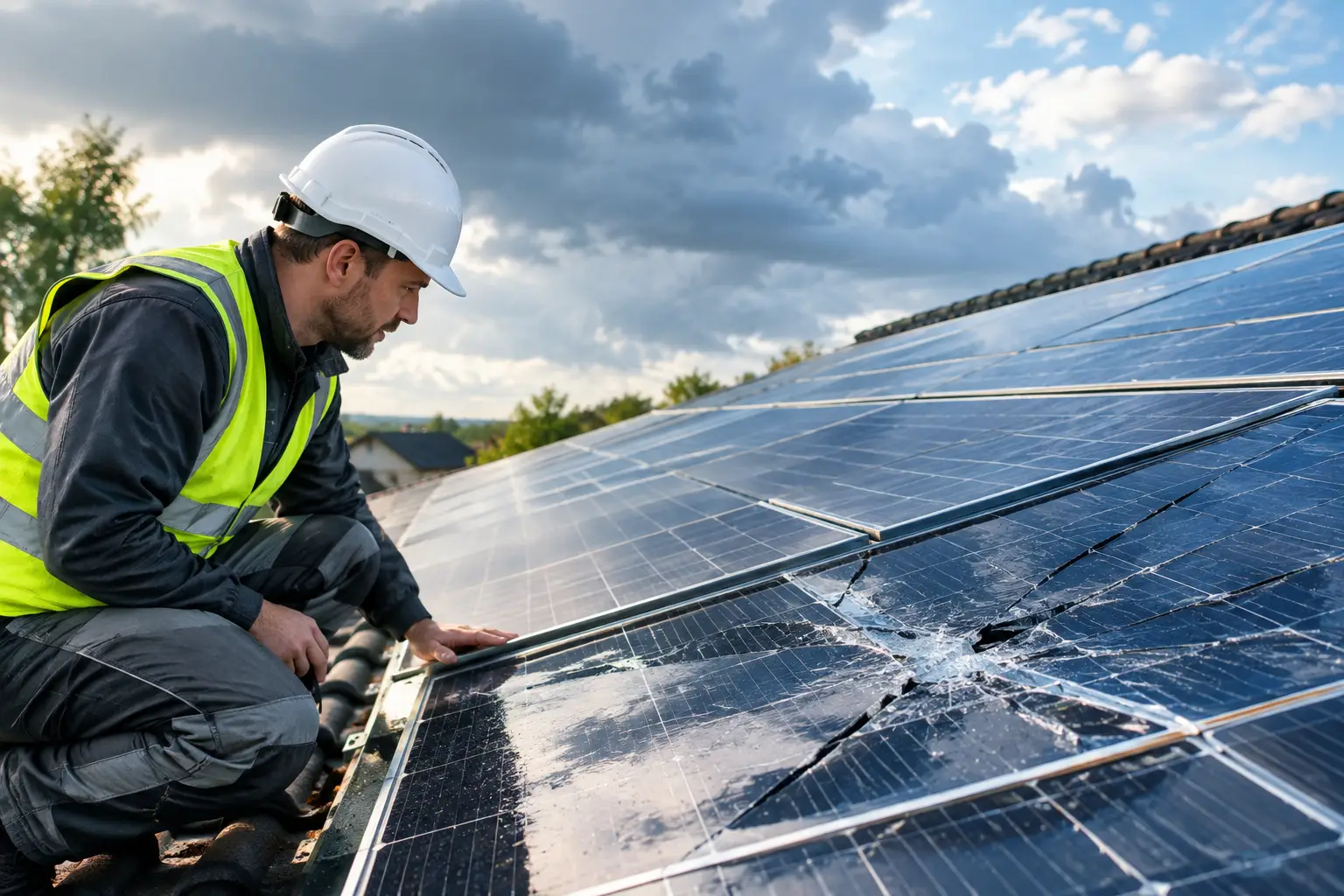
A cracked panel after hail, a loose cable after a storm, or an inverter that won’t restart after lightning: damage to solar panels requires quick and calm action. With this guide for solar panel insurance claims, you will know which steps to take, what evidence to keep, and how to prevent a small defect from growing into long-term yield loss.
Your installation will only produce a return again once the cause is clear and the repair is carried out correctly. That is why a good insurance claim does not start with a form, but with safety, clear observations, and a technical inspection.
Safety first, then collect evidence
Do not go onto the roof yourself after a storm, fire, or other damage. Do not touch loose cables, damaged panels, or inverters. Especially after storm damage, water damage, or a possible lightning strike, there may be risks that you cannot see.
Only switch off the installation if it is safe to do so and you are familiar with the normal procedure. In case of visible damage to cabling, burn marks, a strange smell, or an error message on the inverter, it is better to leave the installation off until a technician has assessed the situation. This limits the risk of additional damage and gives your insurer a clear signal that you have acted carefully.
Next, take photos and videos of what you can safely see. Photograph damaged panels from the ground, the inverter, error codes on the screen, loose parts, and any damage to the roof. Also record the date of the incident. Are there hailstones, fallen branches, or traces of water? Include these in the shot before you clear anything away.
Additionally, save screenshots from your production app or portal. A sudden drop in production, zero production, or an error message can later help to support the timing of the failure. If you do not have monitoring, note down when you first identified the problem.
What solar panel damage is often insured?
Coverage depends on your policy. For solar panels, it usually involves the home’s fire insurance, a separate insurance for the installation, or comprehensive coverage for technical damage. Check the special conditions before assuming a reimbursement.
Storm, hail, fire, lightning strike, water damage, and vandalism are often covered by insurance, but not always under the same conditions. Some policies only compensate for material damage. Others also take into account costs for dismantling, reinstallation, or temporary protection of the roof.
Wear and tear, lack of maintenance, and a defect that has developed gradually are usually less likely to be covered. An inverter that fails after years is therefore not automatically an insurance claim. Damage caused by animals can also vary per policy. Birds nesting under panels can damage cables, connections, and the roof structure. Preventive bird protection reduces that risk, but does not by definition make an existing insurance claim acceptable.
Ask your insurer specifically what is covered under your policy. Mention not only that there is damage, but also what you have observed: for example, damage after hail, a suspected surge after lightning, or panels that came loose due to wind. Stick to the facts. A technical diagnosis can confirm the cause later.
Guide for solar panel insurance claims: the right order
A claim proceeds more smoothly when you maintain the correct order. Report the damage to your insurer in a timely manner and ask if prior permission is required for a repair. Do not wait too long, but also do not postpone a final repair if the installation or home could suffer further damage as a result.
Next, request an independent technical inspection. The technician can determine which parts are damaged, whether the installation is safe, and what work is required. This is more than just a price estimate. A solid technical report makes the distinction between visible damage and hidden problems, such as damaged connectors, insulation faults, or an inverter that has suffered internal failure.
Submit your claim as completely as possible. Combine your photos, the date of the incident, any screenshots of the monitoring, the purchase invoice or installation details, and the technical report. Have you already incurred costs for urgent protection or diagnosis? Keep those invoices and proofs of payment.
In case of major damage, the insurer may send an expert. In that case, leave damaged parts, as far as safely and practically possible, until the expert has seen them. Do not make changes that complicate the investigation. A temporary measure to prevent water ingress or electrical risks is, of course, a different matter. Document that measure with photos as well.
A quote must go further than just replacement
A quote for damage repair ideally contains a clear breakdown. Which panels are damaged? Is the inverter still reliable? Do cables, connectors, roof mountings, or optimizers need to be replaced? Are testing and start-up costs required to put the installation back into service safely?
This detail is necessary because solar panels form a whole. Replacing only a visibly broken panel may be insufficient if the connection or the support structure also has damage. Conversely, not every panel needs to be replaced after an incident. An inspection and measurement provide clarity and prevent unnecessary costs.
Also pay attention to compatibility. With an older installation, the same panel type is sometimes no longer available. An alternative panel may fit technically, but differences in power or electrical properties can affect the operation of a string. An experienced technician assesses whether a one-on-one replacement is possible, or whether another solution is better for long-term yield.
In the quote, also request attention for the restoration of yield, not just the visible damage. An installation that switches back on but structurally produces less is not yet fully restored. Checking production, error messages, and electrical values after the intervention is therefore part of proper damage repair.
Yield loss: when does it matter?
When solar panels are down, your energy savings decrease. However, yield loss is not covered in every policy. For a residential installation, the focus is often limited to repair or replacement of the physical damage. With some comprehensive contracts or business policies, business interruption or production loss can play a role.
Even if yield loss is not covered, a quick intervention remains financially wise. Every day without production counts, especially in the sunny months. With active monitoring, you can see more quickly when an installation deviates from its normal pattern. This helps not only after damage, but also with defects that arise less noticeably.
Always compare production with the same period in previous years and take the weather into account. One cloudy week does not prove a defect. A sudden failure, a strongly deviating production line, or recurring error codes are signals that you should have checked.
Common mistakes that delay a claim
The most common mistake is drawing conclusions too early. Do not say that lightning destroyed the inverter if it is only certain that it stopped working after a thunderstorm. Note what you see and have the cause technically investigated. This makes your claim more credible.
A second mistake is only taking photos of the roof. It is precisely the inverter data, the production history, and an inspection report that often show the full impact. An old photo of the installation just before the incident can also be useful if available.
Additionally, owners sometimes leave damaged installations untouched for too long because they are waiting for approval. Discuss immediately with your insurer which urgent measures are permitted. A quick, documented intervention can avoid further damage and extra downtime.
Finally, a cheap repair is not always the best choice. A temporary solution can cause costs again later, especially if the cause has not been removed. Choose a repair that brings together safety, correct operation, and maximum energy yield once again.
After the repair: check if everything is performing again
After the repair, ask for a clear completion report. You need to know which parts have been replaced, which checks have been carried out, and whether the installation is producing safely again. Keep this report together with your insurance claim. It is also valuable for a later sale of your home or a new insurance inquiry.
Follow the production extra closely for the first few weeks. A single sunny day says little, but a stable production pattern without error messages gives confidence. If in doubt, have the installation checked again. Preventive maintenance and periodic inspections make future problems visible sooner and help extend the lifespan of your installation.
Damage to solar panels is annoying, but it doesn’t have to mean a long loss of yield. Those who act safely, keep evidence carefully, and have repairs carried out based on a technical inspection protect not only their insurance claim but also the investment on the roof.