


Need repair for damaged solar panels?
A crack in a solar panel sometimes seems harmless, especially when your installation is still producing power. However, minor damage can quickly lead to loss of yield, moisture problems, or an unsafe situation. Timely repair of damaged solar panels protects your investment and prevents a limited defect from escalating into a major intervention.
Not all damage requires the same approach. Sometimes a technical check and the repair of a connector, cable, or mounting is sufficient. In case of damage to the panel itself, replacement is often the safest choice. The right decision always starts with a thorough inspection of the entire installation.
Which damage to solar panels requires quick action?
Solar panels are outdoors for years and endure a lot. Hail, storms, branches, falling objects, and animals can cause visible damage. Even without a clear impact, materials can age or connections can come loose.
A visibly cracked glass surface is the clearest signal. Even fine hairline cracks deserve attention. They can allow water into the panel, further damaging cells, wiring, and insulation. The panel sometimes continues to work, but delivers less energy or causes faults in an entire string.
Discoloration, burn spots, or a loose junction box are also reasons not to wait. Such signals can indicate overheating. A poor connection creates resistance, and resistance creates heat. This not only jeopardises your yield but can also pose a safety risk.
Furthermore, watch out for panels that have shifted after a storm, damaged cabling under the panels, or bird protection that comes loose and touches cables. The cause is not always in the solar panel itself. That is precisely why a professional diagnosis is more important than just a quick visual check from the ground.
Repair of damaged solar panels: what is possible?
Whether a panel can be repaired depends on the type of damage. Damaged glass, defective solar cells, or degradation of a panel’s protective layers generally cannot be reliably repaired. In such cases, replacement is usually the best solution. This prevents moisture or heat from spreading further within the panel.
Other components can often be repaired in a targeted manner. Think of a damaged connector, a worn cable, a defective junction box, or a problem with the inverter. A fault in the mounting structure, such as a loose clamp, is also usually easy to resolve. The technician checks not only the defective part but also the cause. Otherwise, the same problem may return.
Replacing a panel in an existing installation requires more than just choosing a panel with the same power rating. Voltage, current, dimensions, orientation, and the string layout must be aligned. A panel that is not a good electrical fit can limit the performance of other panels. For older installations, a technical assessment is therefore extra important.
Sometimes it is wiser to renew several outdated panels or an entire string. This is not automatically necessary, but it can be cost-effective when parts are no longer available or when the installation structurally produces too little. You then get clarity on the cost, the expected yield, and the most logical solution for your installation.
Do this immediately in case of damage
Do not touch a damaged panel, loose cable, or connector yourself. Even when the inverter is switched off, solar panels can produce voltage in daylight. Do not climb onto the roof to view the damage up close. This increases the risk of a fall and can further damage the installation.
From a safe place, do take some photos of the visible damage and note when you identified the problem. Check the display or the app of your inverter for any error messages. If you see a clear drop in production, a fault, or a tripped circuit breaker, then prompt technical assistance is advised.
In case of severe damage after a storm, burn marks, or exposed cabling, switch off the installation according to your inverter’s instructions, if it is safe to do so. Then contact a specialist. Also report the damage to your insurer in a timely manner if it is the result of hail, a storm, or another insured event. Keep photos, reports, and invoices carefully.
Why only looking at the broken panel is not enough
A solar installation works as a single unit. A defective panel can lower the yield of an entire group of panels. In installations where panels are connected in series, one weak link can limit the production of the entire string.
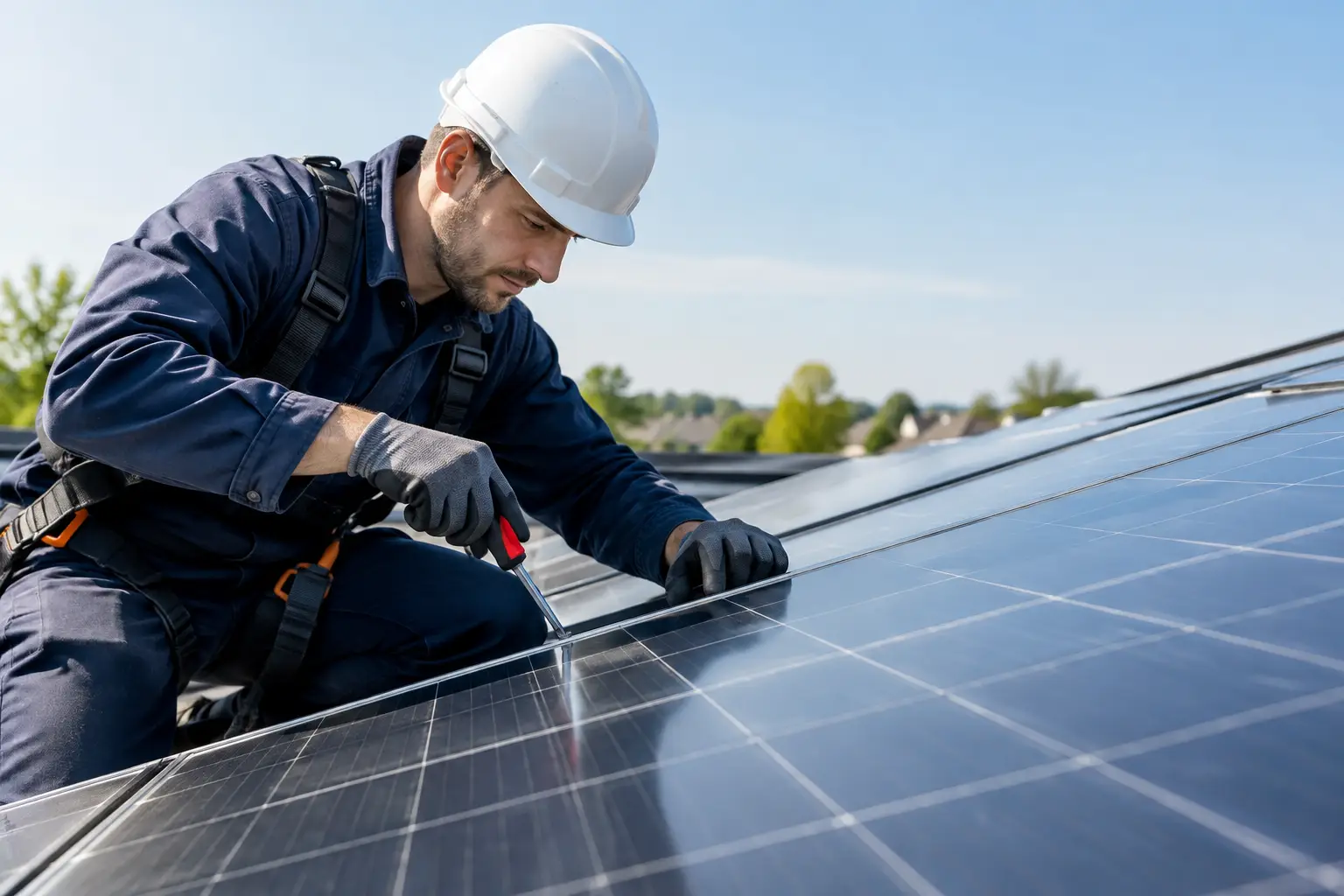
That is why a good intervention looks beyond the visible problem. The technician checks the electrical values, cabling, connectors, mounting, inverter, and any error messages. Where necessary, a thermal check helps to detect hot spots that you cannot see with the naked eye.
This broader check provides certainty. You know not only which component is defective, but also why. That makes the difference between a temporary fix and a repair that makes your installation work reliably again.
Monitoring makes hidden damage visible faster
Not every piece of damage is visible from the ground. Internal damage, early degradation, or a defective connection is often first noticed by a deviating production pattern. Without follow-up, you could lose weeks or months of yield before discovering that something is going wrong.
With professional monitoring of solar panels, deviations in production are detected faster. This is particularly useful if you do not check your inverter daily, are travelling, or manage multiple installations. A notification is not a diagnosis in itself, but it is an important signal for targeted investigation.
For individual owners, this primarily means peace of mind. You don’t have to interpret technical graphs yourself to know if your installation is still performing well. The faster a deviation is noticed, the lower the chance of prolonged downtime and unnecessary loss of yield.
Prevention extends the lifespan of your installation
Damage cannot be completely ruled out, but preventive maintenance reduces the chance of surprises. During a check, loose mountings, wear on cables, dirt, problems with connectors, and early damage are noticed in time. This is cheaper and safer than waiting until a defect shuts down production.
Animals also deserve attention. Birds nesting under the panels can damage cables and accumulate debris. Appropriate bird protection keeps animals away without damaging your panels or roof structure. This protects both the technical operation and the space under your installation.
Cleaning can also contribute to a correct assessment of your panels. Stubborn dirt can mask damage and sometimes causes local heat build-up. Cleaning is not a substitute for an inspection, but it is a meaningful addition to good maintenance.
Choose a repair with clear agreements
In case of damage, you primarily want to know where you stand: what is defective, what is the cause, what repair is needed, and what does this mean for your yield? Therefore, ask for a clear diagnosis and a transparent explanation before any work starts.
Solar Assistance has worked as an independent service partner for existing solar installations since 2012. Even if your original installer is no longer active, a certified technician can assess your installation and carry out the necessary repair. You get clarity on the work and a guarantee on the work performed.
So don’t wait until a small crack, an error message, or declining production becomes a bigger problem. A timely check keeps your installation safe, limits downtime, and restores your confidence in the energy yield from your roof.