


Resolving solar panel inverter error messages
You check the inverter or the app and suddenly an error code appears. A solar panel inverter error message doesn’t always mean your installation stops completely, but it is a signal that your yield may be dropping. And the longer such a malfunction persists, the greater the chance of unnecessary loss of yield.
For many owners, this is frustrating. Your investment should simply work. Without guesswork, without a technical search, and without waiting for days. That is exactly why it helps to know what an error message usually means, what you can safely check yourself, and when it is smarter to quickly call in a technician.
What a solar panel inverter error message usually indicates
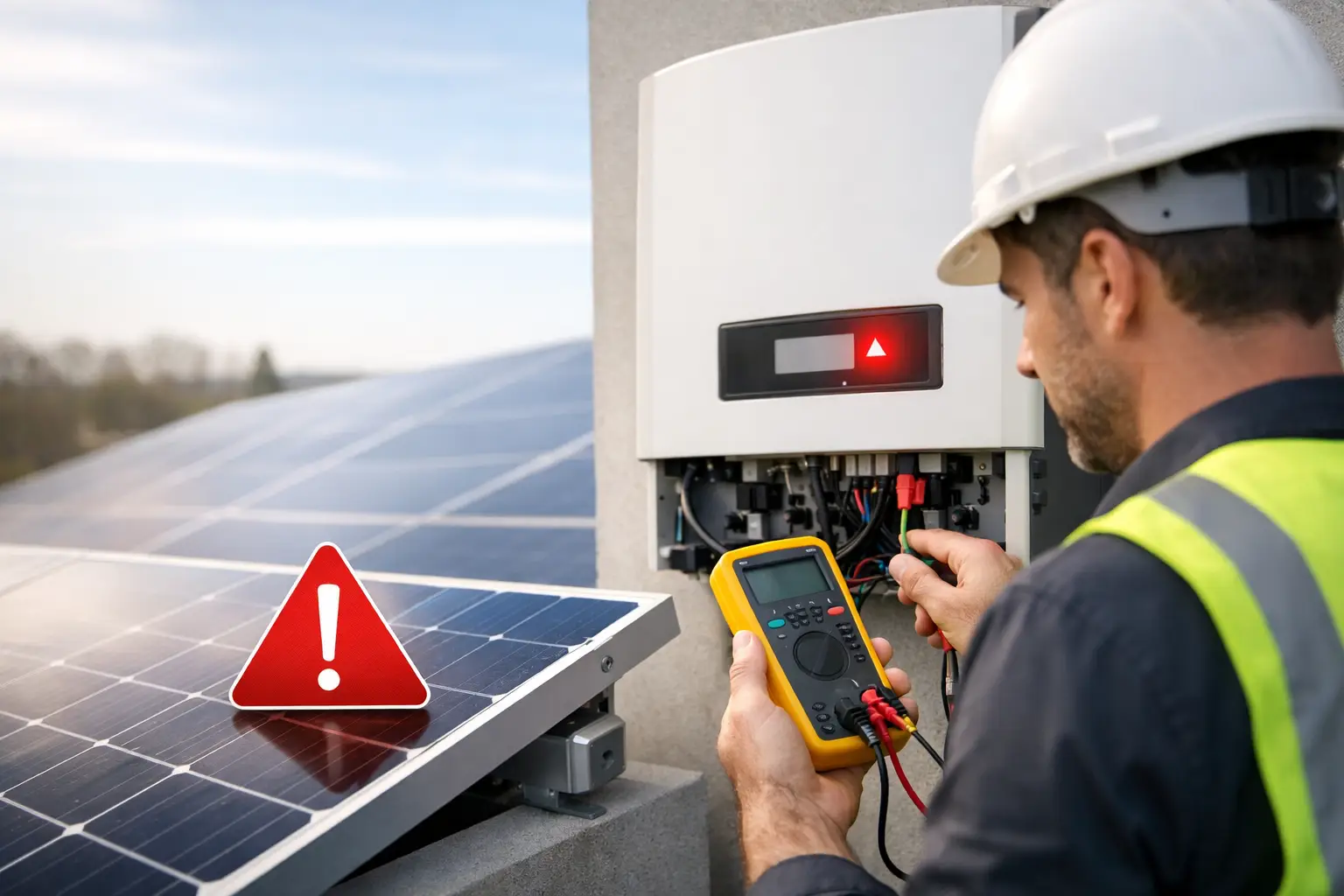
The inverter is the heart of your solar installation. It converts direct current from the panels into usable alternating current for your home or business. If something goes wrong there, the inverter reports it via a code, a red light, a warning in the app, or a status message on the screen.
Such a message can point to a temporary problem, such as a grid voltage peak, but also to a defective component, loss of communication, or a problem on the panel side. That difference is important. Some malfunctions disappear on their own. Others keep coming back and cost you yield every day.
Therefore, the right question is not just: what does this code mean? The better question is: does this error affect my yield, and how quickly do I need to intervene?
The most common causes
In practice, we see that many malfunctions stem from a limited number of causes. One of the best known is a grid problem. If the grid voltage is too high or too low, the inverter can switch itself off to avoid damage. This is safe, but your installation then temporarily produces less or nothing at all.
Temperature also plays a role. On hot days, an inverter can overheat, especially if it is mounted in a poorly ventilated area, in full sun, or in a technical room where heat lingers. The inverter then goes into protection mode or reduces its power.
In addition, there are communication problems. Sometimes the installation still works, but the app no longer shows data or reports a malfunction because the connection to Wi-Fi, the data logger, or the monitoring platform is lost. This seems less urgent, but without insight into performance, you often notice real production losses too late. That is why good monitoring of solar panels is not a luxury, but a way to intervene faster.
Furthermore, technicians regularly see defects in connectors, cabling, fuses, or internal parts of the inverter. Wear and tear is more common in older installations. Moisture, dirt, insects, or poorly executed connections can also cause malfunctions over time.
What you can safely check yourself
Not every error message immediately requires an intervention on the roof or in the cabling. There are a few things you can safely check yourself, without risk and without needing technical knowledge.
First, look at the inverter screen or in the app. Note the exact error code and the time. This may seem minor, but it helps enormously in making a targeted diagnosis later. A message that recurs every afternoon often points to something different than an error that mainly occurs in the morning or during rain.
Next, check if the inverter still has power. Is a light on? Is it in error mode, standby, or completely off? Also check the fuse box to see if a switch has tripped. Do not turn anything on or off randomly if you are not sure what you are doing, but do see if anything has visibly changed.
Do you notice that only the app shows no data, while the inverter itself seems to be working normally? Then it could be a communication problem. You can then check if your internet connection is working and if the Wi-Fi near the inverter is stable.
What you should not do: open the inverter, touch cabling, or perform electrical tests yourself. This is not only unsafe, it can also increase damage or affect warranty conditions.
When you shouldn’t wait
Some messages are fine to observe for a while. A one-time grid error that disappears immediately doesn’t always have to be acute. But there are clear signals where waiting usually costs money.
If the error code keeps coming back, if the inverter fails for a long period, if your app shows zero production for days, or if you notice that the yield is significantly lower than normal, then quick follow-up is necessary. This also applies if you smell a burning odor, see discoloration at connections, or hear unusual noises.
For companies, this carries even more weight. Less downtime there means directly more continuity and less loss. But every sunny day counts for private individuals too. You shouldn’t just ignore a malfunction in April, May, or June if you want to get maximum yield from your installation.
Why error codes alone are not enough
Many owners logically start by looking up the error code. However, that code rarely tells the full story. For example, a message about an insulation fault could point to moisture, damaged cables, poor connectors, or an internal problem in the inverter. The code is therefore a clue, not a definitive diagnosis.
That is exactly why a technical analysis makes such a difference. It’s not just the error message itself that counts, but also the behavior of the installation over time. How often does the malfunction recur? Has the yield been lower for weeks? Are all strings still working? Have there been previous messages that were ignored?
With targeted technical assistance for solar panels, you prevent a temporary malfunction from growing into a more expensive problem. And you avoid the classic situation where an inverter is reset multiple times without the real cause being resolved.
Prevention is cheaper than production loss
Those who only react when the inverter fails completely are often too late. Many malfunctions build up slowly. First a small communication error, then irregular outages, and finally an installation that no longer produces correctly.
Preventive maintenance helps to spot such signals earlier. During maintenance, the operation of the inverter, connections, ventilation, error history, and the general state of the installation are checked, among other things. This reduces the chance of unexpected downtime and often extends the lifespan of the installation.
For owners who want certainty, maintenance of solar panels is primarily a form of peace of mind. You don’t have to wait for a malfunction to know if everything is still doing what it should.
The role of monitoring in malfunctions
An error message is often only the visible part of the problem. The real gain lies in noticing sooner that something is deviating, before the malfunction becomes major. This is where continuous follow-up makes the difference.
With good monitoring, you see not only if the inverter is online, but also if production is proceeding logically. If the installation lags behind on sunny days, if one part performs less, or if the inverter goes into error more often than normal, you can intervene in a targeted way. This prevents long periods of hidden yield loss.
For larger installations, this is almost indispensable. But it also pays off for a residential installation. After all, your investment doesn’t run on feelings, but on measurable yield.
Sometimes the problem isn’t just in the inverter
An error message on the inverter doesn’t always mean the inverter itself is defective. Dirty panels, for example, can lead to abnormal behavior or disappointing production, causing owners to suspect the inverter first. The same applies to shading, defective optimizers, or dirt from leaves and bird nuisance.
That is why a broad perspective is important. If panels are heavily soiled, your yield drops and a malfunction is sometimes noticed later. Professional cleaning of solar panels helps not only for cleaner panels, but especially to be able to assess your performance correctly.
Bird nests under panels also regularly cause cable damage or malfunctions. This problem seems innocent until it starts to weigh on your yield. In such cases, installing bird protection is not a detail, but a way to prevent recurrence.
What you can expect from a good intervention
If you call in help for an error message, you primarily want clarity. Not just that someone stops by, but that you know what is wrong, what the effect on your yield is, and which solution makes sense.
A good intervention therefore starts with diagnosis, not guesswork. The technician reads error codes, checks the operation of the installation, and looks for the real cause. Afterwards, you receive clear advice: a reset is sufficient, a part needs to be replaced, or additional work is required to avoid new malfunctions.
This no-nonsense approach also fits with how Solar Assistance works: focused on fast help, clear communication, and maximum yield with minimum worries.
What you should do immediately in case of a malfunction
Do you see a solar panel inverter error message appearing? Note the code, take a photo of the screen if possible, and check if production actually stops or drops. Don’t wait too long if the message keeps coming back. The sooner the cause is clear, the smaller the loss of yield.
Your solar panels should primarily give you certainty. Not another technical file to deal with. And that is exactly why a malfunction is not a detail to be ignored, but a signal to get your installation back in top shape.