


Preventive maintenance for solar installations pays off
A solar installation providing power today may underperform tomorrow without being noticed. Not due to a major failure, but because of small deviations that remain undetected for too long: dirt, a weak connector, an inverter displaying error codes, or a string producing less than expected. That is why preventive maintenance for solar installations is not a luxury, but a smart way to safeguard yield, safety, and continuity.
For many owners, the problem only starts when the yield visibly drops. However, that is often too late. An installation can underperform for months without it being immediately apparent on the energy bill. This happens regularly with residential systems because most people do not check their production data at a detailed level daily. For businesses, the impact is even greater: every day of loss accumulates, while the failure of part of the installation does not always trigger an immediate alarm.
Why preventive maintenance is necessary for a solar installation
Solar panels have a reputation for being low-maintenance. That is true, but low-maintenance is not the same as maintenance-free. Panels sit outside year after year in rain, wind, heat, dust, and pollution. The inverter operates under load and is sensitive to wear and temperature fluctuations. Cabling, connectors, and mounting materials must remain mechanically and electrically reliable.
Those who only intervene once something breaks are essentially choosing reactive management. This may seem cost-effective but is often more expensive. A timely detected deviation is usually faster and easier to resolve than a defect that has already caused damage. Think of a poor contact building up heat, or dirt causing hotspots and yield loss. Prevention, therefore, is not just about cleaning or checking, but about mitigating risks before they escalate.
What is included in preventive maintenance for a solar installation?
Good maintenance is more than a quick visual check. The scope depends on the type of installation, its age, location, and usage profile. A home often requires a different maintenance approach than a commercial roof with multiple inverters and extensive monitoring.
In practice, preventive maintenance begins with a general inspection of the panels, mounting structure, and cabling. This includes looking for visible damage, dirt, loose parts, wear, and potential risks such as bird nuisance or damaged connectors. This is usually followed by a technical check of the electrical components. Of particular importance are the inverter, the AC and DC sides, and the performance per string.
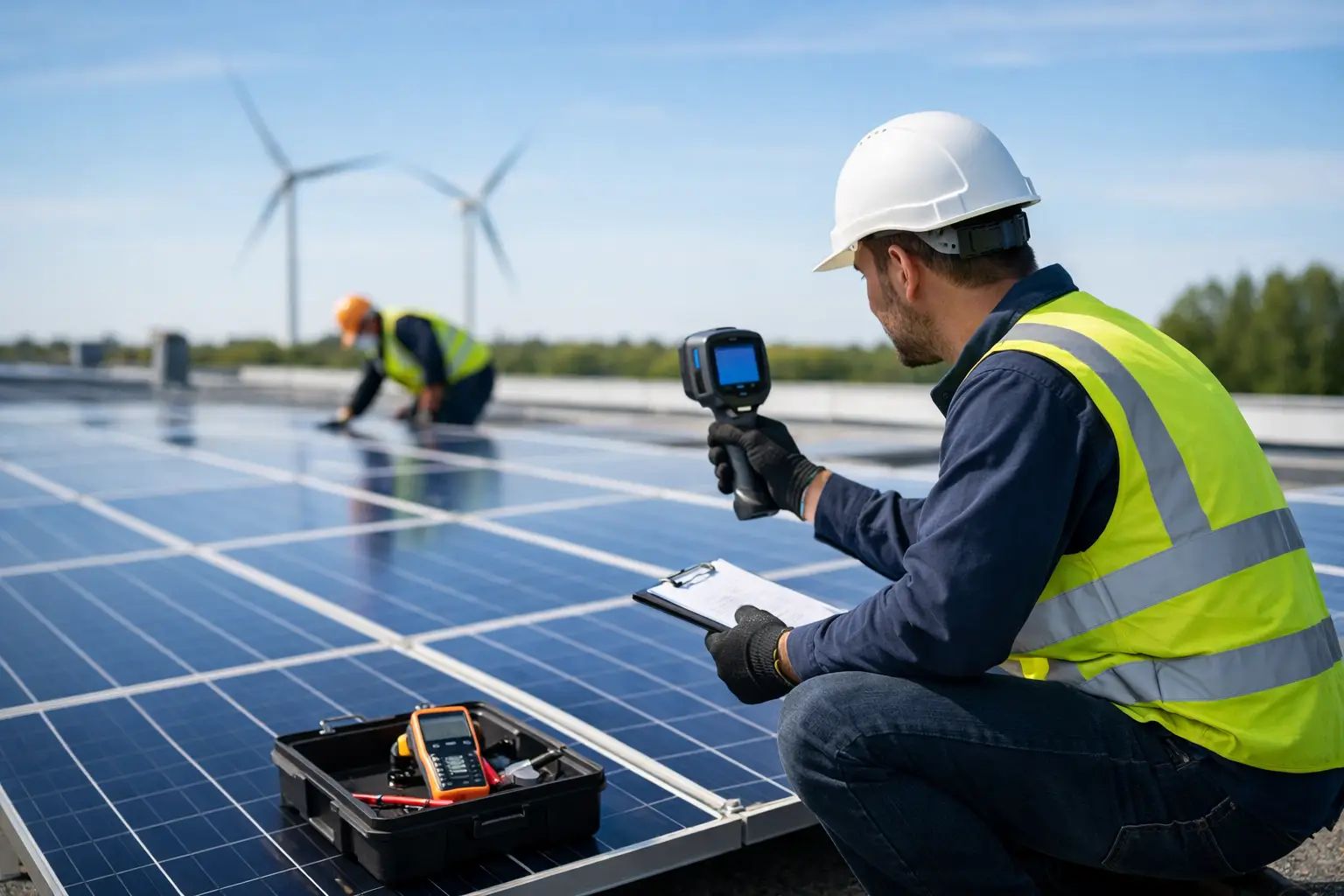
Professional maintenance can also include measurements that reveal deviations before they lead to failure. This is important because not every problem is visible to the naked eye. An installation can look perfectly fine and yet structurally produce less due to a faulty component or a developing error in the system.
Cleaning is useful, but not always standard
When thinking of maintenance, many people first think of cleaning solar panels. This makes sense, but it is only part of the story. Cleaning can be useful if there is stubborn dirt, dust accumulation, bird droppings, agricultural pollution, or a location with increased deposits. In these situations, the dirt load can noticeably reduce the yield.
At the same time, not every roof needs to be cleaned every year. The tilt angle, environment, and rainfall all play a role. Cleaning too often without a clear necessity does not always yield extra returns. What matters is an expert assessment. If dirt affects performance, cleaning is directly beneficial. If the effect is limited, the focus is better placed on inspection, monitoring, and technical checks.
Monitoring makes maintenance smarter
Maintaining a solar installation without proper data means working with a delay. Monitoring helps to recognize patterns, quickly detect anomalies, and track performance. Especially for larger installations, this is not a luxury, but a basic requirement for maintaining control over yield.
Monitoring is also valuable for homes, provided the data is actively followed up. An app alone is not enough if no one knows what to look for. A drop in production can be caused by seasonal influences, but also by a faulty inverter, a problem in a string, or grid voltage issues. Those who read these signals in time prevent small problems from dragging on for months.
Which problems are often avoided with prevention?
In practice, many defects do not appear out of nowhere. They build up. An inverter that regularly shuts down, a connector that heats up, a dirty panel field, or a cable damaged by animals or UV exposure: these are typical examples of issues that seem small at first but turn out to be expensive later.
Preventive maintenance limits the chance of unexpected downtime and helps keep yield loss under control. For residential installations, it often concerns unnoticed production loss. For businesses, the operational impact also counts. If an installation is linked to energy savings, reporting, or sustainability goals, predictable operation is essential.
Safety also plays a role here. Electrical installations on roofs must continue to function reliably. You want to discover poor connections, wear, or faulty components early, not only when an incident occurs.
How often is maintenance needed?
There is no universal maintenance frequency that applies to every solar installation. A young system on a clean residential roof requires less attention than an older installation in a dusty or industrial environment. The quality of the original installation also plays a part. A properly installed system with good components usually remains more stable, but even then, periodic checks remain wise.
For residential installations, a fixed periodic inspection is often sufficient, supplemented by extra checks in case of significant production drops, error messages, or visible dirt. For businesses, VMEs, and larger buildings, the bar is higher. There, a customized maintenance plan is usually the best choice, with fixed intervals, monitoring, and rapid intervention in case of deviations.
The right rhythm therefore depends on risk, usage, and the desired level of certainty. Those who want maximum operational reliability do not choose to wait, but to plan.
When is it best to call in a specialist?
Not all maintenance is a DIY job. A quick look at the app or a visual check from the ground can be useful, but as soon as it involves electrical checks, roof access, fault diagnosis, or professional cleaning, expertise is required. This is not only safer but also more efficient.
A specialist looks not only at what is broken but also at what might cause problems soon. This difference makes preventive maintenance valuable. You are not buying a one-off intervention, but more control over the performance of your installation. For owners who want peace of mind, this is often the deciding factor.
For businesses, this choice is even clearer. Downtime costs money, internal technical teams do not always have specific PV knowledge, and documentation or follow-up can become fragmented. In such cases, having one fixed service partner for inspection, monitoring, and rapid repair is the most logical solution.
Preventive maintenance for solar installations as an investment in yield
Maintenance is sometimes seen as a cost alongside the original investment. In reality, it protects that very investment. A solar installation is built to generate returns for years, but only if all parts continue to do what they are supposed to do. Every percentage of yield loss you avoid counts over the full lifespan of the system.
The financial value of maintenance therefore depends not only on the cost of the intervention but on what you prevent with it. Less production loss, fewer unexpected defects, a longer lifespan for components, and more certainty about actual performance—this makes prevention economically logical.
For larger installations, this calculation is usually quickly made. For individuals, it is more subtle but no less relevant. Especially now that many systems are several years old, the difference between just letting them run and professional follow-up is becoming increasingly visible.
What should you look for when choosing a maintenance partner?
A good maintenance partner for solar panels combines technical expertise with speed and follow-up. A cleaning service alone is not enough, just as a repair service without a preventive approach is too limited. You are looking for a partner that understands the full picture: performance, safety, components, monitoring, and intervention.
Therefore, look for experience with existing installations, in-house technicians, clear reporting, and the ability to work both preventively and correctively. Especially with complex or older systems, practical knowledge is crucial. A maintenance partner must be able to interpret deviations, set priorities, and act quickly when intervention is needed.
For those seeking certainty about yield and operational reliability, a service-oriented specialist like Solar Assistance is a logical choice. Not because maintenance needs to be made complicated, but precisely because it needs to be organized professionally and predictably.
Those who wait for a malfunction are always one step behind. Those who have preventive checks carried out maintain control over performance, planning, and lifespan. This provides peace of mind—and above all, a solar installation that keeps doing what it was intended for.