

Guide to solar panel performance monitoring
Your solar panels can look perfect and yet yield less than expected. An inverter that occasionally fails, a problem with one group of panels, or a communication error often remains invisible without follow-up. With this guide to solar panel performance monitoring, you will learn what to look out for, what monitoring does for you, and when it is best to call in a technician.
What is solar panel performance monitoring?
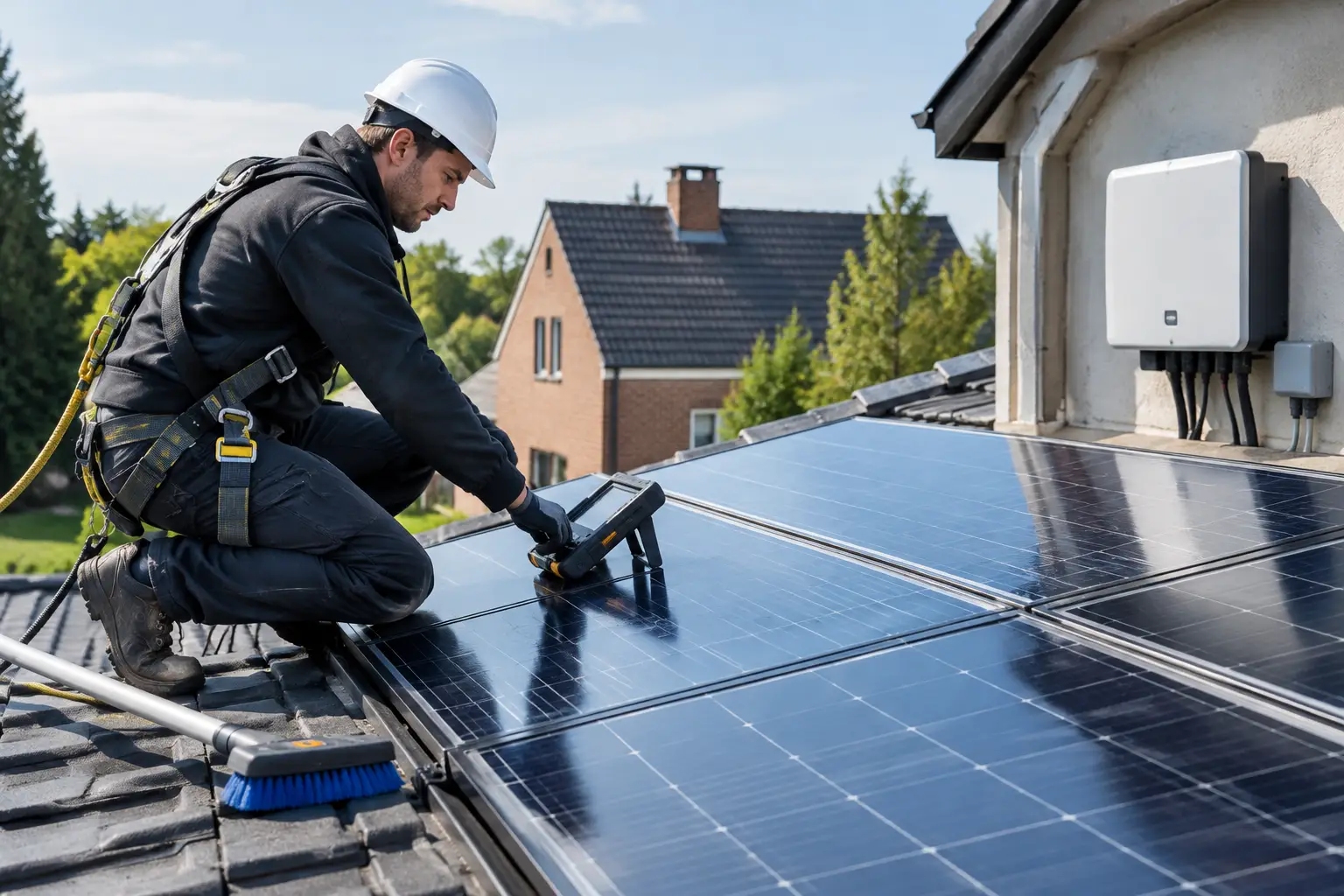
Performance monitoring means following the operation and yield of your solar installation. This usually happens via the inverter. The inverter converts the direct current from your solar panels into usable alternating current for your home. It records how much energy your installation produces and can pass on error messages.
Through an app, an online portal, or a separate monitoring system, you can usually see the production per day, month, and year. This is useful, but figures alone don’t always tell the whole story. A low yield can be normal due to clouds, short winter days, or shade. It can also indicate a fault that requires attention.
Good performance monitoring therefore doesn’t just compare today’s production with yesterday’s. It looks at patterns, error messages, and notable deviations. This way, you notice faster when your installation is not working as it should.
Why follow-up protects your yield
Solar panels require little daily attention, but they don’t work problem-free for years on their own. According to our own figures, a fault remains unnoticed for an average of seven months. During that period, you miss out on production, often without noticing it immediately on your energy bill.
This happens, for example, when the inverter stops and no one sees the notification. Or when one string performs less well. A string is a series of solar panels that are electrically connected to each other. If there is a problem in that series, part of your installation may produce less or nothing, while the rest continues to work.
An internet connection that drops out can also make a difference. Your solar panels may still be producing, but you no longer see current data. That is not a technical detail you should just ignore. Without data, you cannot assess whether your installation is performing well.
Performance monitoring primarily gives you peace of mind. You don’t have to look at an app every day, but you do want to know that a deviation doesn’t drag on for months.
How to recognize a deviation in yield
A single poor day is rarely a cause for concern. The weather simply determines a large part of the production. Therefore, look at several comparable days and the trend over a few weeks.
First, watch for a sudden drop that doesn’t match the weather. If your installation normally produced well on a clear day and the yield suddenly drops sharply, then a check is wise. Also, see if production drops off at certain hours. This could indicate temporary shade, but also a technical problem.
A second signal is an error message on the inverter or in the app. Note the exact message and possibly take a photo of the screen. Do not open the inverter yourself and do not work on cables or electrical parts. That is not safe and makes a correct diagnosis more difficult.
Thirdly, a comparison with previous years can help. Do compare the same period, because a month in the summer says little about a month in the winter. Also take changes around your home into account. A grown tree, new construction nearby, or dirt accumulation can cause more shade than before.
Not every lower yield is a defect
A lower figure doesn’t automatically mean something is broken. High temperatures, for example, can affect the performance of panels. Even a thin layer of dirt isn’t always the main reason for a lower yield. However, stubborn dirt, leaves, moss growth at the edges, or bird droppings can make a difference locally.
Birds deserve extra attention. Nesting material under the panels can cause dirt and damage. If you hear scratching, see birds regularly under the panels, or notice a lot of dirt around the roof, have the situation safely assessed. Preventive bird protection can limit further nuisance.
Which data should you check?
Start simple. Check if your inverter is on and if the screen, app, or portal shows recent production. If you haven’t seen new data for days, there may be a communication problem. This doesn’t always have to be a defect in the solar panels, but it does deserve follow-up.
Next, look at the daily yield and the progress throughout the day. On a sunny day, the graph should usually build up gradually in the morning and decrease again towards the evening. Large empty sections in the middle of a sunny day are a reason to have someone look further.
If you have multiple inverters or see data per string, compare them with each other. Exactly the same values are not always to be expected, especially if the roof surfaces are oriented differently. A clear and lasting deviation between comparable parts of your installation is relevant.
Also save error codes, screenshots, and the date you noticed something. This helps a technician understand faster what might be going on. You don’t have to make a technical diagnosis yourself. Passing on clear information is sufficient.
Monitoring or checking regularly yourself?
Those who like to follow up themselves can periodically look in the app. This works well if you know what to look out for and actually see notifications. The limitation is clear: during busy periods, holidays, or with a changed phone setting, you miss a warning faster than you think.
Monitoring takes over part of that follow-up. At Solar Assistance, more than 10,000 installations are monitored. The systems follow the performance and signal deviations that require attention. This is particularly useful when your original installer is no longer reachable or no longer offers service.
For individuals, there are two solar plans with a different level of follow-up. Solar EYE is monitoring: you get a notification when there is a problem and then contact us yourself to schedule an intervention. This fits when you want to keep the follow-up in your own hands.
Solar COMFY goes further. This plan combines monitoring with annual cleaning and technical inspection, an all-risk insurance, and priority for interventions. In the event of a fault, we contact you ourselves and arrange the further follow-up. This is intended for those who want to do as little as possible themselves.
When is it best to call a technician?
Contact us when the inverter gives an error message, when production unexpectedly drops, or when your monitoring shows no data for a longer period. Also, do not wait if you see visible damage to panels, cabling, or the inverter, for example after severe weather.
An installation that structurally produces less than before also deserves investigation. The cause can be small, such as a communication setting, but can also be related to the inverter, connections, panels, or shade. A technician can measure safely and search specifically, without you taking risks yourself on the roof or with the electricity.
For urgent faults, we can be on-site within 48 hours. Our technicians work throughout Belgium and give a 100% guarantee on work performed. This gives peace of mind if you can no longer rely on the party that installed your system.
Frequently asked questions about performance monitoring
Do I have to check my solar panels every day?
No. A regular look at your production is sufficient if you don’t have monitoring. Check especially in case of error messages, after exceptional weather, and when you suspect the yield is deviating. With monitoring, you get a signal faster without having to check constantly yourself.
Do my solar panels still work if the app shows no data?
They might. Sometimes the problem lies with the internet connection or the communication between the inverter and the app. However, without current data, you don’t know for sure if the installation is producing correctly. Therefore, have a long-term monitoring outage checked.
Can cleaning improve my yield?
That depends on the dirt and the location of your installation. Panels with a lot of stubborn dirt, leaves, or bird droppings can catch less light. Cleaning can then be useful, but it is not a solution for a technical fault. A technical inspection makes the distinction clear.
If you want to be sure that an error message or lower yield doesn’t drag on, contact us via 02 828 90 01 or the contact form. We will look together at which follow-up fits your installation.