



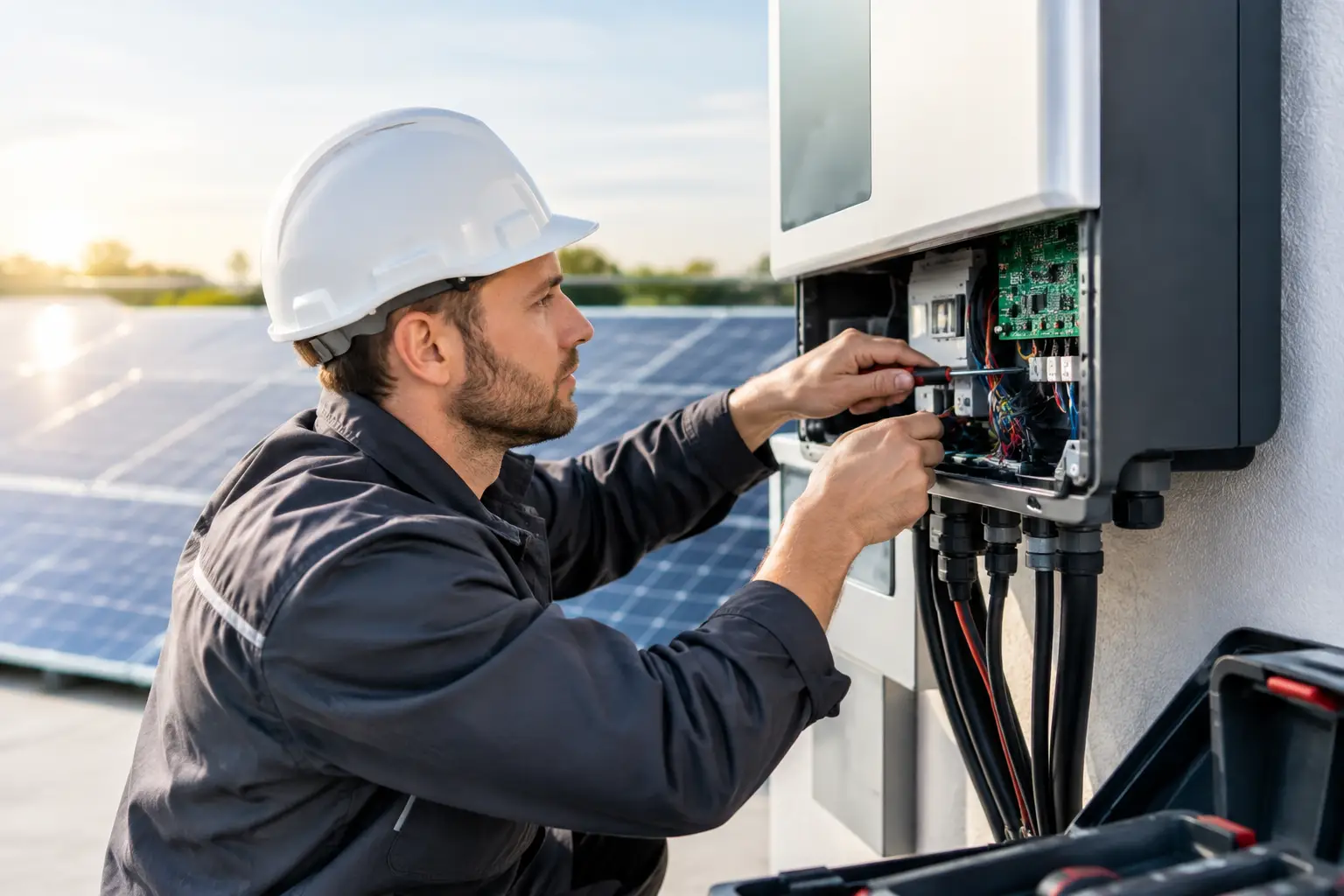
Professional inverter repair assessment
An inverter that shuts down is more than just a technical error message. Your solar panels may still be generating electricity at that moment, but that energy is not reaching your home or business. A correct professional inverter repair assessment prevents you from buying a new device too quickly, but also prevents a small problem from growing into long-term yield loss.
The inverter is the heart of your solar installation. It converts the direct current from your panels into usable alternating current. If that process falters, your efficiency sometimes drops unnoticed. Especially when your installation is not monitored daily, a malfunction can go unnoticed for days or even weeks. A professional inspection quickly brings clarity: is repair possible, what is the cause, and which solution protects your yield in the long term?
What does a professional assessment involve?
A good repair does not start with replacing parts. It starts with a diagnosis. A technician does not just look at the error message on the screen, but also investigates why that message appears. The problem may lie within the inverter itself, but could just as easily be in the cabling, the mains voltage, the solar panels, or the communication between different components.
During a professional assessment, the operation of the inverter, production data, connections, and safety components are checked, among other things. The age of the device and the condition of the installation also play a role. This way, you don’t get a quick guess, but well-founded advice that fits your situation.
This is important because the same error code can have different causes. For example, a message about insulation could indicate moisture in a connector, damaged cables, or a problem on a string of solar panels. Simply replacing the inverter without further investigation can then lead to a new malfunction and unnecessary costs.
Professional inverter repair assessment: repair or replace?
The question is rarely just whether an inverter is defective. The real question is whether repairing it remains economically and technically wise. This depends on the type of malfunction, the age of the device, the availability of parts, and the remaining lifespan of the installation.
A defective display, loose connection, damaged fan, or communication problem is often easily repairable. Certain internal parts can also sometimes be replaced. For an older device with a major internal defective component, the trade-off is different. If the repair cost runs high and the chance of new malfunctions increases, replacement may provide more certainty.
A reliable technician explains this choice clearly. You hear what is defective, what work is required, what the cost is, and what risks remain. This way, you decide based on yield and continuity, not on unclear technical terms.
For a residential installation, a replacement can sometimes also be an opportunity to improve monitoring. With good monitoring of solar panels, you can see more quickly when production deviates from the expected pattern. As a result, you lose less yield between the moment a fault occurs and the intervention.
When is quick action necessary?
Not every message means you are immediately without power. However, there are signals that you should not ignore. In the following situations, a technical assessment is recommended:
- The inverter shows a permanent error message or no longer starts up.
- The yield is noticeably lower than in the same period last year.
- The inverter makes unusual noises, smells burnt, or becomes exceptionally hot.
- The installation repeatedly trips, especially around noon or in sunny weather.
- Your app or portal no longer shows production data, while the installation should be active.
A lower yield does not automatically mean the inverter is broken. Shade, dirty panels, a defective panel, or grid problems can have the same effect. Therefore, an on-site diagnosis is often more valuable than an assessment based on a single error message or a photo of the screen.
What determines the cost of an inverter repair?
The cost depends mainly on the cause and the accessibility of the installation. A simple intervention, such as repairing a connector or correcting settings, requires less time than tracing an insulation fault across multiple strings. For an installation on a difficult-to-reach roof, safety measures and access can also play a role.
Warranty is also important. Some manufacturers offer a standard warranty with options for extension. A professional partner first checks whether a repair under warranty is possible. This prevents you from paying for a part or device that is still covered.
Always ask for transparency before major works start. A clear assessment distinguishes between diagnosis costs, repair work, any parts, and the possible cost of replacement. This way, you know where you stand. For companies, this is extra relevant: production loss, internal follow-up, and planning an intervention often cost more than the technical repair itself.
Solving a malfunction is good, preventing recurrence is better
A repaired inverter only truly provides peace of mind when the cause of the malfunction is also addressed. In case of problems due to overheating, poor ventilation may be the cause. In case of moisture problems, connectors, cable entries, or the placement of the inverter are important points of attention. In case of recurring grid disturbances, it must be checked whether the grid voltage is structurally rising too high.
Preventive maintenance of solar panels helps to identify such risks in time. During a check, technicians can identify loose connections, dirt, wear, or incipient damage before it leads to failure. This extends the lifespan of your installation and reduces the chance of unexpected downtime.
Cleaning can also make a difference, although it does not solve an inverter malfunction. Dirt, moss, pollen, or bird droppings can suppress production. If your yield drops, it is therefore wise to have both the technical operation and the condition of the panels assessed. A correct diagnosis looks at the entire system, not just one component.
What can you expect from a professional intervention?
Above all, you need clarity. A technician must be able to safely analyze the malfunction, explain what is going on in understandable language, and propose a concrete next step. For complex problems, this may mean that measurements are performed first and that parts need to be ordered. A quick diagnosis is valuable, but a rushed repair without root cause analysis is not.
Therefore, choose a partner with their own technicians, experience with various brands, and access to production data. Solar Assistance monitors installations throughout Belgium and combines technical interventions with monitoring and preventive management. This is useful when your original installer is no longer reachable or when you want a single point of contact for your installation.
For business owners, reporting also counts. A facility manager or energy manager wants to know how much production was lost, what the cause was, and what measures limit recurrence. This information makes it easier to plan maintenance, justify budgets, and monitor the performance of larger installations.
Don’t wait until production drops away completely
Many owners only notice a problem when the app shows an error message or when the annual statement is disappointing. By then, the installation may have been producing less for a long time. Therefore, compare your yield regularly with the same period last year. Do take into account the weather, increases in your consumption, and changes such as extra shade from trees or new buildings.
When in doubt, it is wise to quickly call in technical assistance for solar panels. Especially if the inverter fails completely, gives a safety message, or repeatedly trips. A timely intervention limits yield loss and prevents a small defect from causing further damage.
Your solar installation does not have to be a source of concern. Have deviations assessed in time, ask for a transparent diagnosis, and choose a solution that not only fixes the malfunction but also protects your future yield.