


Solar panel inspection for sustained yield
Your solar panels are high up, operate silently, and seem to require little attention. Because of this, a problem can sometimes go unnoticed for months. A solar panel inspection makes visible what you cannot see yourself: declining yield, an inverter fault, loose cabling, or the onset of wear. This protects not only your investment but also your peace of mind.
An installation does not have to fail completely to cost money. Even a limited loss of yield adds up, especially when it is discovered late. With a targeted inspection, you know if your installation is doing what it should and where preventive action is needed.
What happens during a solar panel inspection?
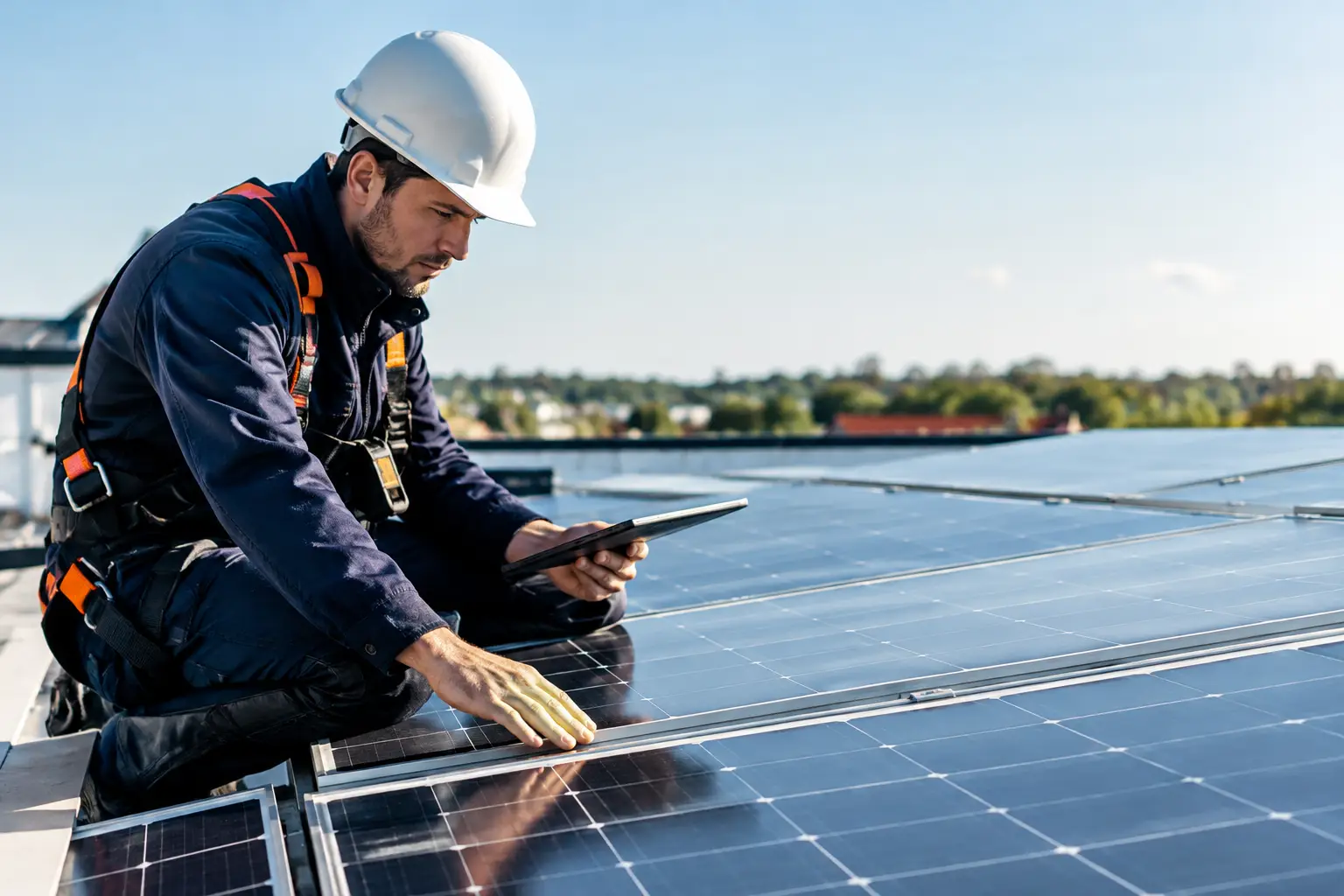
A good inspection goes further than just looking at the panels. A technician assesses the entire installation: the panels, the mounting, the cabling, the connectors, the inverter, and the safety systems. This involves checking whether everything is safely connected and if the components are still functioning correctly.
Yield data also deserves attention. Your installation may still be technically working, yet producing less than expected. This could be due to dirt, shading, a defective panel, a poorly performing string, or an inverter that is no longer working optimally. By comparing actual production with what is logical for your installation, deviations become clear more quickly.
The inspection is therefore not a standard walkthrough. The situation of your roof, the age of the installation, the type of inverter, and the available measurement data determine what a technician pays extra attention to. With an older installation, wear is more often a point of focus. With a recent installation, the focus is sometimes more on mounting, settings, or production differences.
Why an inspection protects your yield
Solar panels have few moving parts, but they are not a maintenance-free system. They are exposed to rain, wind, heat, frost, and temperature fluctuations all year round. Connectors can age, cables can get damaged, and mounting materials may require checking after years of service.
Furthermore, a small technical problem can have greater consequences than you expect. If one part of the installation performs poorly, the yield of multiple panels may drop. With some installations, the inverter simply remains active, meaning you don’t immediately notice that energy is being lost. You only see afterwards that your production was lower than in comparable periods.
Preventive inspection is often cheaper and more reassuring than waiting for a fault. You prevent unnecessary downtime, limit the risk of consequential damage, and extend the lifespan of the installation. For those who see solar panels as a long-term investment, it is a logical choice.
When should you have your solar panels inspected?
There is no identical schedule for every installation. However, a periodic inspection is wise, especially when your installation has been in use for several years or when you have no insight into daily production. Many owners choose an inspection every two to three years. For an older system, an installation with recurring alerts, or a commercial roof, more frequent follow-up may be desirable.
It is also best to plan an inspection after exceptional circumstances. Think of a severe storm, hail, work on the roof, or a renovation where cables and pipes are located near the installation. Visible damage is not always necessary for a technical problem to exist.
Also, do not wait for a planned inspection moment if you see an error message on the inverter, if the yield drops noticeably, or if the inverter frequently shuts down. Prompt technical assistance helps to find the cause before more production loss occurs.
Signals you should not ignore
You don’t have to be a technician to notice a deviation. Regularly check your inverter’s app or portal, if available. Don’t just compare with an exceptionally sunny day, but with the same period in previous years. Take the weather and possible new shading into account, for example from growing trees.
These signals warrant a professional inspection:
- the inverter shows an error code or warning light;
- production suddenly drops sharply without a clear weather-related explanation;
- the inverter makes unusual noise or shuts down frequently;
- you see loose cables, damaged panels, or deformed mountings;
- birds are nesting under the panels or cables seem accessible;
- your installation has not been transmitting data, or has been transmitting very little, for a long time.
Birds are more than just a nuisance. Nesting material and droppings can disrupt ventilation under the panels, cause fouling, and in some cases damage cables. If this is an issue, bird protection is a targeted measure that helps prevent further problems.
Inspection, monitoring, and cleaning: the difference
These services complement each other but do not do the same thing. An inspection assesses the technical condition and safety of the installation at a specific moment. Monitoring tracks performance continuously. As a result, deviations can come to light more quickly, even if you don’t check the yield daily yourself.
For owners who want certainty without analyzing production data themselves, monitoring is particularly valuable. A drop then becomes visible before the annual bill arrives. It can be investigated as soon as it occurs. This shortens the period of potential yield loss and provides more continuity.
Cleaning, on the other hand, has a different function. Dust, pollen, bird droppings, and stubborn dirt can block light. Whether cleaning is useful for your roof depends on the location, tilt, environment, and level of fouling. A professional assessment prevents you from paying for work that has little effect, but also ensures that stubborn dirt does not continue to cost you yield unnecessarily.
What can you do yourself between two inspections?
You don’t have to climb onto the roof to monitor your installation properly. Doing so brings risks and can cause damage to panels, cabling, or roofing. You can, however, safely look for clear changes from the ground and regularly check your production data.
Keep an eye on the area around the installation. New shading from a tree, a chimney, an antenna, or a new building can affect the yield. Also, check that the ventilation around the inverter remains clear. An inverter that has difficulty dissipating its heat performs less well and wears out faster.
Don’t just write down error messages, but also take a photo of them. This helps a technician to quickly assess what is going on. Do not try to resolve a fault yourself by disconnecting plugs or opening the electrical cabinet. With solar panels, components can be live, even when the inverter does not appear to be active.
Choose an inspection with a clear result
A solar panel inspection is only truly useful when you know what was checked and what the next step is. Therefore, ask for clear explanations in plain language. Is the installation safe? Is performance in line with expectations? Are there components that require attention? And is an intervention urgent, wise in the short term, or just something to monitor?
An experienced service partner doesn’t just look at a single alert. They look at the full picture: technical condition, yield, safety, and future risks. Solar Assistance combines this approach with its own technical department, national coverage in Belgium, and monitoring of more than 10,000 installations. This gives you a single point of contact whenever your installation needs attention.
Don’t let a small doubt grow into months of loss. A timely inspection gives you clarity on what is happening on your roof, so your solar panels can quietly continue to do what they are there for: producing as much energy as possible, year after year.