


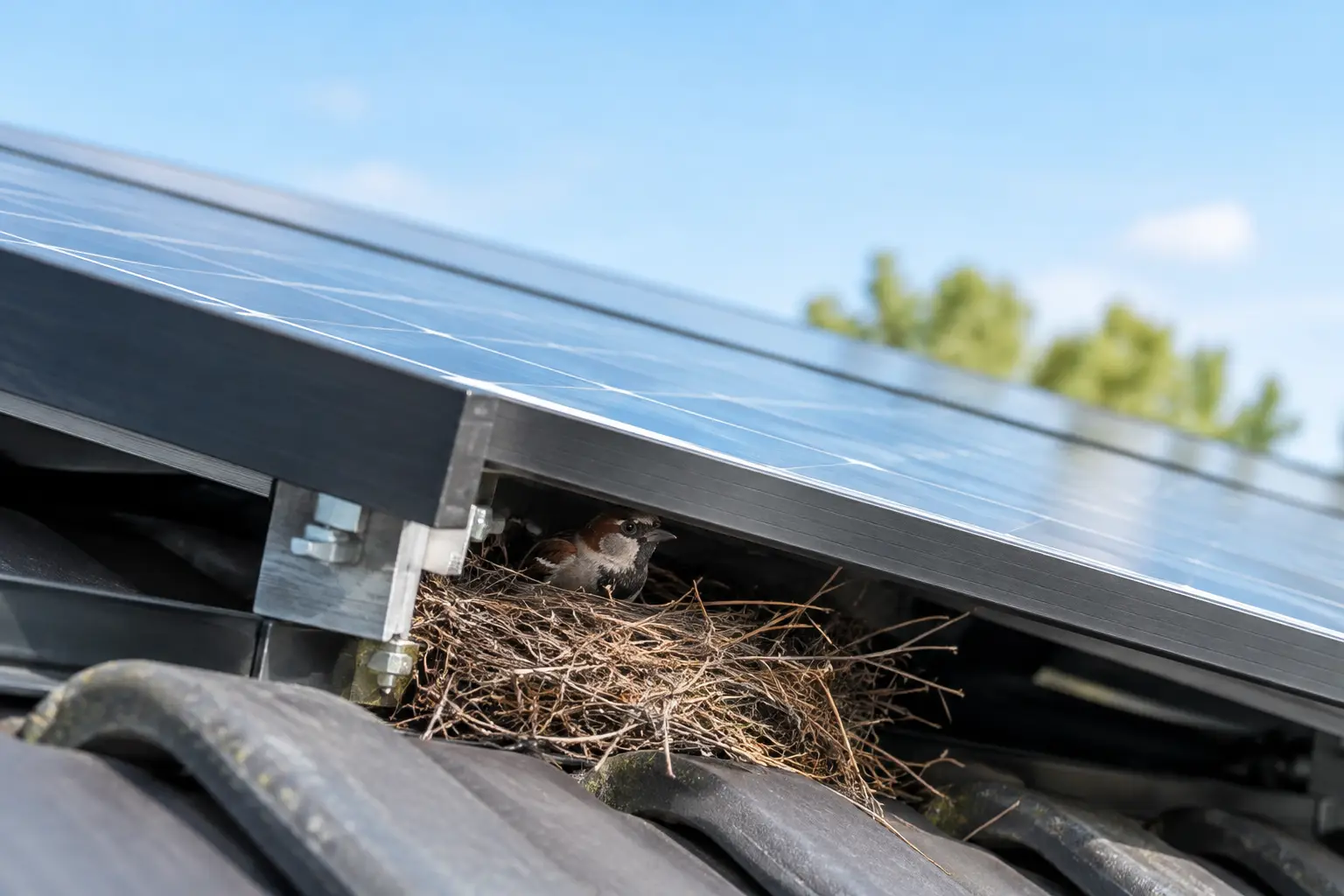
Solar panels with birds nesting underneath
Do you hear scratching, fluttering, or persistent cooing from your roof? Then solar panels with birds nesting underneath could be more than just an annoying sound. Birds seek out the sheltered space between the roof and the panels as a safe spot away from rain, wind, and predators. While it seems harmless, nests, droppings, and loose nesting material can affect the operation and lifespan of your installation.
Acting quickly prevents a small problem from growing into yield loss, damaged cabling, or difficult cleaning. The right approach starts with an inspection: you want to know where the birds are, what they have damaged, and which solution fits your roof.
Why nesting under solar panels causes problems
Solar panels are designed for free ventilation. The space under the panels allows heat to escape and water to drain correctly. When birds stay there for long periods, they fill that space with twigs, leaves, feathers, and other material. Pigeons, in particular, like to make use of this shelter.
That material traps moisture and dirt. Rain doesn’t always wash it away, while wind can blow it further under the panels. The result is a dirtier roof zone that is difficult to reach. Furthermore, droppings can end up on the edges of the panels and run across the glass when it rains. This limits light penetration and can therefore reduce your energy yield.
The greatest risk is often out of sight. Birds can peck at cables or pile nesting material around cabling and connectors. Not every bit of damage causes an immediate failure. A cable with compromised insulation can go unnoticed for months until moisture, an error message, or production loss makes it clear that something is wrong.
With larger installations, multiple nesting sites can spread quickly. This increases not only the risk of contamination and damage but also the cost and duration of a later intervention. Prevention is generally simpler and more cost-effective than repairing after birds have already established themselves.
Recognizing solar panels with nesting underneath
You don’t have to climb onto the roof to have a suspicion. Recurring scratching early in the morning, pigeons repeatedly disappearing into the same spot under the panels, and twigs on the ground are clear signs. A noticeable amount of droppings on the gutter, facade, or under the installation also often points to activity under the panels.
A declining yield can also be an indication, but is not proof in itself. Lower production can also be caused by shade, dirt, an inverter problem, or a technical fault. That is why it is wise to compare yield data against normal seasonal patterns. With professional monitoring, you can see more quickly when an installation deviates from its expected performance. This allows you to look for the cause specifically instead of guessing.
Also check if there are any notifications on your inverter. A warning doesn’t automatically mean birds are the cause, but it does require a check. Don’t wait until a small signal becomes a prolonged downtime.
What you should not do yourself
Do not try to reach under the panels, move cables, or loosen panels yourself. From the ground, you cannot see how the cabling is laid out, and you risk damaging the installation or your roof. Furthermore, working at height carries a risk of falling.
Additionally, nesting requires a careful approach. Birds, eggs, and active nests may be protected. The rules and permitted interventions vary by species, period, and region. A specialist first assesses the situation and plans the work in a responsible manner. Installing bird proofing while an active nest is present is not always possible or permitted.
The consequences for efficiency and safety
A nest under your panels doesn’t automatically mean every panel produces less. However, it is a risk you should not underestimate. Droppings on the panel glass cause localized shading. Even a limited shaded area can affect the yield of an entire panel or a string of panels, depending on the design of your installation.
In addition, ventilation under the panels can decrease when nesting material piles up. Solar panels perform less effectively when they get too hot. The effect varies per roof, orientation, and amount of material, but free air circulation remains essential for stable performance.
The gutter also deserves attention. Twigs, feathers, and droppings can end up in the gutter via the roof edge. A clogged drain causes water problems during heavy rain that are separate from the solar panels but are caused by the nesting. An inspection should therefore include not only the visible panel surface but also the zone underneath and around it.
The safety of the electrical installation is a second reason to intervene in time. Damaged cables, loose connectors, or moisture around electrical components require a technical check. A visual check from a distance is not sufficient for this. A professional checks the mounting, cable routing, and any signs of damage without unnecessarily dismantling parts.
How to tackle the problem sustainably
A good solution consists of more than just removing a nest. If the openings under the panels remain accessible, birds often return. The approach is therefore best carried out in three steps: inspect, clean or repair where necessary, and then block access.
First, it is determined which birds are present and whether an intervention is possible at that time. Then, a technician removes loose material and checks the panels, cabling, mountings, and roof zone. If there are signs of damage, a targeted repair follows. This prevents a hidden defect from lingering.
Only then does bird proofing really make sense. Usually, a fine-mesh, durable barrier is placed around the perimeter of the panels. This blocks access under the installation without piercing the panels or unnecessarily restricting ventilation. The implementation must suit the type of roof and mounting system. A solution that is too coarse or poorly secured will still let birds in or may come loose in the wind.
Avoid temporary measures that only move the problem. Loose nets, tape, repellents, and DIY closures are often not resistant to the elements. They can trap dirt, cause noise, or make access for a later technical check difficult. Choose a solution that respects the roof, the panels, and accessibility.
After the intervention: monitoring keeps your yield up to par
After removing nesting material, monitoring remains useful. The yield can recover once dirt is removed and any technical problems are resolved, but this depends on the condition of the installation. If a lot of droppings have been left on the panels, a professional cleaning may be advisable. This is done using materials and methods that respect the glass, coating, and cabling.
Also have the production monitored in the weeks following the intervention. A normal yield curve provides reassurance that your installation is performing as expected again. If efficiency remains low, further technical investigation is needed. Monitoring makes that difference visible and reduces the chance that loss goes unnoticed for months.
Preventive maintenance bundles these checks into one clear approach. During a maintenance visit, technicians can not only identify dirt or early nesting but also detect loose cables, wear, error messages, and problems with the inverter. This extends the lifespan of your installation and limits unexpected downtime.
When is the best time to call for help?
Take action as soon as you repeatedly see or hear birds under your panels. Certainly do not wait until cables are visibly hanging, droppings are piling up, or the yield drops significantly. The earlier the inspection takes place, the more limited the intervention usually remains.
At Solar Assistance, certified technicians look at your installation as a whole: the panels, the cabling, the roof zone, and the production. You get a clear explanation of what is needed, without unnecessary interventions. For notifications and technical problems, a quick response is essential so you are not left in uncertainty for long.
A roof without birds under the panels is not a minor detail. It protects your installation against dirt and damage, keeps the yield at a better level, and above all, provides peace of mind. Therefore, have any suspicion checked in time, so that your solar panels continue to do what you invested in them for: producing reliable energy.