


Solar panel roof inspection: prevent loss of yield
For many owners, a solar panel roof inspection only seems necessary when something visibly goes wrong. A loose cable, a leak, or a panel that looks dirty. However, most problems arise much earlier and out of sight. Minor damage to the cabling, a shifted roof hook, or early corrosion can unnoticedly reduce your yield. Those who have inspections carried out in time prevent downtime and protect their investment.
Solar panels require little maintenance, but they do operate every day under varying conditions. Wind, rain, heat, frost, and dirt put a strain not only on the panels but also on the support structure, cables, and connections on your roof. A targeted check gives you certainty about the safety and yield of your installation.
Why a solar panel roof inspection pays off
Your solar panels produce electricity as long as all components work well together. One weak link can affect the performance of an entire string. That is a series of panels that are electrically connected to each other. If one connection becomes defective or a panel performs less well, you don’t always notice it immediately on your inverter.
An inspection makes such deviations visible before they lead to a malfunction, loss of yield, or damage to your roof. This is especially relevant for installations that have been in place for several years, after a storm, or for a home with many trees, birds, or shade.
You are not just investing in a technical check, but also in peace of mind. You know whether your installation is securely fastened, whether water is being drained correctly, and whether there are signs of wear. For owners who cannot or do not want to go onto the roof themselves, this is the most reliable way to monitor the condition of their installation.
What is checked during a solar panel roof inspection?
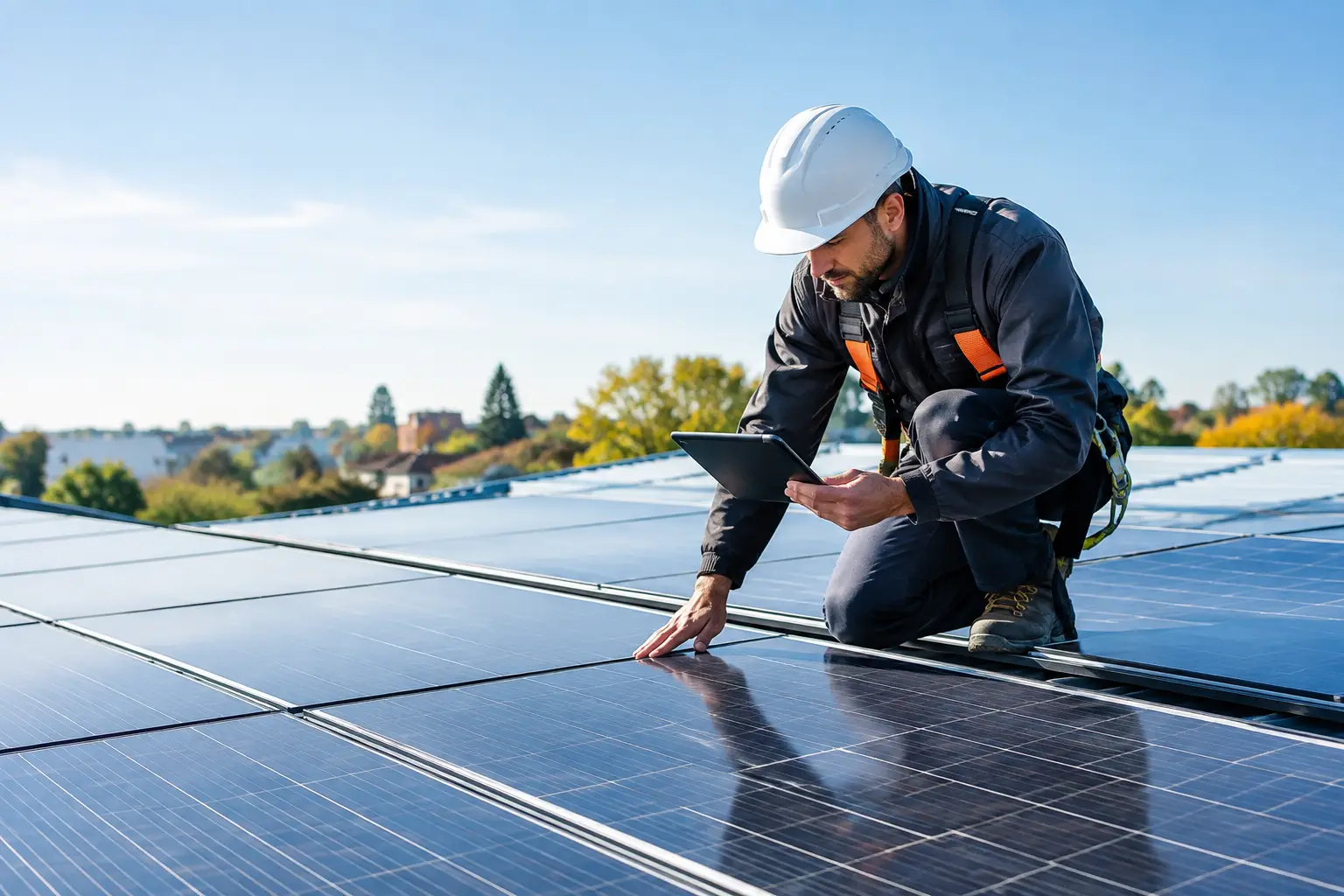
A professional inspection goes further than just looking at the panels from the ground. The technician checks the installation as a whole and assesses what is needed to keep the energy yield safe and stable.
This includes looking at:
- the fastening of panels, rails, clamps, and roof anchors;
- cables, plugs, and connections for wear, damage, or loose parts;
- the condition of panels, including cracks, discoloration, and visible damage;
- potential leaks, damaged roof tiles, and vulnerable penetrations;
- dirt, moss growth, leaf accumulation, and nesting under the panels;
- signs of shading or components that limit yield.
Not every finding requires an immediate repair. Sometimes it is enough to secure a loose part or remove dirt. For other problems, faster intervention is wise, for example, when a cable’s insulation is damaged or a roof penetration no longer seals properly. A good inspection report makes it clear what is urgent, what you should plan for, and what you should simply continue to monitor.
When is the best time to have your installation checked?
There is no fixed rule that applies to every roof. The correct frequency depends on the age of your installation, the location of your home, and the conditions on the roof. As a guideline, a visual and technical check every few years is wise. For commercial installations or roofs with a higher risk, an annual check is often more appropriate.
After extreme weather conditions, an extra check is not an unnecessary luxury. Think of heavy wind gusts, hail, heavy snow, or storm damage in the area. Also, when your production is suddenly lower than in the same period last year, it makes sense to look at more than just the weather. Fewer sun hours could be an explanation, but a technical problem or dirt could just as easily be a factor.
Also pay attention to signals you can see yourself. Loose panels, cables that are visibly hanging, birds under the installation, damp patches in the attic, or an error message on the inverter deserve quick follow-up. Waiting until the installation fails completely often costs more in yield and can make the repair more complex.
Loss of yield is not always visible
A working inverter does not automatically mean that your solar panels are performing at their maximum. The installation can continue to produce electricity while part of the yield is lost. This happens, for example, with beginning corrosion in a connector, localized dirt, or a panel that is functioning less effectively.
That is why monitoring your production is so valuable. With monitoring, you can see more quickly if your installation deviates from the expected pattern. You don’t have to compare figures yourself every day. A deviation can be investigated specifically, so that a small problem does not become a long-term loss of yield.
A roof inspection and monitoring complement each other well. Monitoring tells you that something might be changing in performance. The inspection helps to find the cause on the roof. This way, you work preventively instead of only reacting when the yield has been disappointing for months.
The roof deserves as much attention as the panels
Solar panels stay on a roof for decades. The quality of the installation is therefore at least as important as the condition of the panel itself. Roof anchors, rails, and penetrations must be resistant to load and weather influences. When components weaken due to age, wind, or movement, this can have consequences for the installation and for your roofing.
For a pitched roof, the inspection includes the roof tiles around the fixings. For a flat roof, ballast, load-bearing capacity, and water drainage play a larger role. If water remains standing around the installation, it increases the chance of wear to the roofing. The correct approach therefore differs per roof type.
Birds can also cause problems. Nests and leaves under the panels retain moisture, limit ventilation, and make maintenance more difficult. In some cases, birds gnaw on cables. Bird protection prevents them from nesting under your installation and helps to limit damage and dirt.
What happens if a problem is found?
An inspection only has value if you know what the next step is. With a good assessment, you get a clear picture of the findings, the potential impact, and the recommended action. You don’t need to know technical terms to understand what is going on.
Some issues can be resolved immediately, such as a loose cable or a small adjustment to the fastening. For other work, a follow-up intervention may be necessary. Think of replacing damaged connectors, repairing a roof penetration, or addressing a defective panel. An experienced service partner looks not only at the malfunction but also at the cause. This prevents the same problem from returning quickly.
Solar Assistance has been working on the yield and continuity of existing solar installations since 2012. With its own technical service, national coverage in Belgium, and 24/7 monitoring, a deviation can be followed up quickly. For technical questions or malfunctions, you usually receive a response within 48 hours, so you are not left in uncertainty for unnecessarily long.
Combine inspection with preventive maintenance
An inspection is a strong starting point, but works best as part of a broader maintenance approach. Cleaning can, for example, be useful when dust, pollen, leaves, or bird droppings visibly cover the panels. Not every panel needs to be cleaned annually. The location and the degree of pollution determine whether the effect on yield is large enough.
Preventive maintenance also helps to notice small defects before they disrupt your production. This is particularly interesting if your installer is no longer active, if you are not receiving clear follow-up, or if you simply want one point of contact for your solar installation. You maintain an overview, prevent surprises, and extend the lifespan of important components.
For companies, this approach is even more important. An installation on a warehouse, farm, or office building often represents a larger production capacity. Every day with an unnoticed defect means missed yield. Regular inspection, monitoring, and clear reporting make maintenance plannable and limit unwanted downtime.
Choose certainty on your roof
You don’t have to wait for an error message, storm damage, or a noticeably low energy bill. A timely roof inspection gives you clarity about the technical condition of your solar panels and the roof they are on. This allows you to intervene specifically when necessary, without unnecessary work or surprising costs.
Those who have their installation monitored choose maximum energy yield with minimum worries. Therefore, have your roof and solar panels checked at a time of your choosing, not just when a small defect becomes a bigger problem.