


Guide to Insurance Claims for Solar Panels
A branch on the roof, a burnt-out inverter, or panels that suddenly produce much less after hail: damage to solar panels requires a fast, well-thought-out approach. With this guide to solar panel insurance claims, you will know which steps to take immediately, what evidence you need, and how to prevent a minor incident from leading to long-term loss of yield.
Damage is rarely just about a visibly broken panel. Cables, connectors, the inverter, the mounting structure, and the indoor wiring can also be affected. If your installation continues to work partially, a malfunction might only be noticed weeks later through lower production. Acting quickly therefore protects not only your insurance claim but also your yield.
Safety First, Then Limit Damage
Do not touch damaged panels, loose cables, or the inverter. Especially after a storm, water ingress, lightning, or fire, there may still be voltage on the installation. Do you see smoke, hear crackling, or smell burning? Only switch off the installation if it is safe to do so and contact emergency services in case of acute danger.
Next, document the situation without going onto the roof. Take overview photos of the roof and detailed photos of visible damage. Also photograph the inverter, error messages on the screen, and any damage to the meter cupboard. Note the date and time, and save reports of storms, hail, or lightning strikes in your area.
Do not attempt to temporarily repair the damage yourself with tape, foil, or loose cable connections. An incorrectly executed temporary solution can increase the risk and cause disputes regarding the original damage. Have a technician assess what needs to be secured.
Check What Your Policy Actually Covers
In many cases, solar panels are covered by your home insurance because they are permanently attached to the building. This does not automatically mean that every cause and every component is insured in the same way. The exact coverage depends on your policy, the chosen guarantees, and any exclusions.
Specifically check if damage from storms, hail, snow pressure, fire, water damage, and lightning is included. Also look at the coverage for electrical damage. This is relevant when an inverter or other electrical component fails after a power surge, for example, due to lightning in the vicinity.
Additionally, pay attention to three points. First, the deductible: what amount do you pay yourself? Next, the compensation method: does the insurer reimburse repair, replacement, or the current value? Finally, consequential damage. Loss of production due to downtime is often not standardly covered in a private policy. For businesses, this difference can be even greater, as a production installation is part of business continuity.
If you are unsure about your coverage, ask your insurer specifically whether the solar panels, inverter, optimizers, battery, and charging station are listed separately. This prevents you from assuming protection that is not in your contract.
Report the Damage Quickly and Factually
Report the damage as soon as possible to your insurer or broker. Describe what you have observed, but do not draw technical conclusions if you cannot support them. “Two panels are cracked after hail” is clearer than “the entire installation is defective” when that has not yet been investigated.
Immediately send your photos, the purchase invoice if available, and details of your installation. Think of the number of panels, brand and type of the inverter, year of installation, and the capacity of the system. Do you have a previous inspection, maintenance report, or completion document? Include those as well. They show how the installation was configured and maintained before the damage occurred.
Ask if the insurer will appoint their own expert and if you are already allowed to have repairs carried out. Emergency measures to prevent further damage are often necessary, but make clear agreements beforehand. Keep all communication, quotes, and invoices in one file.
Technical Assessment Makes the Difference
Visible damage doesn’t always tell the whole story. A panel may appear intact after a hailstorm, while internal cell fractures later cause reduced yield. Moisture in connectors, damaged cable insulation, and an inverter with surge damage also require a targeted check.
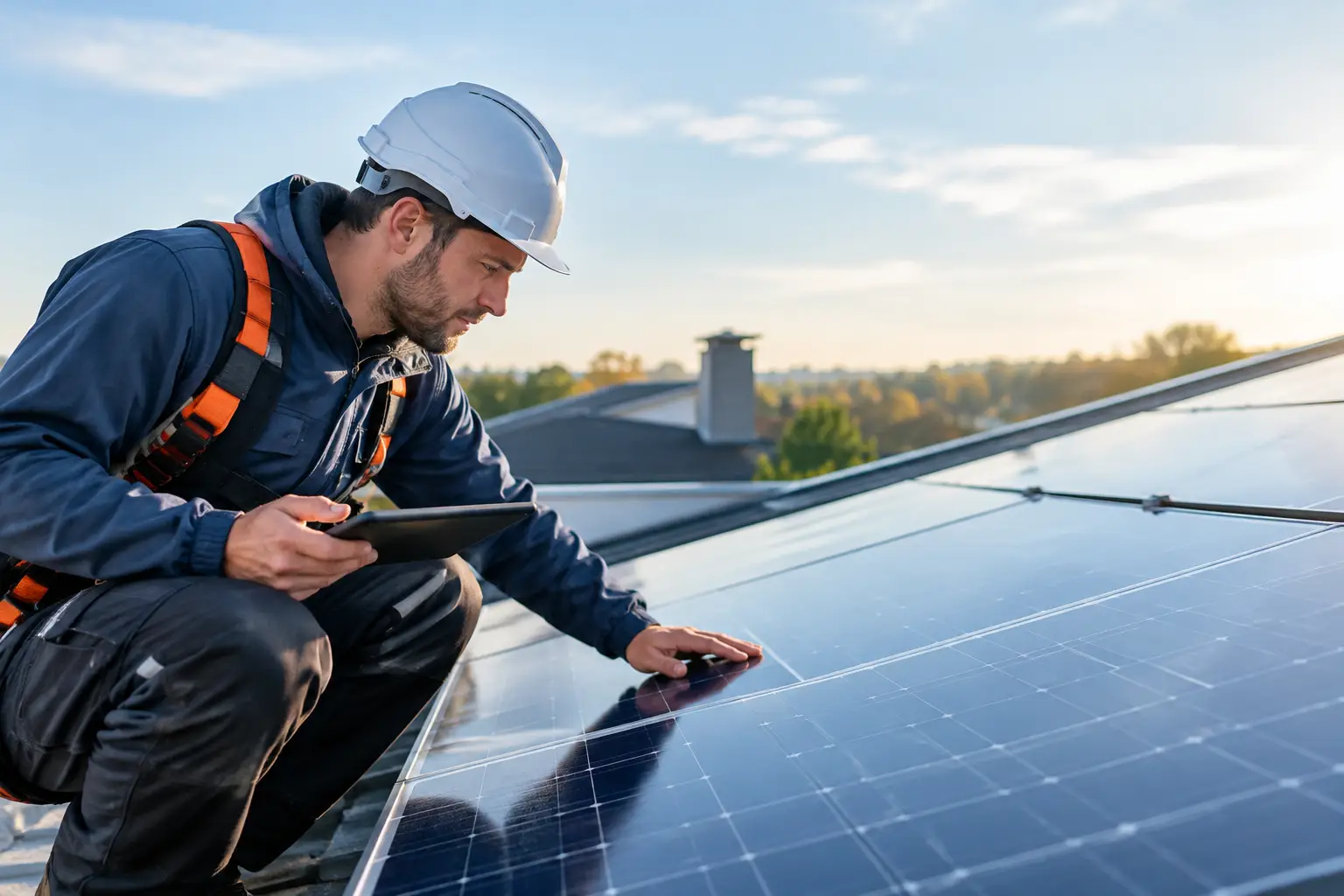
A technical inspection maps out the full impact. During this, a technician checks the panels, mounting points, cabling, grounding, protections, and inverter error messages, among other things. Where necessary, production data is reviewed. A sudden drop compared to similar days or years can be an important signal.
This investigation provides more than just a list of defective parts. You get clarity on what needs to be repaired immediately, which parts can safely continue to function, and whether there are hidden risks. This helps with the claims process and prevents a second intervention because the first repair was too limited.
With older installations, one-to-one replacement is not always possible. A certain panel type or inverter may no longer be available. You then have to weigh whether to replace a specific part, choose a compatible solution, or perform a larger technical adjustment. The cheapest choice in the short term is not always the best choice for yield and lifespan.
Gather Evidence of Your Loss of Yield
For a private insurance claim, the emphasis is usually on material damage. However, it is wise to also secure your production data. Download the data from your monitoring platform before settings are changed or an inverter is replaced. Take screenshots of error messages, production drops, and periods when the installation was completely down.
Don’t just compare with the production of one sunny day. Look at the same period in previous years, taking weather and season into account. Don’t have historical data? Then a technical analysis can help estimate the expected production level.
Good monitoring is also valuable after the repair. It confirms whether the installation is producing as expected again. An installation that starts up after a damage event but structurally underperforms deserves further investigation. This prevents an unnoticed problem from costing yield for months.
Repairing with an Eye for Continuity
After the claim is approved, speed is important, but quality remains paramount. A repair must make your installation safe, stable, and correctly functioning again. Therefore, ask not only when the work can start, but also what checks will be performed afterward.
A proper repair involves more than just installing a new part. The technician checks if the new components are compatible with the existing installation and tests the operation under load. In the case of roof damage, the waterproofing and mounting must also be in order again. Especially after storm damage, a check of the mounting structure is not an unnecessary luxury.
After the intervention, have it documented what was replaced, which measurements were performed, and what warranty applies to the work. This gives you a clear file for your insurer and a starting point for future maintenance.
Prevent the Next Insurance Claim from Becoming Larger
Not all damage can be avoided. You have no control over hail and lightning. However, you can limit the chance of failure, consequential damage, and long downtime. Regular inspection helps to spot loose mountings, outdated connectors, early corrosion, and damaged cabling early on.
Dirt, leaves, and bird debris also deserve attention. They not only cause lower yields but can also hold moisture and exacerbate local heat problems. Furthermore, a panel that underperforms over a long period is harder to notice when you have no insight into the daily production.
For many owners, the best reassurance is a combination of periodic checks and active monitoring of the yield. In case of a deviation, you can then intervene faster, before a small technical problem grows into a long downtime or a complex insurance claim.
A damage event is annoying, but it doesn’t have to remain a blow to your investment. Ensure you have a complete file, have the installation technically assessed, and actively monitor the yield after repair. This way, you restore not only the visible damage but also the certainty that your solar panels are doing what you installed them for: producing reliable energy, year after year.