


How to detect string failure in solar panels
An inverter that simply shows a green light does not automatically mean all solar panels are producing. With string failure, part of your installation stops working while the rest continues to supply power. Those who want to know how to detect string failure in solar panels must therefore look beyond the total daily yield. A quick check prevents a defect from costing you returns for weeks or months unnoticed.
What is string failure in solar panels?
Solar panels are usually connected to each other in groups. Such a group is called a string. The panels in one string together supply direct current to the inverter, which converts it into usable alternating current for your home or business.
In the event of string failure, one entire group of panels fails or that group performs significantly worse. This can happen due to a loose connector, a cable problem, a defective panel, a fault in the inverter, or damage from weather and animals. The other string can continue to work in the meantime. As a result, your installation may appear to be producing normally at first glance, but your yield will decrease.
The larger the installation, the more difficult it often is to detect issues without monitoring. With two identical strings, the failure of a single string can nearly halve your production. With multiple strings, the loss is less obvious, but remains financially significant.
Recognizing the first signs of string failure
A noticeably low yield is usually the first sign. Do not just compare it with a sunny day from last year. Also look at days with similar weather, the same period of the year, and the expected production in your monitoring app. A lower yield can, of course, also be caused by clouds, shadow, dirt, or high temperatures. With string failure, the drop is often clearer and more constant.
Do you have access to data per string or per MPPT input of the inverter? Then you can see differences between the groups more quickly. An MPPT is the input the inverter uses to determine the best operating point of a string. Two strings with roughly the same orientation and the same number of panels should generally give fairly similar values on a clear day. A string that delivers zero watts or remains structurally much lower deserves investigation.
Error messages also provide direction. Think of messages about insulation, grid voltage, DC faults, earth leaks, or an input voltage that is too low. Write down the exact error code and take a photo of the screen if necessary. Do not just clear a message before you know the cause. The information can help a technician intervene faster and more effectively.
Furthermore, pay attention to a production curve that suddenly changes. Normally, the yield increases gradually in the morning, reaches a peak around noon, and then decreases again. With a failed string, that curve often remains noticeably lower than expected on sunny days. A malfunction that occurs at the same time every day can also indicate shadow or a temperature-sensitive problem.
Detecting string failure: start with data, not the roof
The safest first step is to view the production data. Check if the inverter is online and if your app shows current data. Then look at the daily, monthly, and annual yield. A drop on a single day says little. A deviation that persists over several similar days is much more relevant.
Also compare your installation with its own history. Did you produce 20 kWh on a clear day in April last year and now you don’t exceed 11 kWh without a clear reason? Then a technical inspection is wise. Do not blindly compare with the neighbors’ installation. Orientation, tilt angle, shadow, power, and age of the panels often differ.
In systems with multiple string inputs, you can sometimes see voltage and current per input in the portal. The combination of both values is important. No current can mean that a string is interrupted. A deviating voltage can indicate a connector, cable, panel, or protection problem. These values must be assessed in context. Not every inverter shows them, and on a dark day, conclusions are less reliable.
Good monitoring of solar panels makes this process much easier, but you don’t have to be able to read all the graphs yourself. The most important thing is that deviations are noticed quickly, before small production losses have a major impact.
What you can safely check yourself
You can already collect a lot of information without any technical actions. First, check if any new shadow has been created. A grown tree, an antenna, a dormer, leaves, or an object on the roof can affect part of a string. Look from the ground or a window to see if panels are visibly damaged, heavily soiled, or covered.
Also check the inverter. Is a red fault light on? Do you hear unusual noises? Is the inverter off, or do you see an error code? Note the date, time, weather, and the values you see in the app. This data helps with a technical diagnosis.
Do not open any DC connectors and do not disconnect any cables. Solar panels continue to produce voltage in daylight, even when the inverter is switched off. An incorrect action can be dangerous and cause damage. Also, do not go onto the roof yourself for an inspection, especially in wet or windy conditions or on a steep roof.
Soiling usually causes a gradual drop in yield and not sudden full string failure. However, a heavily soiled installation can cloud the assessment. If dirt, bird droppings, or moss visibly block a lot of light, professional cleaning of solar panels can help to properly assess the actual efficiency again.
Common causes of a failed string
An interruption in the cabling or a loose contact is a common cause. Connectors can wear out after years, connect poorly, or cause problems due to moisture. Rodent damage also occurs, especially when birds nest under the panels or when cables are accessible.
In addition, a single defective panel can affect the operation of an entire string. Think of internal damage, a defective bypass diode, or damage due to moisture. Not every piece of damage is visible from the outside. Therefore, measuring at the right points is necessary to accurately locate the fault.
The cause can also lie in the inverter. A defective input, a protection that is triggered, or an insulation fault can cause a string not to be processed. Sometimes the string itself is fine, but the configuration or communication of the system is the problem.
Finally, age plays a role. Cables, connectors, and inverters do not all have the same lifespan. Preventive maintenance on solar panels reduces the chance that wear and tear only becomes visible when the yield has already dropped significantly.
When should you call in a technician?
Call in technical help as soon as a string gives zero production, an error message recurs, or you see a clear drop in yield over several suitable days. Do not wait until the next annual bill. You won’t get missed production back, and a small problem can worsen due to moisture, heat, or corrosion.
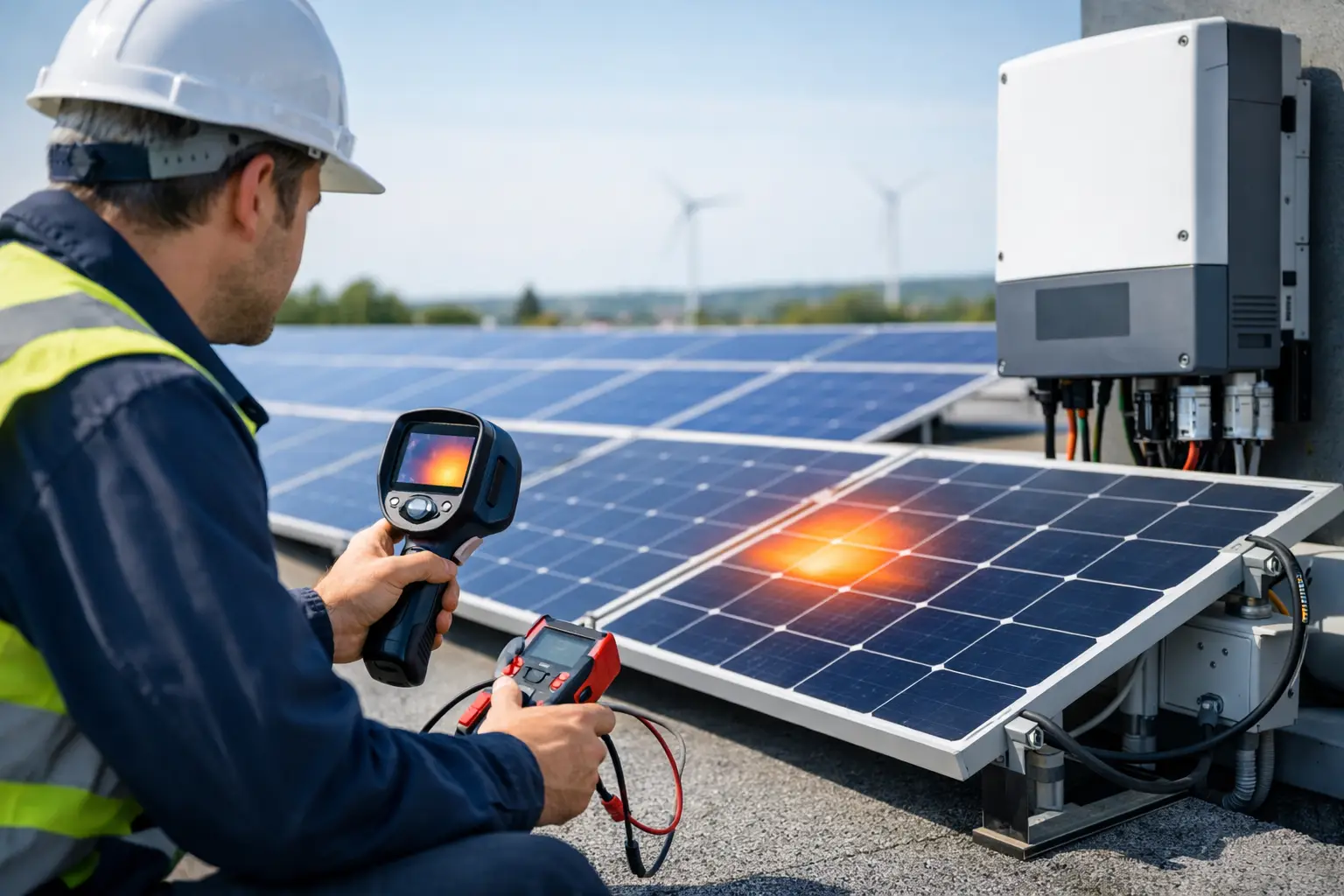
A technician checks the installation step by step. First, the monitoring data, error codes, and inverter settings are assessed. Then, measurements can be taken to see if each string is delivering the correct voltage and current. If necessary, an inspection of cables, connectors, panels, and protections follows. This not only confirms that there is string failure, but also where the defect is located.
That distinction is important. Replacing a panel while the actual cause is a damaged cable solves nothing. Conversely, there is no point in only repairing a connector if a panel is internally defective. Targeted diagnosis limits downtime and prevents unnecessary costs.
In the event of an acute malfunction, you can count on technical assistance for solar panels. Solar Assistance works with its own technicians and focuses on a fast, transparent solution. You will get clarity on the cause, the necessary repair, and the expected impact on your return.
How to prevent string failure from going unnoticed for long
The best protection is a combination of monitoring, periodic inspection, and rapid follow-up of deviations. Check your app regularly, but do not rely solely on a total figure. During a maintenance visit, also have the cabling, mountings, connectors, and the condition of the inverter checked.
Do you regularly suffer from birds under your panels? Address that problem in a timely manner. Nests, dirt, and damage to cables can affect the reliability of your installation. Preventive measures are often cheaper than a repair after a long-term failure.
Your solar panels should not just sit on the roof, but also perform reliably year after year. Do you see an unexplained drop or an error message that recurs? Collect the data and have the installation checked in a targeted manner. This protects your yield, extends the lifespan of your system, and keeps worries to a minimum.