


Most common solar panel defects
An inverter that suddenly fails, a string that underperforms, or panels that look fine but still yield too little – you often only notice the most common solar panel defects when the yield has already been lower for weeks or months. That is exactly what is tricky about solar installations: many problems are not immediately visible, but they do cost efficiency.
Those who have solar panels rightly expect them to work worry-free for years. In practice, this depends on more than just the quality of the panels. Cabling, inverters, connectors, mounting, soiling, and monitoring also play a role. Furthermore, a defect does not necessarily mean complete failure. Sometimes your installation is still running, but clearly below its normal level. And that is precisely where a lot of yield is lost.
The most common solar panel defects in practice
In residential installations, we often see the same types of problems recurring. Not because solar panels are unreliable, but because an installation consists of multiple components that must all continue to work together correctly.
Inverter problems occur most frequently
The inverter is the heart of your installation. It converts the generated direct current into usable alternating current. If the inverter stops, your entire production usually stops as well. But complete failure is not the only problem. An inverter can also give error codes, temporarily shut down due to grid voltage problems, or work less efficiently due to age or internal wear.
For many owners, this is the first defect that really stands out because the impact is significant. At the same time, it is also a component with a more limited lifespan than the panels themselves. Panels often last 25 years or longer. An inverter usually does not reach that without replacement or repair.
Poor connectors and loose cabling
An installation is exposed to heat, cold, moisture, and wind for years. Connectors and cable connections must be able to handle all of that. If a connection is poorly mounted, comes loose over time, or becomes corroded, it can lead to power loss, malfunctions, or in serious cases, safety risks.
This type of defect is treacherous. You cannot see it from the ground. Yet, a single poor connection can affect an entire string. As a result, some of your panels yield less, while the rest seem to be working normally.
Microcracks and damaged panels
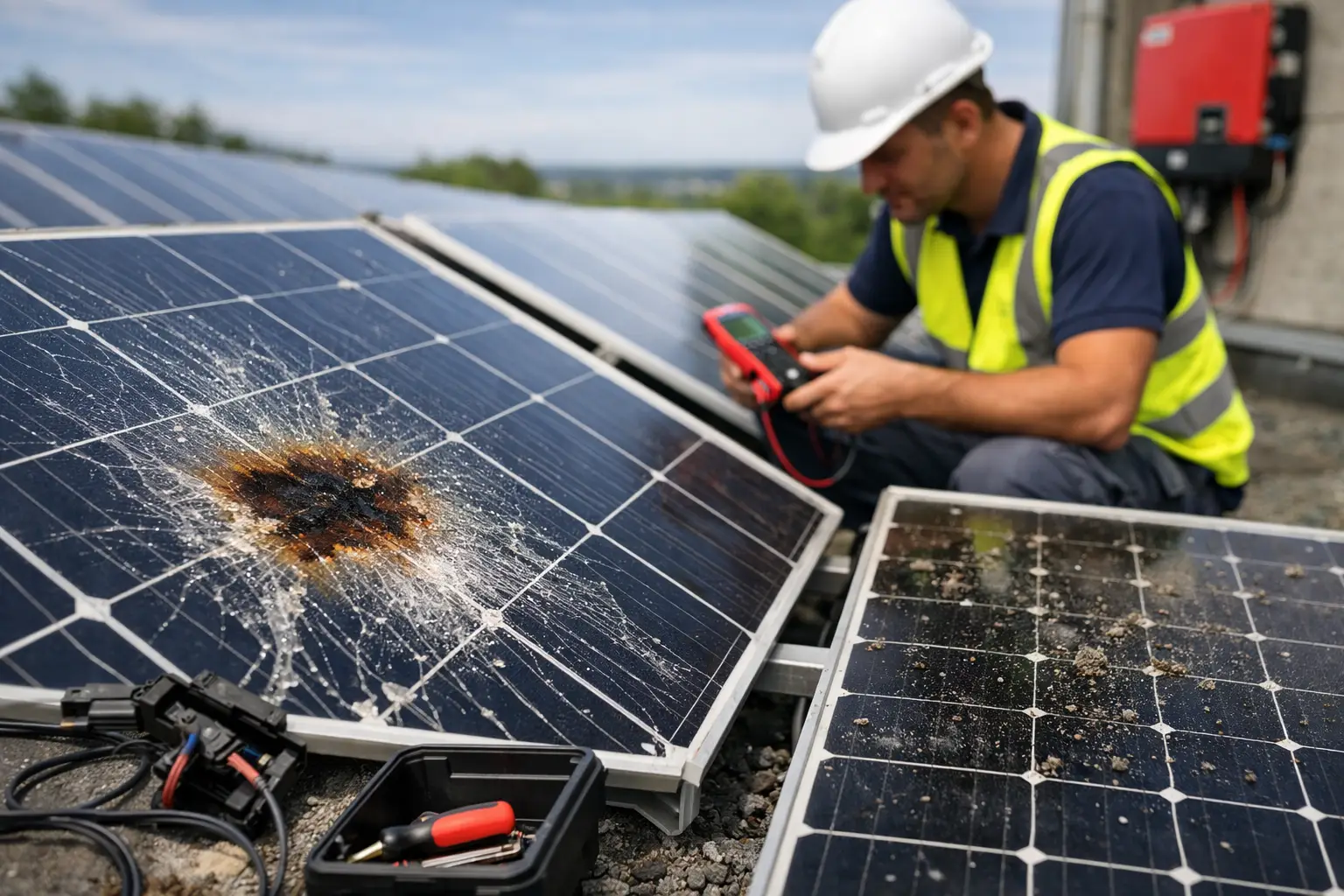
Not every piece of damage to a solar panel is immediately visible. Small cracks in the solar cells, also known as microcracks, can occur due to transport, mounting, pressure loads, or age. They do not always lead to immediate failure, but they do lead to gradual loss of yield.
Sometimes there is also visible damage, for example from a storm, falling branches, or an impact on the glass. In that case, a quick inspection is important. A damaged panel does not always continue to function safely or profitably.
Hotspots and local overheating
A hotspot occurs when one part of a panel becomes warmer than the rest. This can be caused by cell damage, soiling, shading, or an internal defect. Such an overheated zone reduces the panel’s performance and can accelerate the shortening of its lifespan.
You don’t notice hotspots with the naked eye. They are usually identified through thermographic inspection or targeted technical checks. That is precisely why they often stay under the radar for too long.
Problems with optimizers or monitoring
In installations with optimizers, a defect in one optimizer can disrupt the operation of an individual panel. This is local in itself, but if you don’t notice it, part of your installation will continue to underperform. Monitoring itself can also provide incorrect or incomplete data, causing a malfunction to come to light later than necessary.
Good follow-up makes a big difference here. With proper solar panel monitoring, you can see more quickly when production deviates from the expected level. This provides peace of mind and limits downtime.
Not every defect causes complete failure
This is an important point. Many owners only think of a problem when the installation stops producing altogether. In reality, partial defects are at least as relevant. A string that yields 20% less, an inverter that resets regularly, or a panel that structurally lags behind: these are malfunctions that increase your electricity bill without immediately triggering an alarm.
Especially in installations without active monitoring, this remains unnoticed for a long time. You might still see production on the display or in the app, so everything seems fine. But without comparison to historical performance, weather conditions, and string behavior, you quickly miss hidden losses.
What causes these defects?
There is rarely a single cause. It is often a combination of aging, mounting quality, external loads, and a lack of inspection. An installation that is technically well-installed can still develop problems due to weather influences, soiling, or voltage fluctuations on the grid.
In older installations, wear and tear also play a role. Seals, connectors, and electronic components age. This is normal. The main question is how quickly you detect deviations and whether you intervene before a small problem becomes larger.
Soiling also deserves attention. Dirt, dust, moss, leaves, and bird droppings are not always a defect in themselves, but they can lead to hotspots, shading, and lower yields. Regular solar panel cleaning helps to limit these risks, especially on roofs where dirt builds up quickly.
How do you recognize a defect without being a technical expert?
You don’t have to be a technician to pick up on signals. A noticeably lower yield than last year, error messages on the inverter, an app that no longer shows data, or an electricity bill that rises while your consumption remains the same are all reasons to have your installation checked.
Audible signals can also tell you something. An inverter that sounds different, restarts frequently, or feels warm deserves attention. The same applies to visible soiling, loose cables, or nests under the panels. Birds don’t just cause a nuisance; they can also damage cabling and disrupt air circulation under the panels. In such situations, bird protection can be a practical preventive measure.
What does delay cost?
The biggest misconception is that a small defect does little harm. But every day with lower production is lost efficiency. With limited deviations, it might not seem dramatic at first glance. Over months or years, however, it adds up, especially now that owners are increasingly relying on their own production.
Additionally, a small technical problem can spread. A poor connector won’t fix itself. An inverter with recurring error codes usually doesn’t repair itself either. The longer you wait, the greater the chance of additional damage, longer downtime, and higher intervention costs.
For those who want certainty, preventive solar panel maintenance is therefore not an unnecessary luxury. It is a way to protect yield and avoid surprises.
When is a repair sufficient and when is it not?
This depends on the defect, the age of the installation, and the expected additional yield after the intervention. A loose connector, faulty cabling, or a defective optimizer can often be resolved in a targeted manner. In the case of a worn-out inverter or recurring malfunctions in older components, replacement may be wiser.
Panels aren’t black and white either. Sometimes you can easily replace a single damaged panel. But with older installations, compatibility comes into play. Not every new panel fits technically or aesthetically with an existing setup. In that case, a broader analysis is more useful than just swapping one part.
A good diagnosis prevents you from spending money on treating symptoms. That is why technical assistance for solar panels is especially valuable when you not only want to resolve a malfunction but also want to know why it occurred and how to prevent it from happening again.
Prevention is usually cheaper than production loss
The best way to limit defects is not to wait until something goes wrong. Regular inspection, monitoring, and maintenance ensure that deviations surface more quickly. This provides not only more yield but also more peace of mind.
For individual owners, this primarily means not having to guess for themselves whether everything is still working well. For professional owners, it is even more about continuity and less downtime. In both cases, the principle is the same. A solar installation performs best when it is actively monitored.
This doesn’t have to be complicated. A periodic visual inspection, analysis of yield data, and targeted technical checks on critical components are often enough to spot problems early. Especially for installations where the original installer is no longer reachable, an independent service partner is often the safest choice.
You can’t always prevent the most common solar panel defects, but you can prevent their impact
No installation is completely free of risk. Electronics age, weather conditions change, and small errors may only become visible after years. What really matters is how quickly you intervene as soon as performance deviates.
Solar Assistance sees that many owners only seek help after the yield has been lower for some time. It’s a shame, because quick detection is precisely what makes the difference between a minor correction and long-term loss. If you have solar panels, you primarily want them to do what they are supposed to do: perform stably, year after year, with as few worries as possible. Peace of mind doesn’t start with the purchase, but with good follow-up.