


Why is my solar yield decreasing?
You often don’t notice it in a single day. But if your production is lower for months than it used to be, the question naturally arises: why is my solar yield decreasing? This is no minor detail. Lower yield means a longer payback period, less certainty, and the risk that a technical problem remains unnoticed for too long.
A lower solar yield isn’t always an immediate defect. Sometimes the explanation is perfectly normal, such as seasonal differences or warmer weather. In other cases, a decrease does point to dirt, wear and tear, shading, or an issue with the inverter. The difference lies in the size of the drop, how suddenly it occurs, and whether your installation otherwise remains stable.
Why does my solar yield sometimes decrease naturally?
Solar panels do not produce the same amount every month. In spring and summer, the yield is usually higher than in autumn and winter. This is due to longer days, more solar radiation, and a more favorable sun position. If you compare a month in November with a month in June, the decrease seems large, while it may be perfectly normal.
Temperature also plays a role. This sounds contradictory, but solar panels do not work better just because it is very hot. They actually perform slightly more efficiently in clear weather and moderate temperatures. On hot summer days, the efficiency can therefore be a bit lower than you might expect.
That is why it is best not to look at just one sunny or weak day. What matters is the trend over several weeks or the same period compared to previous years. Especially with older installations, it pays to make that comparison systematically through good monitoring of your solar panels.
The most common causes of lower yield
In practice, we see that a drop in yield can usually be traced back to a limited number of causes. Some are harmless. Others require quick action to avoid further loss.
Dirt on the panels
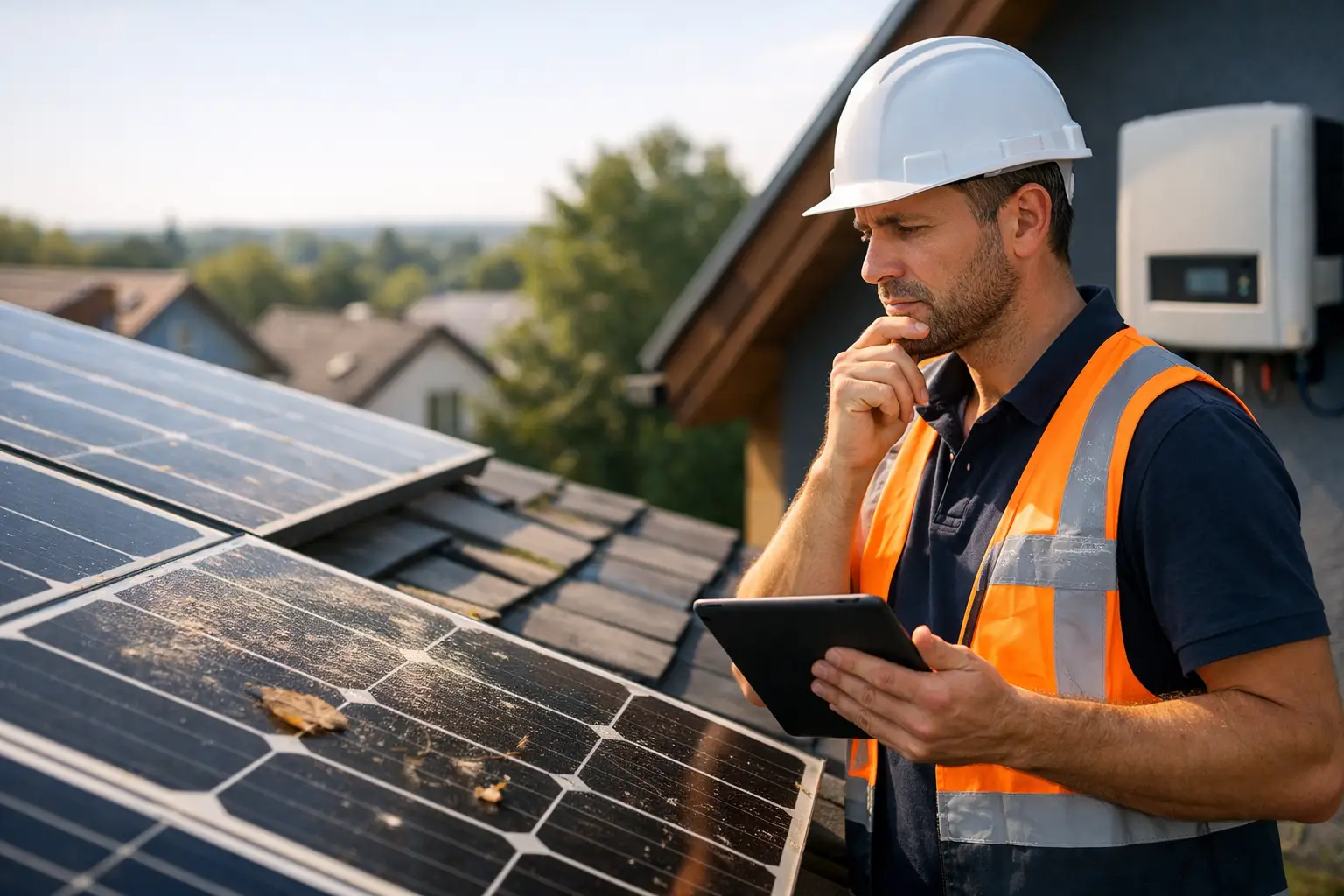
Dust, fine sand, leaves, moss, pollen, and bird droppings can block incoming sunlight. This effect is often greater than owners think. Especially with panels with a low tilt, on agricultural buildings, in urban environments, or in places with many trees, the loss accumulates faster.
Not every panel gets equally dirty. This creates local differences in production. A small dirty section can affect the efficiency of an entire panel. Professional cleaning of solar panels helps not only for a cleaner roof, but above all for a more stable and higher yield.
New shading
A tree that has grown, a neighbor’s dormer, a new antenna, or even leaves piling up on one corner: shading is a common cause of production loss. Because solar panels work together in series, limited shading on one panel can have a larger effect on the entire string.
Shading is deceptive because the problem is not always constantly present. It might only occur in the morning, in a certain season, or when the sun is low. As a result, it is less noticeable without detailed measurements.
Problems with the inverter
The inverter is the heart of your installation. If it displays error codes, fails, or works less effectively, you will see it almost immediately in the production. Sometimes it involves a complete standstill. Sometimes the installation still runs, but with losses.
For older installations, this is an important point of attention. Inverters simply do not have the same lifespan as the panels. If your installer is no longer reachable, you want clarity and a solution quickly. In that case, technical assistance for solar panels is not a luxury, but a way to limit downtime.
Aging and wear
Solar panels slowly lose a small part of their power over the years. This is normal. Most panels degrade gradually, often at a limited rate per year. Such a slow decline is therefore not an immediate cause for concern.
What is not normal is a sudden or sharp drop. Then there may be more going on, such as damaged connectors, wear on cabling, moisture ingress, or a panel that has become internally defective. Without an inspection, such a problem can sometimes drag on for months.
Loose connections or electrical defects
Not every problem is visible from the ground. An installation can suffer from poor contact, damaged plugs, worn cables, or defective optimizers. Especially for installations that have been exposed to the elements for years, a technical inspection is wise.
These types of defects do not only cause lower yield. They can also pose safety risks. Preventive maintenance on solar panels helps to detect such problems early, before they lead to major damage or longer outages.
Birds under the panels
Pigeons and other birds like to nest under solar panels. This seems harmless, but nests and dirt accumulation can hinder ventilation, damage cables, and cause extra fouling. This too can affect performance over time.
If this is an issue on your roof, having bird protection installed is often a targeted way to prevent recurring problems. Especially for homes where the problem crops up every year, this saves a lot of frustration and unnecessary loss of efficiency.
When is a decrease normal and when is it not?
That depends on the context. A slight deviation compared to last year doesn’t have to mean anything. Weather simply varies from year to year. Also, a short dip during a hot period or in a month with a lot of dust in the air can be temporary.
You should become more alert if the drop comes suddenly, if it persists over several months, or if your monitoring shows irregular patterns. Think of production peaks that disappear, a string that clearly lags behind, or an inverter that shuts down more often. Then it makes sense to look further.
For individual owners, that is often the difficult part. You can see that the figures are lower, but not whether that still falls within the normal margin. For companies, this is even more critical, because every percent of lower yield has a direct impact on ROI and energy costs.
What can you check yourself?
You don’t have to be a technician to make an initial assessment. First, look at your app or inverter screen. Do you see error messages, empty periods, or noticeably lower daily totals than before? Then compare the same month with those of previous years, not with a peak month from the summer.
Also visually check if there is new shading, if there is a lot of dirt on the panels, and if birds are nesting under the installation. If you hear strange noises from the inverter, or if it shuts down regularly, that is a clear signal.
What you should not do is go onto the roof yourself or open electrical components. This involves risks and rarely solves the real cause. A good diagnosis saves time, frustration, and unnecessary loss of yield.
Why monitoring and maintenance make the difference
Many owners only discover a problem with their annual statement or when they happen to look at their app. By then, you may have already lost weeks or months of yield. That is exactly why monitoring and periodic inspections are so important.
With continuous follow-up, you see more quickly when your installation deviates from the normal pattern. This gives peace of mind. You don’t have to check every day yourself and you prevent small problems from becoming big ones.
Maintenance works the same way. It’s not just about cleaning. It’s about continuity, prevention, and being sure that all parts continue to do what they are supposed to do. Especially for installations that have been running for several years, this pays for itself in less downtime and a more stable return.
For those primarily seeking certainty, that is often the biggest gain. Not waiting until something goes wrong, but staying ahead of problems.
Don’t let a drop in yield drag on for too long
If you are wondering why your solar yield is decreasing, the right reaction is not to panic, but also not to keep waiting. A small deviation can be normal. A persistent or sudden drop deserves an inspection. The sooner the cause is clear, the sooner you return to maximum energy yield.
Since 2012, Solar Assistance has been helping owners of existing installations to detect losses, limit downtime, and gain more certainty about the operation of their system. That is often exactly what is needed when your panels yield less than they should.
Your solar panels were installed to provide a return for years. You want to ensure they continue to do so, without surprises and without worries.