



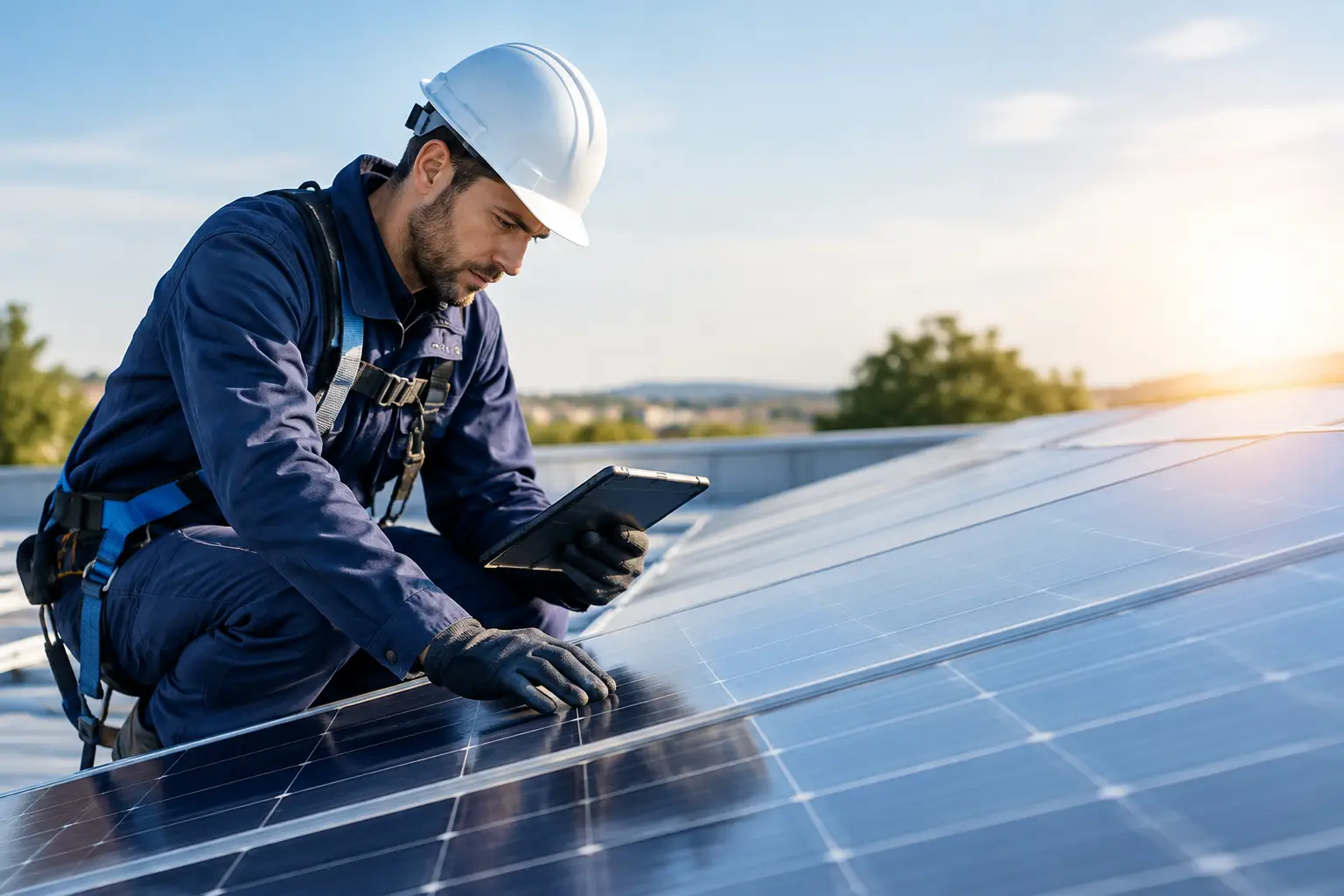
New standards for solar panel inspection explained
An inverter that continues to produce does not automatically mean your installation is still fully in order. The new standards for solar panel inspection place more emphasis on electrical safety, correct documentation, and an installation that continues to operate reliably in the long term. This is relevant for new installations, but also when you expand, repair, or recommission an existing system.
For you as an owner, an inspection is about more than just paperwork. It confirms that your installation is safely connected to the power grid and helps prevent problems that could later cause yield loss, malfunctions, or disputes with your insurer.
What is checked during a solar panel inspection?
A solar panel inspection looks at the entire electrical path, not just the panels on your roof. An accredited inspection body assesses whether the installation complies with the General Regulations on Electrical Installations, known as AREI. During this process, they check the protection devices, cabling, grounding, the inverter, and the connection to the distribution board.
The documentation must also be in order. This includes a single-line diagram, a site diagram, and the technical specifications of the equipment used. These documents may seem secondary, but they make an installation verifiable and safely maintainable later on. A technician must be able to see quickly how the installation is structured, especially during a malfunction or intervention.
Standards for electrical installations evolve regularly. This does not mean that every existing solar panel installation must be fully adapted immediately as soon as a rule changes. The situation depends on the age of the installation, the time of commissioning, and the work you carry out. For an expansion or significant modification, the rules applicable at that time generally apply.
When is an inspection mandatory?
When installing a new solar panel system, a positive inspection is required before the installation officially goes into service. Without a valid inspection report, the connection and administrative processing can cause problems. The report is therefore an essential part of a correct delivery.
A new or additional inspection is also often required for major adjustments. For example, when you install extra panels, replace an inverter with a model with different characteristics, connect a battery, or modify the electrical distribution board. Have the exact nature of the change assessed beforehand. This prevents you from having to carry out unexpected adjustments after the work is completed.
After a negative inspection, you must have the identified issues resolved. A re-inspection is then required. Do not wait too long. A remark about grounding, protection, or cable shielding is not something to ignore, even if the installation appears to be producing normally at first glance.
An existing installation: do you have to renew everything?
Not necessarily. Existing installations do not simply stop working because standards have changed since they were installed. The original installation and the inspection report remain the starting point. However, a recent intervention can reveal that components are outdated, damaged, or no longer safe.
This happens, for example, with brittle cable insulation, moisture in connectors, a distribution board without sufficient space, or an inverter that is no longer working reliably. In such cases, repairing or adapting is not a luxury. It protects your installation and limits the risk of long-term downtime.
New standards for solar panel inspection: where is the emphasis?
Current rules and inspections place a strong emphasis on three things: safe electrical protection, clear identification, and correct technical files. This sounds technical, but the effect is very concrete. Your installation must be able to shut down safely in the event of a fault, emergency services and technicians must know that solar energy is present, and maintenance must be possible without guesswork.
During the inspection, attention is paid to the condition and placement of cables. Cables must not hang loose, be pinched, or rub against sharp edges. Connectors must be correctly coupled and remain protected against moisture and UV radiation. A small defect in the cabling can slowly develop into a malfunction that is difficult to find.
The protection devices in the electrical cabinet also deserve attention. The correct circuit breakers, residual current devices (RCDs), and surge protection must match the installation. Exactly what protection is needed depends on the structure of your installation and the risks at the location. A home with a simple installation requires a different assessment than a commercial roof with multiple inverters and long cable runs.
Grounding is another important point. It helps dissipate dangerous voltages when something goes wrong. Good grounding is not always visible, but it is decisive for your safety and for the correct operation of protection devices.
Why yield and inspection are linked
An inspection is primarily a safety check. However, it also has a clear link to yield. Poor connections, damaged cables, moisture ingress, or a fault in the distribution board can cause interruptions that you may not always notice immediately. Your panels may appear to be fine, while your yield is dropping.
That is why an inspection report is no substitute for monitoring. It shows that the installation met the requirements at a specific moment. It does not tell you if your inverter produces less months later, if one string fails, or if dirt and shade are limiting your yield.
With permanent monitoring, you see deviations faster. This is especially valuable when you don’t check your inverter daily or when you manage multiple installations. A drop in production then becomes a signal you can investigate, rather than a surprise on your annual bill.
For companies, the impact is even higher. Downtime on a large roof can quickly add up, especially when a fault is only discovered after weeks. Preventive checks, clear reporting, and rapid technical assistance keep the installation available and make maintenance predictable.
How to prepare well for an inspection
Good preparation prevents delays and extra costs. First, collect the available documents for your installation. The previous inspection report, diagrams, manuals, and inverter data are useful. Do you no longer have these because your installer is no longer active? Then a technical inspection can help map out the current state and reconstruct missing information.
Next, ensure that the electrical cabinet and the inverter are easily accessible. An inspector must be able to work safely and examine all relevant components. Also, check for any visible damage to cables, switches, or the inverter. Always report previous faults in advance, even if they seem to have temporarily disappeared.
Have small defects resolved before the inspection. Think of missing labels, a loose cable, or a cabinet that does not close properly. These are not details. Correct marking makes it immediately clear to any technician where the installation can be switched off and which circuits may be live.
Choose an inspection before planning an expansion
Do you want to install extra panels, a home battery, or a new inverter? Then have your existing installation checked first. The new components must match the capacity of your connection, the condition of your cabinet, and the existing cabling. An expansion without a prior check can lead to unexpected adjustments or a negative inspection.
An independent service partner looks not only at what is technically possible. The expected yield, the remaining lifespan of existing components, and practical accessibility also play a role. Sometimes a targeted repair is sufficient. Sometimes it is wiser to replace an outdated component in time to avoid future downtime.
What do you do in case of a negative inspection report?
Read the remarks one by one and have them translated into clear actions. Some points are administrative, such as a missing diagram. Others require a technical intervention, for example, an adjustment to the protection, grounding, or cabling. Always ask exactly what needs to be done and have the work performed documented.
Do not opt for a quick fix just to pass a re-inspection. A correct repair must also be durable. This means quality materials, neat cable routing, and a solution that does not make maintenance more difficult later. This way, you protect not only your inspection but also your production capacity.
Solar Assistance helps owners of existing solar panel installations with inspections, repairs, maintenance, and monitoring. Especially when the original installer has disappeared, having a single technical point of contact provides peace of mind. You know who to call if a remark, malfunction, or falling yield occurs.
The best preparation for new rules is therefore not to wait until a problem arises. Keep your installation documentable, technically well-maintained, and actively monitored. Then an inspection remains what it should be: a confirmation that you are producing safely, with as little worry and as much yield as possible.