



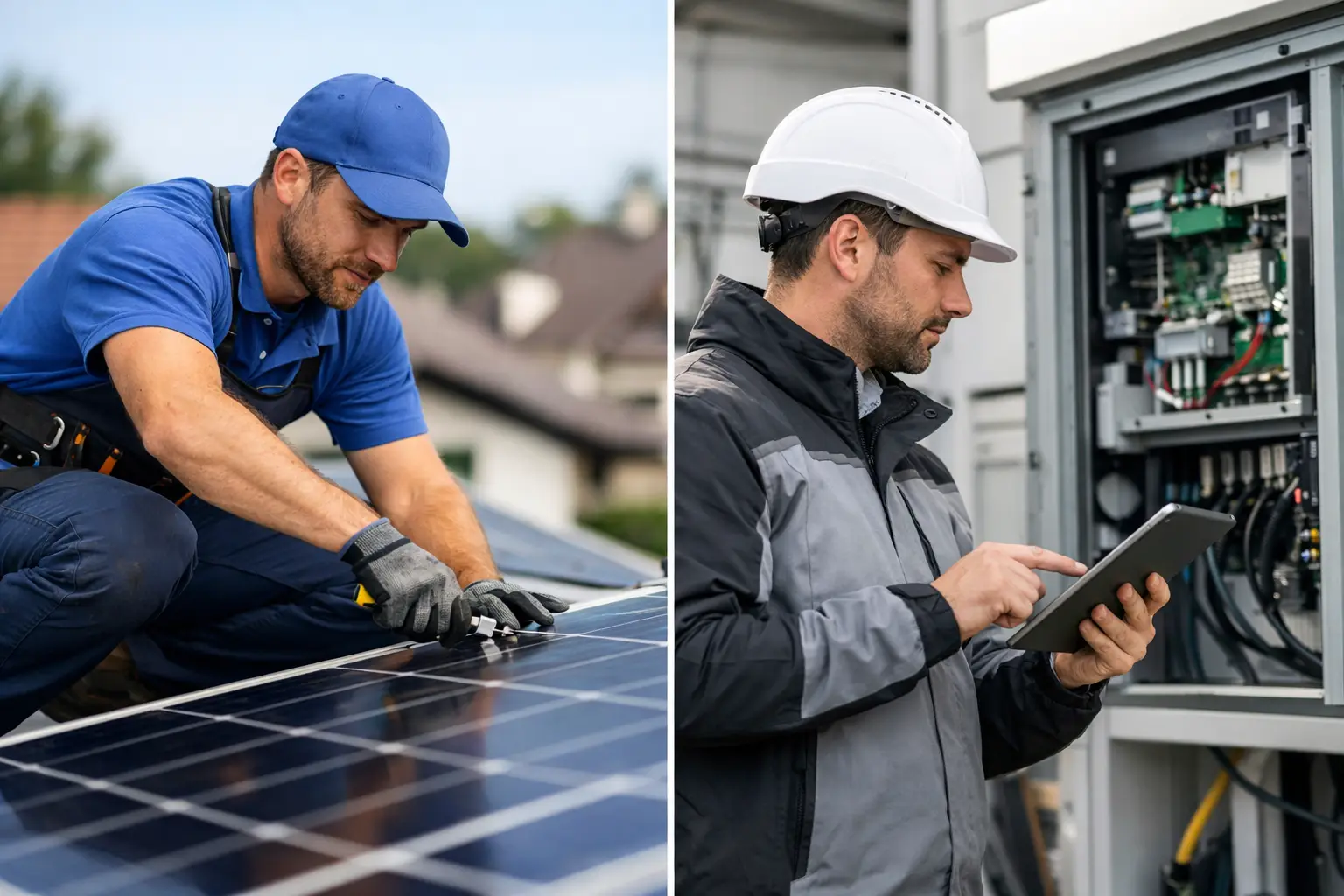
Local installer or independent service partner?
Your inverter shows a fault, the yield remains unexpectedly low, or your installer no longer responds. That is when the choice between a local installer or independent service partner suddenly becomes very concrete. You aren’t looking for a technical story, but for quick clarity: is your solar installation working as it should, what is going on, and who will fix it?
The right choice depends on your situation. A local installer can be strong when installing a new system or for a clear request within the original warranty. An independent service partner focuses on the entire lifespan of your installation: monitoring performance, preventing problems, and intervening when necessary. That difference determines how much worry your solar panels cause you.
What does a local installer typically do?
A local installer usually sells and installs solar panels, inverters, and home batteries. For a recent installation, they are often your first point of contact. The installer knows the chosen materials, the execution on your roof, and the agreements made. Especially in the case of a mounting error or a problem covered by the installation warranty, this prior knowledge is valuable.
The reality changes once the installation has been running for a few years. Many installers focus primarily on new projects. Service and maintenance then fall outside the daily schedule. Some companies have limited capacity for faults. Others have stopped, been taken over, or are no longer active in solar panels. You are then left with an installation that should be producing power, but without a clear point of contact.
Even a good local installer cannot always handle all brands, older systems, or complex faults immediately. Therefore, ask in advance not only who will install your system, but also who will continue to follow it up for the next ten, fifteen, or twenty years.
When does an independent service partner offer more security?
An independent service partner does not necessarily sell a new system. The focus is on what is already on your roof, carport, or commercial building. That makes the interest clear: your installation must continue to perform, regardless of the brand of the panels or the original installer.
This is especially useful if your installer is no longer reachable, if you receive insufficient explanation about a recurring fault, or if you want to have your production checked. A service partner does not just look at the inverter’s error message. They also investigate whether panels are dirty, cabling has damage, connectors are properly connected, and if the monitoring is providing reliable data.
For a company, this independent view is even more important. One faulty inverter or a series of panels performing less well can go unnoticed for a long time. The result is lower yield and potential loss of production, while the installation is simply present on paper. With professional operational management, you gain insight into performance, deviations, and performed interventions.
Monitoring makes downtime visible
Solar panels do not produce the same amount every day. Clouds, seasons, and shade play a role. That is why you don’t always notice a technical problem on your energy bill. Without follow-up, a defect can persist for weeks or months.
With monitoring, production is checked regularly. A deviation can indicate a communication problem, an inverter fault, a string failure, or a lower yield than expected. Monitoring is no guarantee that every problem automatically disappears, but it does ensure that a problem is identified faster. This limits unnecessary downtime and gives you more control over your investment.
Ask a service partner how alerts are assessed. An automatic warning without technical follow-up provides less security than a service where someone analyzes the cause and, if necessary, schedules an intervention.
Maintenance prevents small problems with big consequences
Preventive maintenance is not about unnecessary visits. It is intended to find defects before they affect your yield, safety, or warranty conditions. An inspection can, for example, reveal loose connections, wear and tear, early damage, or dirt accumulation.
Cleaning can be useful when dirt, moss, dust, pollen, or bird droppings hinder production. This does not automatically apply to every roof and every panel. A reliable partner first assesses the situation and does not advise a standard treatment without reason. In case of stubborn dirt or many birds, bird protection can help to limit dirt and damage.
Especially for installations with multiple inverters, flat roofs, or difficult-to-reach zones, a fixed maintenance schedule is wise. You won’t have to search for help only when the yield has already dropped.
Local installer or independent service partner: what should you look for?
Look beyond the distance to your home or business. A local partner is nice if they are quickly available, but proximity alone says little about service capacity, technical knowledge, or follow-up. The core question is: who takes responsibility as soon as your installation does not do what it should do?
Always ask how faults are handled. Is there a clear response time, for example within 48 hours? Does the party have its own technicians? Can they also work with other brands? And do you receive a clear report of what was found and performed after an inspection or repair?
Also check what happens outside the warranty period. The original installer may be the best choice as long as they are reachable, have experience with maintenance, and fulfill their service agreements. An independent partner is often more logical if you want a single point of contact that works across brands and permanently monitors your installation.
For larger installations, scalability counts. A facility manager or energy manager benefits from regular reporting, an overview of open actions, and predictable maintenance moments. For individual owners, accessibility, understandable explanations, and quick help are often decisive. The need differs, but the goal remains the same: maximum energy yield with as little worry as possible.
Pay attention to warranty, insurance, and administration
Choosing an independent service partner does not mean your original warranty expires. However, it is wise to first establish which party is responsible for what. Keep invoices, inspection reports, warranty certificates, and installation data. In the event of a defect, this information helps to determine more quickly whether it is a warranty case, wear and tear, or external damage.
Your insurance may also set conditions for maintenance, inspection, or damage assessment. Think of storm damage, fire, faulty inverters, or damage caused by animals. A service partner can help with technical assessments and clear documentation. This makes a case stronger and prevents loss of time when you want to repair quickly.
With older installations, administration is often an underestimated problem. Login details for monitoring are missing, documentation is incomplete, or no one knows exactly which part was installed. An experienced technical service can first map out what is present. Only then can you make an informed decision about repair, replacement of parts, or repowering.
Choose continuity, not just a quick fix
Having a fault resolved is important. Even better is preventing a situation where you only react when your yield has been lagging for weeks. That is why a one-off intervention is not always enough. After a repair, also ask what the cause was, whether it can recur, and what check is needed to reduce that risk.
Solar Assistance has worked exclusively on the efficiency and management of existing solar installations since 2012. With its own technical service, 24-hour monitoring, and experience with more than 10,000 monitored installations, the emphasis is on rapid detection, targeted interventions, and demonstrable performance. This is relevant when you don’t want to search for help again for every new problem.
You don’t have to choose between personal contact and professional follow-up. The best partner combines clear communication with technical decisiveness. So, don’t just choose based on who installed your system at the time, but based on who gives you the certainty today that it will keep producing.