


Best checks for aging solar panel installations
An installation that is ten, fifteen, or twenty years old can still produce electricity perfectly well. However, without the best checks for aging solar panel installations, a decline in efficiency often goes unnoticed until it is too late. The panels may look fine to the naked eye, while an inverter, connection, or dirt has been costing energy for months.
This is exactly why an older installation deserves attention. Not because you need to replace everything immediately, but because targeted checks clarify what is working well, where the risks lie, and which interventions actually deliver a return. This way, you protect your investment and prevent unnecessary downtime.
Start with yield, not with guesswork
The most important question is simple: is your installation still producing what you should expect? Compare the yield not just to last year, but also to previous years around the same period. Take into account the weather, shade from grown trees, and changes to the roof or the surrounding environment.
A limited deviation is normal. A sudden or gradual decline without a clear explanation deserves investigation. Especially when the yield of an old installation drops year after year, there may be more at play than just less sun. A single defective panel, a weak string, or an inverter that frequently shuts down can sometimes have a bigger impact than you think.
Do you lack reliable yield data? Then that is an immediate point of attention. Without a history, it is difficult to determine when efficiency starts to drop. Monitoring makes deviations visible before they grow into a major loss. This provides peace of mind, especially if you don’t want to check the inverter yourself every day.
Check the inverter and error messages
The inverter converts the current from your panels into usable electricity. In older installations, this is often the component that requires extra attention first. Regularly check if the display, the app, or the status lights report a malfunction, warning, or unusually low production.
Don’t just look for a complete failure. Short, recurring interruptions are also relevant. For example, an inverter may stop at high temperatures, have issues with grid voltage, or work less efficiently than before. If the message disappears, the problem seems solved. Meanwhile, yield may be lost every time it occurs.
Note error codes with the date and time. This helps a technician find the cause more quickly. Do not reset the inverter repeatedly without knowing why it stops. With an electrical installation, a quick, targeted diagnosis is safer than trying until the error message disappears.
Look at panels, glass, and visible dirt
A visual check from the ground already says a lot. Do you see cracked glass, discoloration, loose panels, or clear damage after a storm or hail? Then have this inspected. Small cracks can let moisture in. This does not always lead to immediate failure, but it can affect the lifespan and safety of the panel.
Dirt also deserves attention. Dust, pollen, leaves, moss, bird droppings, and agricultural dust can locally block light. A thin, even layer usually has less impact than stubborn dirt on individual panels. It is precisely those local spots that can slow down a series of panels.
Never clean with a high-pressure cleaner, aggressive agents, or a hard brush. These can damage glass, seals, and cabling. Professional cleaning is done with suitable equipment, safe work at heights, and attention to the state of the system. It is particularly useful when dirt is visible or when yield is lagging.
Also check for shade that developed later
The environment of your home changes. A tree that was small when the panels were installed may now shade several panels at certain hours. A dormer, new chimney, antenna, or a neighbor’s renovation can also have an effect.
In older systems, shade sometimes has a stronger impact than expected. Depending on the setup, one partially shaded panel can influence the production of other panels in the same string. Therefore, look at the shade at different times and in different seasons. What is not a problem in June may cost yield in the spring and autumn.
Have cables, connectors, and the meter cupboard technically inspected
Cables and connectors are often out of sight. Yet they are crucial for safe and stable operation. Sun, temperature fluctuations, moisture, rodents, and roof movement can affect insulation and connections after years of use.
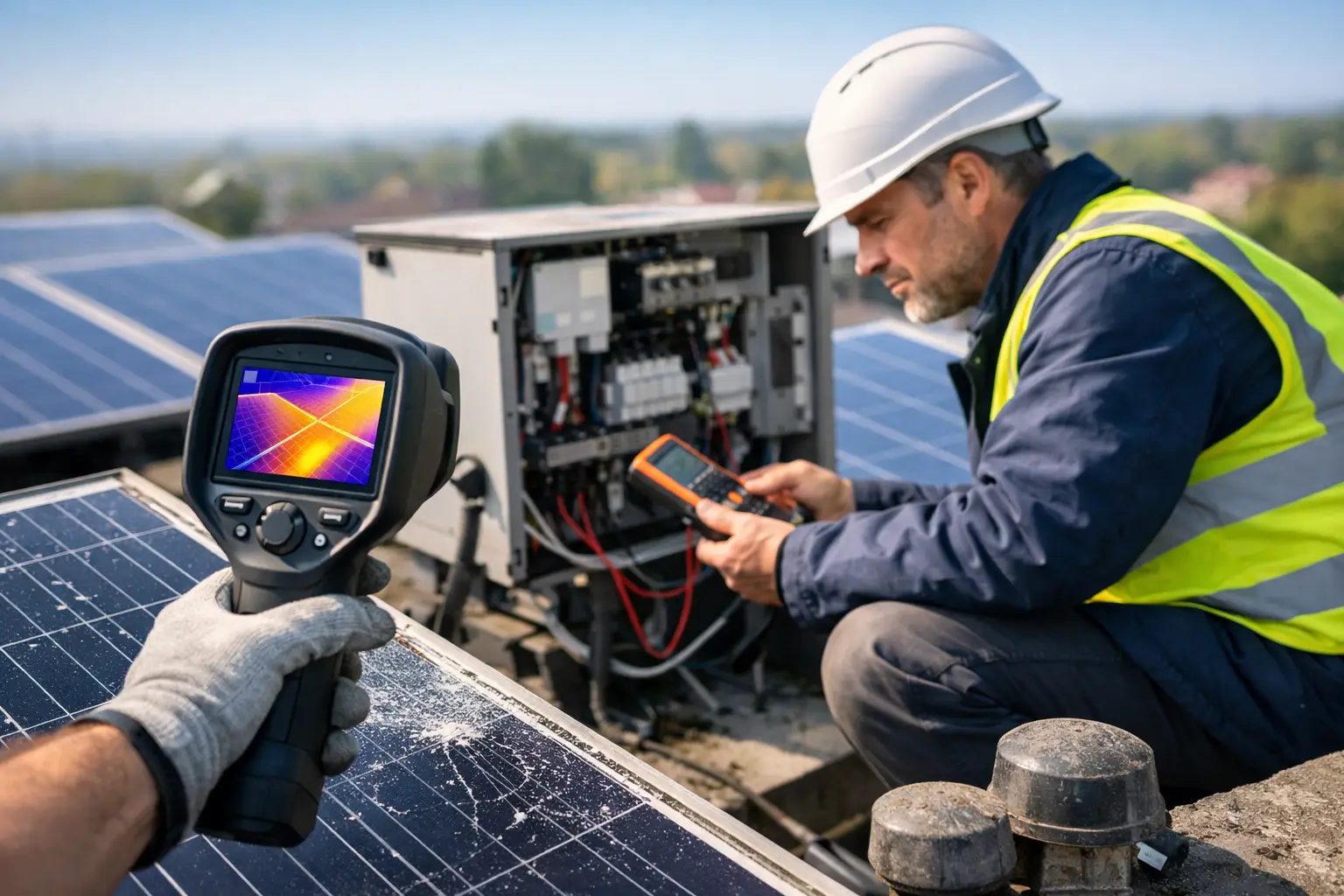
You don’t need to loosen any parts yourself. However, watch for signs such as visible damaged cables, a loose cable duct, discoloration around connections, a burning smell, or an inverter that stops unexpectedly. If in doubt, do not open the installation yourself, but request technical assistance.
A professional technical inspection looks at connectors, grounding, fuses, surge protection, and the condition of the cabling, among other things. This is not just detail work. Poor contacts can generate heat and cause production failure. Early intervention often prevents a major repair.
Check the roof construction and mounting
Solar panels last a long time, but a roof also changes. Wood can warp, tiles can shift, and seals can age. That is why the mounting of the panels is part of the best checks for aging solar panel installations.
From the ground, look for panels that are no longer neatly aligned, visible loose parts, or shifted roof tiles. Do you see damp patches in the attic or under the roof after rain? Do not automatically conclude that the solar panels are the cause, but do have the combination of the roof and mounting materials assessed.
An inspection is particularly wise after a heavy storm, a roof renovation, or when the installation has not received maintenance for a long time. This prevents a small mechanical problem from growing into damage to your roof or installation.
Watch for birds and pests under the panels
The space under solar panels is attractive to pigeons and other birds. Nests, feathers, and droppings cause dirt and can block drainage points. Sometimes animals also damage cables. Do you regularly hear fluttering, see nesting material, or does a lot of debris fall from under the panels? Then do not wait until the yield drops.
Bird protection secures the space under your panels without sealing off the installation with an improvised solution. This prevents recurring dirt and helps keep the installation accessible and safe. Especially with older systems, it is wise to first check if there is already damage or loose cabling present.
Compare the capacity with your current consumption
An old installation can work well technically and yet no longer optimally match your situation. Perhaps your family has grown, you charge an electric car, or you heat partly with a heat pump. Or your consumption has actually decreased and you want to better understand what you use yourself and what you feed back.
Therefore, do not just look at the number of kilowatt-hours produced. Also look at how much of that solar power you use directly. A check of your installation is a good time to verify if the inverter settings, meter data, and any battery still match your current energy profile.
Replacement is not always necessary. Sometimes a repair, a better monitoring setup, or resolving shade and dirt issues is enough. Is an inverter at the end of its lifespan or are some panels clearly less reliable? Then targeted renewal may be wiser than continuing to wait for malfunctions.
Schedule preventive maintenance at the right time
Don’t wait until the inverter flashes red. A periodic check provides insight into safety, performance, and wear before your production fails completely. For an older installation, this is extra valuable, especially if the original installer no longer exists or you don’t have a complete file.
Gather what you still have beforehand: invoices, warranties, inverter data, yield history, and previous error codes. Even without a complete file, a specialist can check a lot, but this information speeds up the diagnosis. Ask for a clear explanation afterwards: what was checked, what is the state of the installation, what action is urgent, and what can wait?
Solar Assistance helps owners of existing installations with inspection, monitoring, maintenance, and targeted repairs. The goal is not to replace parts that are still functioning well, but to prevent yield loss and unexpected downtime as much as possible.
An old solar panel installation does not warrant a panic reaction, but it does deserve attention. By checking now what your installation is actually performing, you prevent a small, silent problem from eating away at your yield for months.