


Guide to inverter maintenance without surprises
Your solar panels may look perfect and yet yield less than expected. Often the cause is not on the roof, but with the inverter. This device converts the direct current from your panels into usable alternating current for your home. In this guide to inverter maintenance, you can read what you can safely check yourself, which signals require action, and when professional help is the best choice.
An inverter works hard every sunny day. Heat, moisture, dust, fluctuations on the grid, and wear and tear affect performance. Those who spot small deviations in time prevent a malfunction from going unnoticed for weeks. This protects your yield, your investment, and above all, your peace of mind.
Why inverter maintenance protects your yield
The inverter is the heart of your solar installation. If it stops, your solar panels produce no usable energy, even if the sun is shining brightly. A short malfunction can be limited to a few hours. Without follow-up, however, a faulty inverter can cause long-term loss of yield.
Maintenance does not mean that a technician has to replace parts every year. It is about targeted checking, cleaning where necessary, comparing performance, and investigating deviations. This way, you discover, for example, a recurring grid error, a loose contact, or a ventilation problem before the device fails completely.
The correct frequency depends on your installation. An inverter in a dry, well-ventilated technical room generally has less to endure than a device in a hot attic, dusty garage, or damp utility room. With older installations, checking is extra valuable, as components become more sensitive to wear over time.
What you can safely check yourself
You don’t have to be a technician to stay alert. Look at your inverter’s display or app a few times a year. Especially check if the status is normal and if the yield feels logical for the season and the weather. Don’t just compare a cloudy day in November with a sunny day in June, but look for clear differences with similar periods.
Also walk past the device. Do you hear an unusually loud humming sound? Do you see an error message, a red warning light, or traces of moisture nearby? Then further investigation is needed. A light operating sound is normal for some types. A new, persistent sound is not always.
Keep the space around the inverter clear. Boxes, coats, or insulation material can obstruct air circulation. Especially in summer, overheating can cause an inverter to temporarily deliver less power or shut down. Never touch electrical connections and do not open the housing yourself. It contains components that can contain dangerous voltage even after switching off.
Finally, check if the ventilation openings are visibly free of dust. You can carefully wipe the outside with a dry, soft cloth. Do not use water, cleaning agents, or compressed air. Compressed air can blow dust deeper into the device and cause damage.
Signals that your inverter needs attention
Some problems are clear, others remain quietly in the background. That is why it is wise not to react only when the display shows an error code. These signals deserve attention:
- The yield is noticeably lower than in a comparable period.
- The inverter regularly shows an error code or frequently switches off and back on.
- The device feels exceptionally warm or the fan runs very loudly for a long time.
- Your monitoring shows hours or days without production while there was sufficient sun.
- There are discolorations, a burning smell, traces of moisture, or visible damage around the device.
An error message does not automatically mean the inverter is defective. Sometimes the grid voltage is temporarily too high, for example, when many solar panels in the neighborhood are feeding back power at the same time. An internet problem can also cause your app to show no data, while the installation is still producing. The difference between a communication problem and a production malfunction is exactly why checking and monitoring are so valuable.
Guide to inverter maintenance: how to handle it
A good maintenance approach starts with insight into performance. Therefore, keep the basic data of your installation: the brand and type of the inverter, the installation number, any warranty documents, and the normal annual yield. This makes a quick diagnosis easier when something changes.
Next, plan a visual check at least annually. Look at the status, error messages, ventilation, and surroundings. Preferably do this in the spring, before the period when your installation produces the most. If you see a deviation then, it can often be resolved before your summer yield is lost.
In addition, have a technical inspection carried out periodically. A certified technician can assess connections, cabling, protections, insulation values, and the operation of the inverter. With an installation with optimizers, battery, or charging station, this check is even more important. The components work together and a malfunction at one point can have consequences for the whole.
For many owners, continuous follow-up is the practical addition to an inspection. With professional monitoring, deviations in production become visible faster. This is useful if you don’t want to look at an app every week or are often away from home. At Solar Assistance, more than 10,000 installations are monitored. This way, a problem can be picked up faster and downtime remains as limited as possible.
When cleaning and maintenance come together
A low yield does not always point to the inverter. Dirt on the panels, shading, bird droppings, faulty cabling, or a problem with an individual panel can have the same effect. Therefore, a technician must first assess the entire installation instead of immediately replacing one component.
Cleaning can be useful when dirt, dust, leaves, or bird droppings are clearly visible and affect the yield. The effect depends on the location, angle of inclination, and surroundings. Panels next to agricultural land, a busy road, or trees often require more attention than panels on an unobstructed roof. However, cleaning does not solve a technical fault in the inverter. A correct diagnosis prevents you from paying for work that does not remove the cause.
Bird protection can also play a preventive role. Birds nesting under the panels can damage cables and cause dirt accumulation. Those who tackle such risks early reduce the chance of malfunctions and unnecessary loss of yield.
What does a technician do during a malfunction?
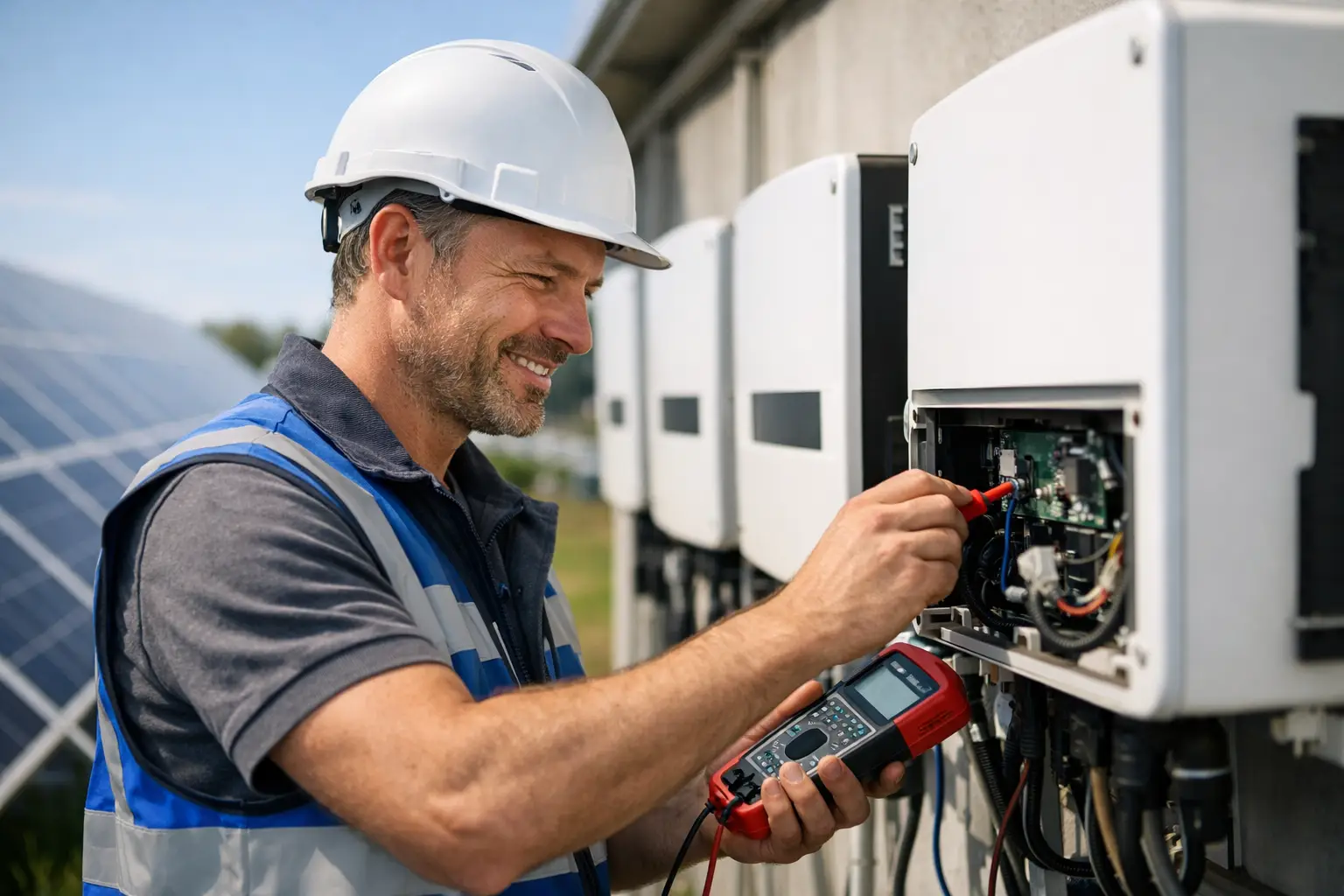
In a technical intervention, a good technician does not start by guessing. He reads error codes, checks the production history, and measures voltages and protections where necessary. Then it is determined whether the problem lies in the inverter itself, in the electricity grid, in the cabling, or with the solar panels.
Sometimes adjusting a setting, repairing a connector, or reconfiguring a communication link is sufficient. In other cases, a repair or replacement of the inverter is necessary. This depends, among other things, on the age of the device, the warranty, the availability of parts, and the cost compared to the expected remaining lifespan.
Replacing an older inverter can be wise, but not every malfunction requires a new device. Therefore, get advice based on measurement data and a clear explanation. Also ask what the impact is on your monitoring, inspection, warranty, and any battery. This way, you make a decision that fits your installation and your consumption profile.
Don’t forget the administration
After a repair or replacement, documents can be important for your insurance, warranty, or grid operator. Keep intervention reports, invoices, serial numbers, and photos of any damage. With a major adjustment, a new inspection or administrative notification may be necessary.
That might sound like extra work, but a complete file saves time when a claim, warranty question, or sale of your home arises later. After an intervention, always ask which documents you should keep and which steps the technician will take care of.
Your installation does not need to demand your attention daily. However, it deserves a fixed check-up moment and quick action as soon as the yield or status deviates. Those who have their inverter monitored preventively maintain more certainty about the operation of the installation and give small problems less chance to become major downtime.