


Manual checks versus professional monitoring
An inverter that still shows a green light does not automatically mean your solar panels are performing at their peak. With manual checks versus professional monitoring, that is exactly where the difference lies: looking yourself every now and then gives an impression, while professional follow-up makes deviations visible quickly. This way, you lose less yield and know sooner when action is required.
For many owners, a problem starts small. A panel delivers less due to dirt, a string partially fails, or the inverter operates below its normal capacity. Without a clear notification, such a malfunction can go unnoticed for weeks or even months. The installation still produces power, but less than it should.
What manual checks do and do not tell you
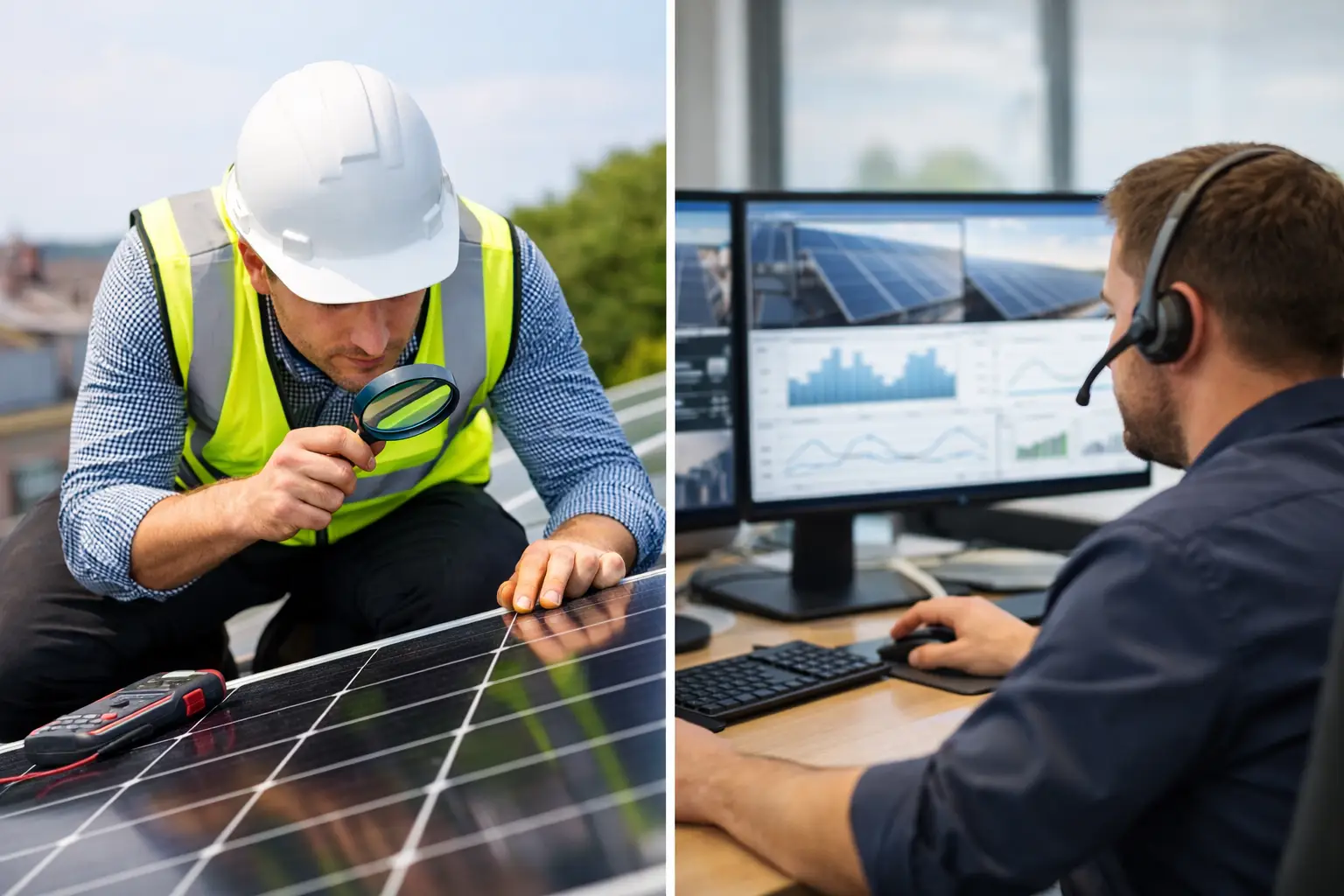
Manual checks usually mean that you regularly check the app or the display of your inverter yourself. You check if the installation is online, how much energy it produced today, and if there is an error message. That is useful. You stay involved with your installation and sometimes notice major problems immediately.
Yet this approach has its limits. The yield of solar panels changes every day due to solar radiation, temperature, shade, and the season. As a result, it is not always easy to see if a lower yield is normal. On a cloudy day, you expect less production. But how do you know if the difference is due to the weather or a technical problem?
Manual checks also require discipline. In practice, you often only look when you happen to think of the app, when your energy bill turns out higher, or when the inverter clearly reports a malfunction. By then, yield may have already been lost.
The most common blind spots
A completely failed inverter is usually noticeable. The more difficult cases are partial malfunctions. Think of one string of panels producing less, a defective optimizer system, a recurring communication error, or an inverter that reduces power on hot days.
Dirt, emerging shade, or bird nests under the panels can also affect efficiency. You don’t always see these causes in a standard app. Regular inspection of the installation, combined with targeted cleaning or bird protection when necessary, helps to limit such yield losses.
Manual checks versus professional monitoring: the practical difference
Professional monitoring does not just look at whether an installation is still producing. It compares production data with what can reasonably be expected at that moment. Factors such as the capacity of the installation, location, historical performance, and weather conditions are all taken into account.
When a deviation is noticed, it can be investigated. That makes the difference between reacting to a visible malfunction and intervening preventatively in a problem that is not yet clearly visible. You don’t have to interpret every graph yourself or compare figures daily.
At Solar Assistance, more than 10,000 installations are monitored. This experience is important because, in practice, malfunctions do not always give a simple error code. Sometimes extra analysis is needed to determine whether it concerns communication, an inverter, cabling, panels, or an external cause.
Professional monitoring also means you have a clear point of contact. If a deviation is identified, a technician can be specifically prepared. This shortens the time between detection and solution. Especially for a commercial installation, where downtime directly impacts the yield, this is a major advantage.
When checking yourself can be sufficient
In some cases, you can follow up on a small, new installation without a complex setup reasonably well yourself. This applies especially if you understand the app, check regularly, and know approximately what production to expect. In the event of a clear error message, you can then quickly call in technical assistance.
But even then, checking yourself remains a snapshot. It mainly tells you what you see at the time you look. It provides less certainty about deviations that develop gradually, only occur at certain times, or disappear before you open the app.
Manual checks are therefore a good supplement, but rarely a complete management plan. For example, look at your production over the longer term monthly, check if the inverter shows error messages, and keep an eye on the area around your panels. Do you see a striking difference compared to previous years? Then do not wait until the problem gets worse.
When professional monitoring is the logical choice
Professional monitoring offers added value especially when yield and continuity are important. This is often the case with larger installations, but not only there. As a private individual, you also want to know if your investment is doing what it should.
These situations are a clear signal that professional follow-up is wise:
- Your installer is no longer active or offers no further service.
- You do not fully understand the data in the inverter app.
- Your production seems lower than before, without a clear explanation.
- You have multiple inverters, optimizers, or a larger installation.
- You want malfunctions to be detected and resolved faster.
- You do not want to be responsible for daily follow-up yourself.
For companies, an extra layer is added. An installation on a warehouse, farm, healthcare location, or commercial roof is often a serious investment. A small deviation that persists for a long time can mean a lot of missed production. Monitoring gives energy managers and facility managers better insight into performance without them having to be technical specialists themselves.
Monitoring works best together with maintenance
Data tells you that something is deviating, but it doesn’t solve the cause by itself. That is why monitoring works best as part of a broader approach. A targeted inspection can, for example, show that cabling is damaged, that panels are heavily soiled, or that an inverter needs replacement.
Preventive maintenance helps to find problems in time. Technicians check, among other things, the condition of inverters, connections, cabling, and visible damage. In the event of malfunctions, prompt technical assistance is then important to limit production losses.
Cleaning also requires nuance. Not every installation has the same cleaning needs at the same time. The location, angle of inclination, environment, and presence of dust, leaves, or bird droppings make a difference. If production data shows a deviation, it can help to determine more specifically whether cleaning or inspection is necessary.
Focus not just on the app, but on your actual yield
The question is therefore not whether you should check manually or outsource everything completely. Looking yourself every now and then remains wise. You see striking notifications faster and stay informed about your installation. But for reliable performance follow-up, an app alone is often not enough.
Professional monitoring adds analysis, continuity, and follow-up. You don’t have to guess whether a poor day is normal, and you are less dependent on the moment you check yourself. This provides peace of mind, but above all, a better chance of maximum energy yield over the full lifespan of your solar panels.
Those who want certainty about the yield therefore look beyond the green light on the inverter. The best check is the check that spots a deviation before it grows into long-term yield loss.