


Correctly interpreting inverter error codes
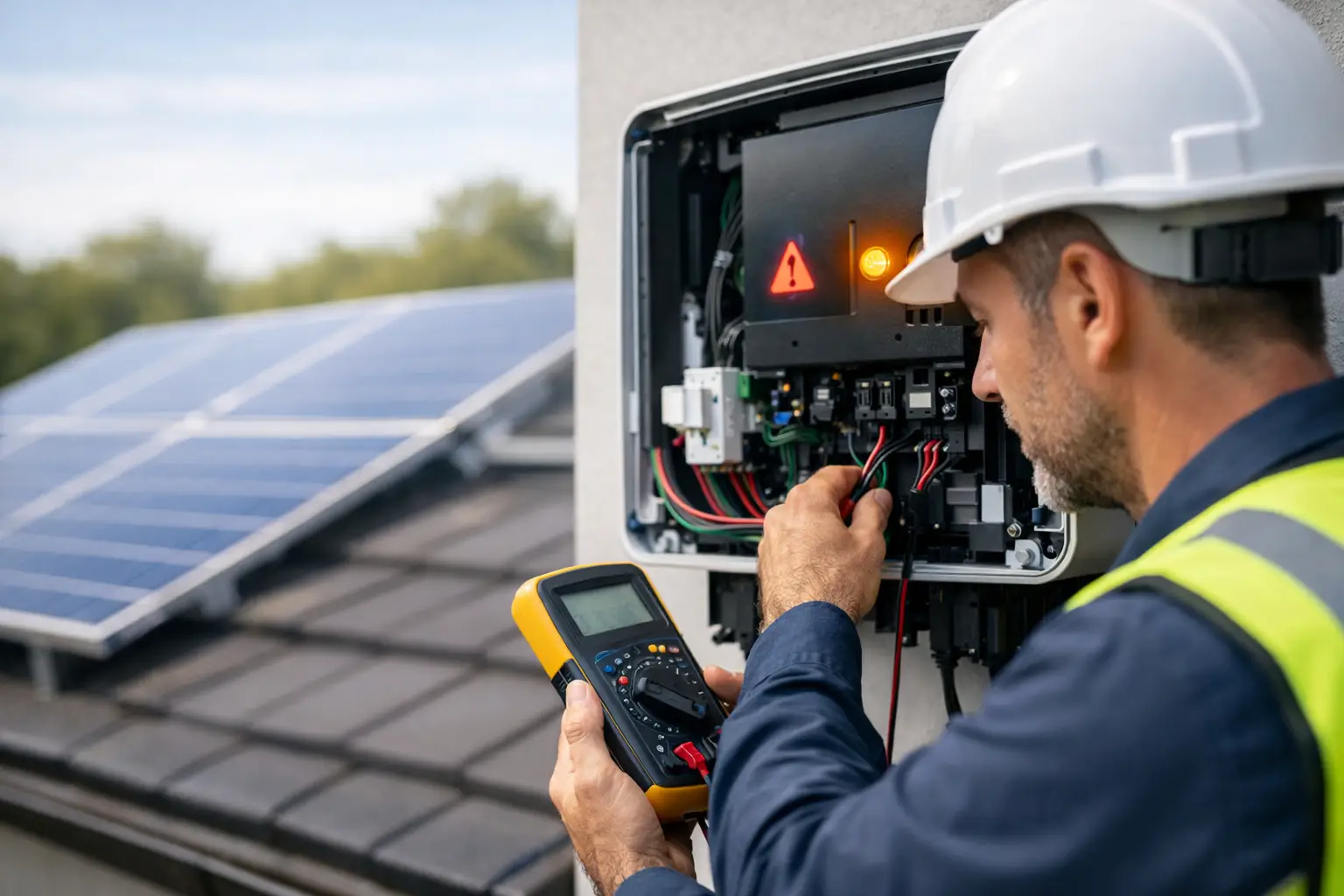
Your inverter flashes, beeps, or suddenly displays a code on the screen. At that moment, you only want to know one thing: is this a minor signal or has your yield stopped? Correctly interpreting an inverter error code is then not a technical detail, but the fastest route to certainty, less downtime, and an installation that continues to perform.
Many owners look at the error message and hope it disappears on its own. Sometimes it does. But sometimes your installation runs less efficiently for hours or days without you noticing. That is precisely why it pays to look not only at the code itself, but also at the context. When did the message appear? Has production actually dropped? Does the error recur? That difference determines whether you can monitor it calmly or should take immediate action.
Why an error code doesn’t always mean the same thing
An error code seems exact. Yet, in practice, it isn’t always. Manufacturers use different names for similar problems. One inverter shows a number, another a text message. Moreover, the same code can mean something different in hot weather than during a grid failure or after a maintenance service.
That is why blindly searching for an error number is rarely the best approach. You often get general explanations online, but not the specific situation of your installation. For example, a message about overvoltage could indicate a temporary grid problem. It could also recur due to a structural voltage problem in your connection. In the first case, you lose little yield. In the second case, your efficiency can gradually come under pressure.
Those who only read the literal code sometimes miss the real problem. Those who link the error message to production data, history, and the behavior of the installation get a much more reliable picture.
Correctly interpreting inverter error codes starts with three questions
Before you reset or switch anything off, it is best to first ask three simple questions. Does the inverter still indicate production? Is the error a one-off or does it recur? And do you see other signals, such as a red light, unusual noises, or an app that no longer shows data?
That first check says a lot. If the installation is still producing power as usual, it is often a warning or a temporary deviation. If production drops out, there is a higher chance that you are dealing with a real malfunction. Recurring errors always deserve extra attention, even if they seem to disappear in between. It is precisely those recurring messages that often cause simmering yield loss.
With modern installations, it is smart to also look at the data. With good monitoring of solar panels, you see not only that there was an error, but also how long it lasted and what the impact on your yield is. That makes the difference between guessing and targeted intervention.
The most common types of error codes
Not every message requires the same reaction. Broadly speaking, error codes usually fall into a few recognizable categories.
Grid voltage errors
These are messages about grid voltage being too high or too low, grid frequency, or loss of grid connection. They occur regularly, especially in places where many solar panels are feeding back at the same time. Often the inverter will then stop temporarily to protect itself and the grid.
A one-off grid voltage error on a hot, sunny afternoon doesn’t have to be immediately alarming. If the same error recurs often, you may be losing yield structurally. That requires further investigation. Not just into the inverter, but also into cabling, connection, and grid conditions.
Insulation or leakage current messages
These error codes indicate a possible loss in electrical insulation. This could be related to moisture, damaged cables, connectors, or aging of components. You shouldn’t take this lightly. It’s not just about efficiency, but also about safety.
If you see such a message after heavy rain or after work on the roof, an inspection is wise. Waiting can lead to the malfunction recurring or worsening.
Temperature and ventilation errors
Inverters do not like overheating. Messages regarding temperature arise from poorly functioning ventilation, dirt, a defective fan, or an unfavorable mounting location. On hot days, the inverter may then throttle down or shut down.
This sometimes seems like a seasonal problem, but it definitely costs yield. Especially if the error occurs during sunny peak moments. Regular maintenance of solar panels and the installation environment helps to detect such problems faster.
Communication and monitoring errors
Sometimes the inverter still works, but you no longer see data in the app or portal. Then it might be a communication problem. This is less urgent than a complete production stop, but it is also not something to ignore. Without data, you often only notice malfunctions much later.
That is exactly why continuous follow-up is so valuable. With 24/7 monitoring, you notice deviations faster and don’t have to check yourself whether your installation is still doing what it should.
Internal hardware errors
Messages about relays, sensors, circuit boards, or internal components more often indicate a technical defect in the inverter itself. In such cases, a reset is usually not a sustainable solution. The error may disappear for a while, but resurface later.
In this case, rapid technical assistance is often the safest choice. Especially if the installation is completely down or the error recurs frequently.
What you can do yourself and what you’d better not
Correctly interpreting an inverter error code also means knowing where your limit lies. You don’t have to be a technician to do the first check. Look at the display, note the exact code, take a photo if necessary, and check if production is still running in the app. Sometimes it also helps to check if there was a general power cut or grid failure in the area.
What you’d better not do is open the housing yourself, disconnect cables, or perform multiple random resets without knowing the cause. By doing so, you risk extra damage, loss of warranty, or an unsafe situation. Especially with messages regarding insulation, leakage current, or internal defects, caution is more important than speed.
A reset is also not a real solution if the error keeps coming back. You are then only postponing the problem, while your yield decreases in the meantime.
When it’s best to call for help immediately
Some situations require no waiting. If your inverter shows a persistent red error message, if production stops completely on a sunny day, or if the same code recurs regularly, then rapid intervention is logical. This also applies if you notice a burning smell, discoloration, traces of moisture, or strange noises.
For many owners, the uncertainty is particularly difficult. You see a code, but don’t know if you are losing one hour of yield or several days. In that case, professional technical assistance is not an unnecessary luxury, but a way to limit damage and downtime. Especially if your original installer is no longer active or remains difficult to reach.
Why error codes without follow-up cost money
An error message that disappears feels reassuring. Yet, something could still be going wrong behind the scenes. Think of an inverter that shuts down every time at peak moments due to grid voltage. Or a temperature problem that only acts up on hot afternoons. You might not see a constant alarm, but your yield will still lag behind.
That makes error interpretation so important. It’s not just about solving defects. It’s about protecting your investment. Every day with unnoticed loss is energy your installation should have delivered, but didn’t.
With larger installations, that impact is even clearer. For companies, it’s not just the technical error that counts, but also continuity. Less production means less return and sometimes also extra administrative or operational consequences. That is why many owners choose a combination of monitoring, periodic checks, and rapid intervention.
Correct interpretation often requires more than a manual
Your inverter manual is useful, but not the ultimate solution. It usually explains what a code means in theory. What it often doesn’t tell you is why that code is appearing now, how often it has occurred before, and what the impact on your installation is.
That is where the value of experience lies. Not just reading the message, but also recognizing the pattern. Is this a temporary deviation, wear and tear, dirt, a grid problem, or a defect that will escalate further? That distinction determines whether simple monitoring suffices or whether a repair is necessary.
In practice, you often see multiple factors playing together. A dirty environment can contribute to higher temperatures. Poor monitoring can mean that recurring errors are noticed too late. Postponed maintenance, in turn, ensures that small signals become big problems. Those who have their installation monitored preventively avoid precisely that chain reaction.
How to get a grip on your installation again
Those who want certainty don’t need to be able to decipher every error code themselves. What does help is a fixed approach. Note the message, monitor production, and don’t wait too long with recurring or unclear errors. Then you stay in control without taking unnecessary risks.
For individual owners, peace of mind is particularly important. You want to know that your installation is doing what it should, without having to become a specialist yourself. For professional installations, continuity, reporting, and avoiding downtime also count. In both cases, the same applies: the faster you correctly assess an error, the smaller the loss.
An error code is therefore not a detail on a screen. It is a signal about the health of your installation. By reading that signal correctly, you prevent surprises and your solar installation continues to do what it was intended for: generating energy reliably, with maximum yield and minimum worries.