



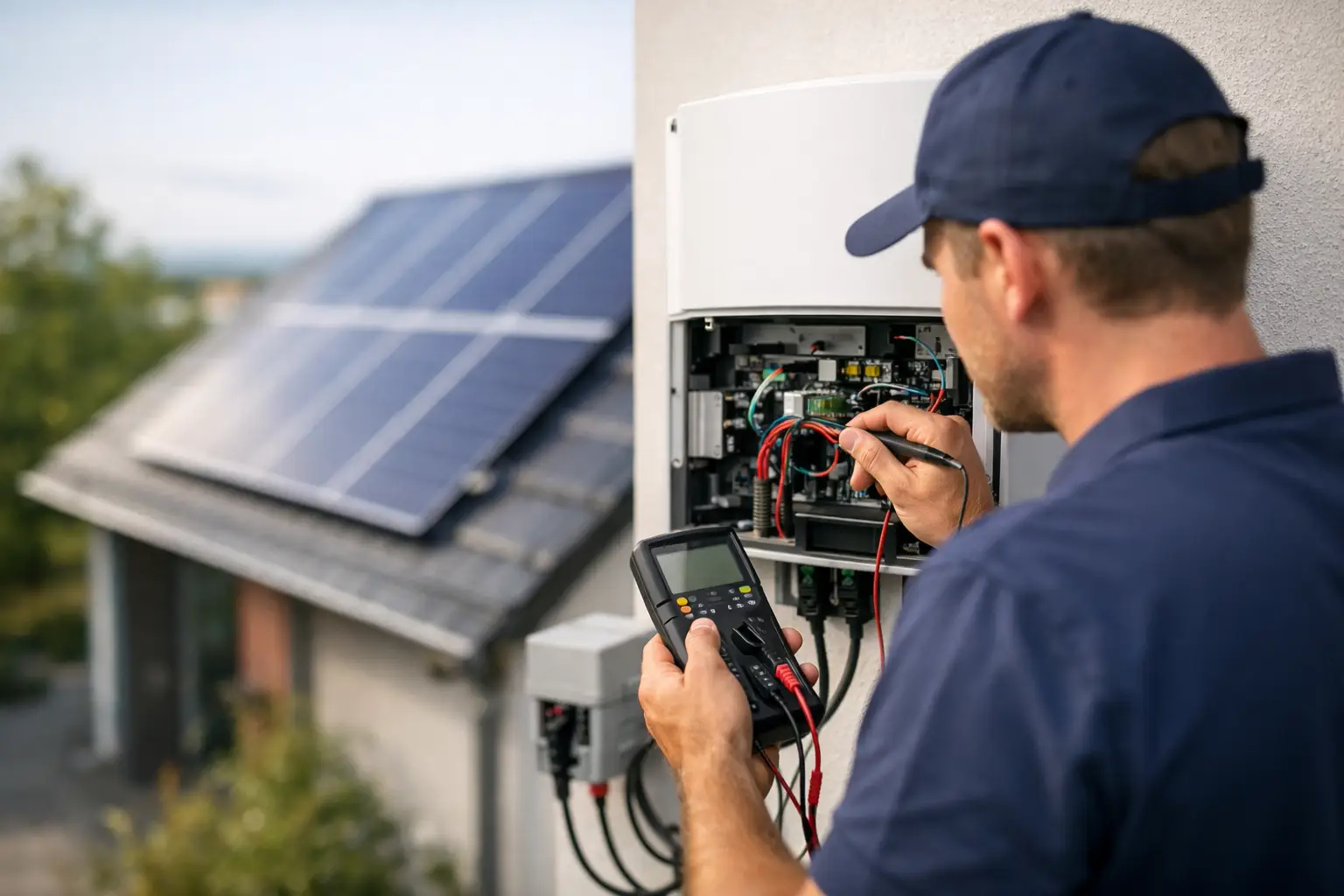
Inverter fault? This is what you should do first
You often only notice it late: the app no longer shows production, the display shows an error message, or your energy bill is higher than expected. An inverter fault sometimes seems minor, but every day of downtime costs yield. That is why responding quickly and correctly is important – not only to solve the problem, but also to limit the loss of yield.
What an inverter fault really means
The inverter is the heart of your solar installation. Solar panels generate direct current, and the inverter converts it into alternating current that you can use at home or in your business. If something goes wrong there, production drops immediately or stops completely.
Not every fault means the inverter is defective. Sometimes it involves a temporary grid voltage peak, a communication problem, an incorrect restart, or a safety feature that has been triggered. In other cases, the problem lies deeper, such as wear and tear, moisture, overheating, or a defective component. That difference is important, because a message on the screen does not always indicate how serious the situation really is.
The most common causes of an inverter fault
In practice, we see that faults can usually be traced back to a limited number of causes. A grid problem is common. If the voltage on the electricity grid is too high or too low, the inverter temporarily switches itself off to prevent damage. This is annoying, but it is also a safety mechanism.
Heat is also a common cause. An inverter works best within a certain temperature range. If it is located in a poorly ventilated room, in full sun, or in a place where dust accumulates, it can overheat. It will then first reduce its performance and may subsequently go into fault mode.
Furthermore, there are communication problems. The installation may still be working, but you no longer see data in the portal or the app. This seems harmless, but without monitoring, you often miss the moment when a real loss of performance begins.
Finally, there are technical defects, such as worn-out fans, damaged connectors, internal electronics failing, or wear due to age. This risk increases, especially with installations that have been running for years without inspection.
What you can safely check yourself during an inverter fault
You don’t need to be a technician to perform an initial check. First, check if the inverter is still receiving power. Is the display still lit, do you see lights, or is everything off? Then check if the fuse or circuit breaker has tripped. Sometimes the cause lies there, especially after a power outage or work on the electrical installation.
Next, look at the error message. Note the code or take a photo of it. This helps later with a targeted diagnosis. Also pay attention to the environment: does the room feel very warm, can you still hear the fan running, or is there dust around the device?
Finally, check your monitoring. Have you not seen data for a while, or has production suddenly dropped sharply? Then the problem might be older than you thought. This often happens to owners who only check their installation occasionally. That is precisely why continuous follow-up is so valuable: you notice deviations faster and limit downtime.
What you should not do yourself
In the event of an inverter fault, it is tempting to disconnect cables yourself, open the casing, or reset components until the error disappears. This is not a good idea. A solar installation remains under voltage, even when part of the system appears to be switched off. This makes DIY repairs risky.
Moreover, an incorrect action can worsen the problem. A defective connector, a moisture problem, or an internal electronic defect cannot be solved with a random restart. Sometimes the message disappears briefly, but it returns later. Meanwhile, you are losing production and the real cause remains.
When rapid assistance is really necessary
Sometimes you can safely perform one check and wait a while. But there are clear signals where it is better to call in technical help quickly. For example, when the inverter fails completely, repeatedly gives the same error message, emits a burning smell, becomes unusually hot, or has shown no production for several days.
Speed is also important for recurring faults. An error that returns every sunny day often points to a structural problem. Then it is no longer a one-off interruption, but a loss of yield at the moments when your installation should be producing the most.
For companies, farms, and buildings with higher consumption, this carries even more weight. There, downtime means not only less solar power, but also a poorer business case and less control over energy costs. Rapid intervention is then not a luxury, but part of good management.
Inverter fault or a problem elsewhere in the installation?
An important nuance: not every drop in production is a real inverter fault. Sometimes the inverter is working correctly, but the problem lies with the solar panels, cabling, optimizers, the meter cupboard, or the internet connection of the monitoring.
That is exactly why a good diagnosis requires more than just looking at the inverter screen. A professional also looks at voltages, error logs, production data, and the behavior of the installation over time. This prevents a component from being replaced while the real cause lies elsewhere.
For owners, this is especially important because troubleshooting costs time and money. You don’t want to need multiple interventions for one problem that could have been correctly identified in one go.
How to limit loss of yield
With faults, everything revolves around time. The faster the problem is noticed, the smaller the loss. Yet many faults are only discovered late. Especially with installations without active follow-up, an inverter can underperform for weeks or even months without anyone noticing.
Monitoring makes the difference here. Not because every small signal immediately means a disaster, but because deviations become visible before they cost a lot of yield. An installation system that is permanently monitored provides more peace of mind. You don’t have to check daily yourself and you are less dependent on chance.
In addition, periodic maintenance helps. A check of ventilation, dirt, connections, and error history often extends the lifespan of the inverter and reduces the chance of unexpected failure. Prevention is usually cheaper than an urgent repair during a period of high production.
Repair, replace, or repower?
Not every inverter needs to be replaced immediately. For newer devices, repair is often logical, as long as parts are available and the repair remains economically justifiable. For older inverters, this is different. Then replacement may ultimately be more advantageous, especially if the new solution is more reliable and easier to monitor.
Sometimes a broader approach is smart. For example, when an installation is technically outdated, repeatedly gives faults, or no longer fits the current consumption profile. Then repowering is worth considering: targeted modernization to regain more certainty and yield, without renewing the entire installation.
The best choice depends on age, brand, fault history, available parts, and the expected long-term yield. A quick fix is not always the cheapest choice if you have downtime again within a year.
Why independent service counts
Many owners run into the same problem: the original installer is no longer active, responds too late, or offers little help once the warranty period is over. Then you want one thing above all: a partner who doesn’t just sell, but also truly provides service when your installation needs attention.
An independent specialist looks at performance, continuity, and recovery. Not at quickly selling new panels. This is especially relevant in the case of an inverter fault, because the solution often lies in correct diagnosis, rapid intervention, and clear advice on the next step.
For those seeking certainty, there is a big difference between ad-hoc help and structural follow-up. With monitoring, maintenance, and a technical department that handles faults quickly, you limit downtime and protect your investment better. That is also how Solar Assistance views installations: maximum yield, minimum worries.
When you shouldn’t wait
If your inverter gives an error message today, it is not a detail for later. Even a temporary fault can indicate a problem that will return, especially with heat, grid voltage fluctuations, or wear and tear. Waiting sometimes seems practical, but often costs more yield than you think.
The best approach is simple: safely check what you can see yourself, note the message, and have persistent or unclear faults checked quickly. This way you keep your installation reliable, limit downtime, and ensure your solar investment continues to do what it should – provide a return year after year.