



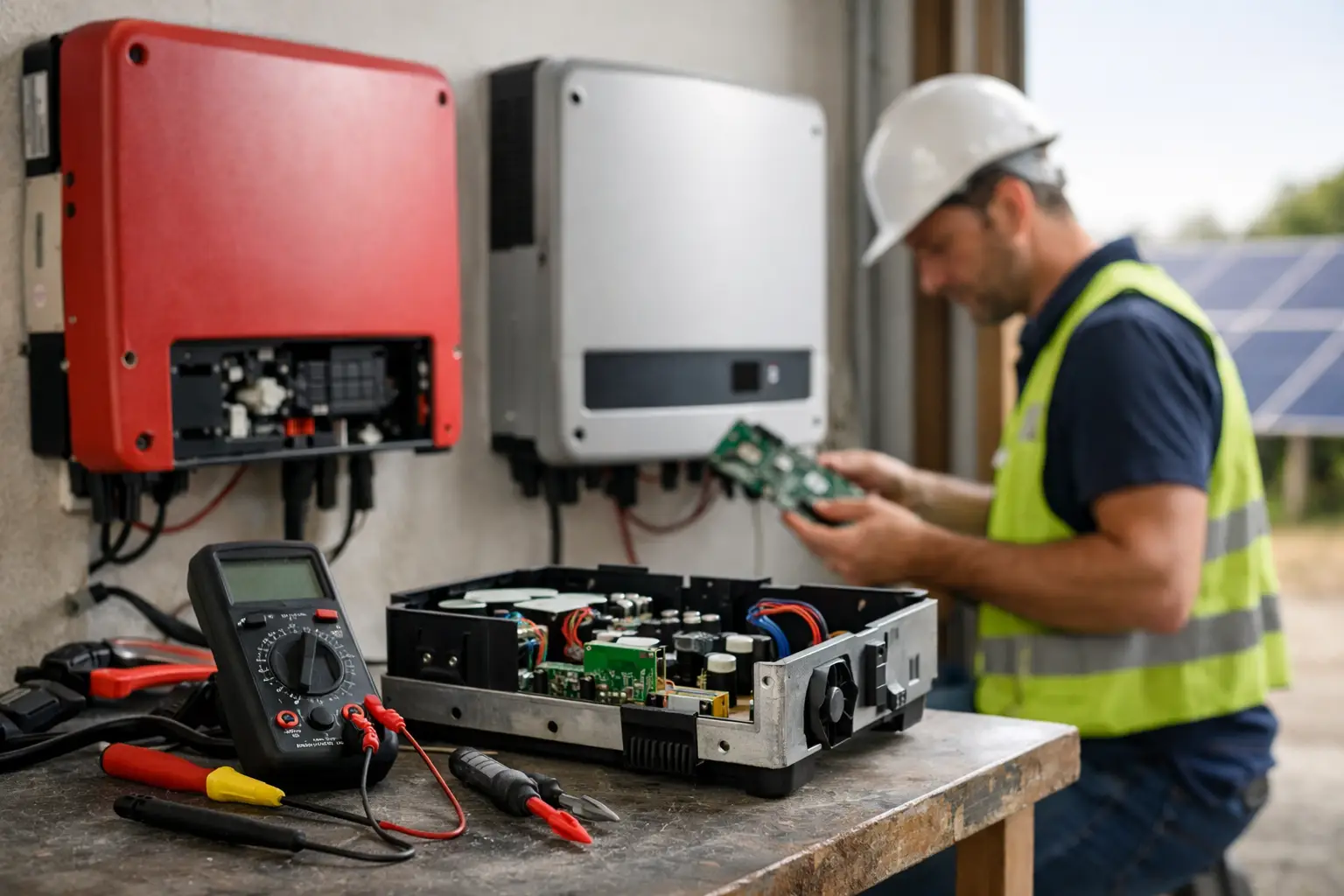
Repair or replace the inverter?
Your solar panels are producing less than expected, the app shows an error message, or the inverter fails regularly. Then the same question quickly arises: is it better to repair or replace the inverter? The right answer depends on the age, the nature of the defect, the expected lifespan, and above all, what will provide you with the most yield and the least worry in the long run.
An inverter is the heart of your solar installation. As long as that device works well, it correctly converts the generated power and you get the maximum out of your panels. If something goes wrong, you don’t always notice it immediately. This is precisely where unnecessary loss of yield often occurs. Especially if your installation has been running for several years, deciding quickly and correctly is important.
When can you still repair an inverter?
A repair is often worthwhile if the defect is limited and the rest of the device is still in good condition. Think of a problem with a connector, a fan, a fuse, a circuit board, or a communication component. In such cases, a targeted intervention can restore operation without a full replacement being necessary.
Repairing makes sense especially with relatively young inverters. For example, if the device is not yet eight to ten years old and it concerns a clearly defined defect, there is a good chance that you can continue for years with a repair. This is often financially more interesting, provided that the repair is carried out properly and a realistic assessment is made of the remaining lifespan.
The availability of parts also plays a role. Some brands and models are easy to repair because spare parts are still available. With older devices, this is less obvious. Then a small malfunction can still result in a higher cost or longer downtime.
When is there no longer any doubt about repairing or replacing the inverter?
Sometimes the choice is quickly made. If an inverter is aging, repeatedly shows malfunctions, or becomes structurally less reliable, then replacement is usually the wisest option. You then avoid paying for a repair today only to face costs or downtime again within a short time.
For most residential installations, the technical lifespan of an inverter averages around 10 to 15 years. This does not mean that every device stops exactly then, but it does mean that the risk of defects increases. If your inverter is twelve years old and fails for the second or third time, it is best to look beyond the immediate repair cost.
Replacement is also often smarter if:
- the repair cost is high in relation to a new device
- parts are no longer available
- the inverter is no longer compatible with modern monitoring
- the efficiency of the device clearly lags behind
- your installation has since been expanded or modified
In those situations, you choose not only for a working inverter but also for more continuity and less risk of new failures.
The real question is: what does downtime cost you?
Many owners primarily compare the price of a repair with that of a new inverter. That is understandable, but the full picture is broader. Every day that your installation produces less or nothing, you lose yield. You feel this not only in your energy consumption but also in the payback period of your installation.
Especially in the spring and summer, a defective inverter can quickly take its toll. A cheap repair that can only be carried out after weeks is not always the best choice. Fast diagnosis and a well-thought-out solution are often worth more than the lowest invoice.
That is why proper follow-up is so important. With targeted monitoring of solar panels, you can notice and address malfunctions faster before they cause major losses. For many owners, this primarily provides peace of mind: you don’t have to constantly check yourself if everything is still working.
Age, defect, and warranty determine the choice
The decision to repair or replace an inverter usually depends on three practical factors: the age of the device, the type of defect, and the warranty.
With a young inverter that is still under manufacturer’s warranty, repairing or exchanging via the warranty is often the logical route. Then you primarily want to be sure that the case is followed up correctly and the downtime remains limited.
With a device out of warranty, the consideration becomes more business-like. A limited defect in a relatively recent inverter can still be perfectly profitable to repair. But with an old device with power loss, recurring error codes, or signs of wear, the uncertainty carries more weight.
For individuals, this is often the most difficult point. You don’t want to replace too quickly if repair is still possible. But you also don’t want to put money into a device that is at the end of its lifespan. A technical analysis on-site then makes the difference between guessing and knowing for sure.
Also pay attention to signals around the inverter
Not every problem is entirely within the inverter itself. Poor cabling, moisture ingress, overheating, incorrect placement, or dirt in the technical room can cause or worsen malfunctions. Replacing an inverter without addressing the underlying cause then only solves part of the problem.
That is why it pays to look more broadly at the entire installation. Regular maintenance of solar panels helps to detect defects faster and address wear or safety issues in time. This prevents small deviations from growing into expensive interventions.
Heat is also an underestimated factor. Inverters that hang in a poorly ventilated room for years have a harder time. This shortens the lifespan. In such cases, when replacing, you must not only provide a new device but also look at the conditions in which it must work.
Repair or replace for older installations
With older solar installations, replacement is often more than an emergency solution. It can also be an opportunity to make the installation future-proof again. A modern inverter usually offers better follow-up, clearer error detection, and sometimes more efficient operation.
That doesn’t mean new is always better. If your existing system continues to perform well and the defect remains limited, a repair can be perfectly sufficient. But as soon as multiple components start to age, it becomes more interesting to think about a broader optimization.
This applies even more strongly to professional customers. With larger installations, it’s not just the cost of the device that counts, but also the impact of downtime on operations, reporting, and planning. Then you usually choose the option that best protects continuity, even if it seems more expensive in the short term.
Fast intervention often makes the biggest difference
Whether you choose to repair or replace, speed remains crucial. The longer a defect goes unnoticed, the greater the loss of yield. That is exactly why technical assistance for solar panels is not a luxury, but a practical way to limit downtime and achieve yield again faster.
For many owners, the problem is not just the malfunction itself, but also the lack of clear follow-up. Who should you contact? Is it still under warranty? Is it really the inverter? And how long will you be without production? A partner that handles diagnosis, intervention, and follow-up then provides peace of mind and a faster solution.
How do you make the right choice?
Anyone doubting whether to repair or replace an inverter would do well not to look only at today. Ask yourself a few simple questions. How old is the device? Is this the first defect or not? What is the expected repair cost? How quickly can the problem be solved? And how much certainty do you have after that?
If a repair is affordable and the inverter still has enough of a future, then repairing is often the best choice. If the chance of new malfunctions is high or the downtime costs too much, then replacement is usually wiser.
A correct diagnosis remains the foundation. Not based on feeling, but on measurements, error analysis, and experience with similar installations. This prevents you from paying for the wrong solution.
Solar Assistance often sees in practice that owners wait too long. Not out of unwillingness, but because they hope the problem isn’t too bad. That is exactly where yield is lost. The sooner you have someone check exactly what is going on, the greater the chance of a limited intervention and the smaller the chance of long-term failure.
Those who want certainty should therefore not only think in terms of repairing or replacing. The smartest choice is the one that gets your installation running stably again, with as little downtime and as much yield as possible. That is ultimately what a good solar installation is for: doing what it should do for years, without you losing sleep over it.