


Need to resolve a solar panels malfunction? Here is how to handle it
You often don’t notice it right away. No smoke, no noise, no alarm. Yet your installation could have been underperforming for days or weeks. That is exactly why resolving a solar panels malfunction is not a minor detail, but a quick way to limit loss of yield, frustration, and unnecessary downtime.
For many owners, it starts with a vague feeling. The app shows less production than expected. The inverter displays an error message. Or the energy bill is disappointing, even though the weather was favorable. Then you want one thing above all: to know what is going on and how quickly it can be fixed.
When a malfunction costs more than you think
A malfunction in solar panels is rarely just a technical problem. It also affects your yield. Every day your installation produces less or nothing at all, you miss out on energy yield. For a home, this translates into a higher energy bill. For a company, it can also have consequences for consumption, planning, and continuity.
What many people underestimate is that not every malfunction is fully visible. Sometimes the installation doesn’t fail completely but operates below its normal level. This is more insidious than a complete standstill because the problem remains unnoticed for longer. A defective optimizer, a poor contact, dirt, a cabling issue, or an inverter that isn’t working stably: these are faults that suppress your yield without you seeing it immediately.
That is why it pays not to wait. The sooner you have a discrepancy investigated, the smaller the chance of long-term loss.
Resolving a solar panels malfunction starts with the right diagnosis
Anyone wanting to resolve a malfunction often wants to know the cost and how quickly it can be repaired right away. Understandable. However, a good intervention always starts with a correct diagnosis. Without that step, there is too much guesswork involved.
An error message on the inverter doesn’t always tell the full story. Sometimes the message points to a grid problem, while the real cause lies elsewhere. In other cases, the inverter appears defective, but the problem is in a string, connector, fuse, or communication failure.
A thorough analysis therefore takes a broader look. It checks whether the installation is still producing, how that production behaves, whether all parts of the system are working together correctly, and whether there are visible or measurable deviations. Only then do you know if it involves a minor correction, a repair, replacement of parts, or a larger underlying problem.
For you as an owner, that primarily means certainty. You don’t want a halfway solution, but a repair that actually lasts.
Common causes of malfunctions
Most malfunctions fall into a few clear categories. The inverter remains a key point of attention because it is the heart of the installation. If it doesn’t work properly, production drops partially or completely. But cabling, connectors, and protections are also sensitive to wear, poor connection, or damage.
External factors also play a role. Bird nests under panels can damage cables. Stubborn dirt can cause hot spots or loss of yield. A network problem can cause your monitoring to fail while the installation is still technically working. And with older installations, you sometimes see components simply reaching the end of their lifespan.
For companies and larger roofs, scale is an added factor. A small malfunction in one zone can go unnoticed for a long time if there is no active monitoring. Then the loss gradually adds up.
What you can check yourself and what you can’t
You don’t need to be technical to do an initial check. See if the inverter shows an error code, if the installation is still visibly producing, and if there are recent differences in your app or monitoring. If you notice a sudden lower yield during similar weather, that is a clear signal. A dropped Wi-Fi connection or an app that no longer shows data also deserves attention.
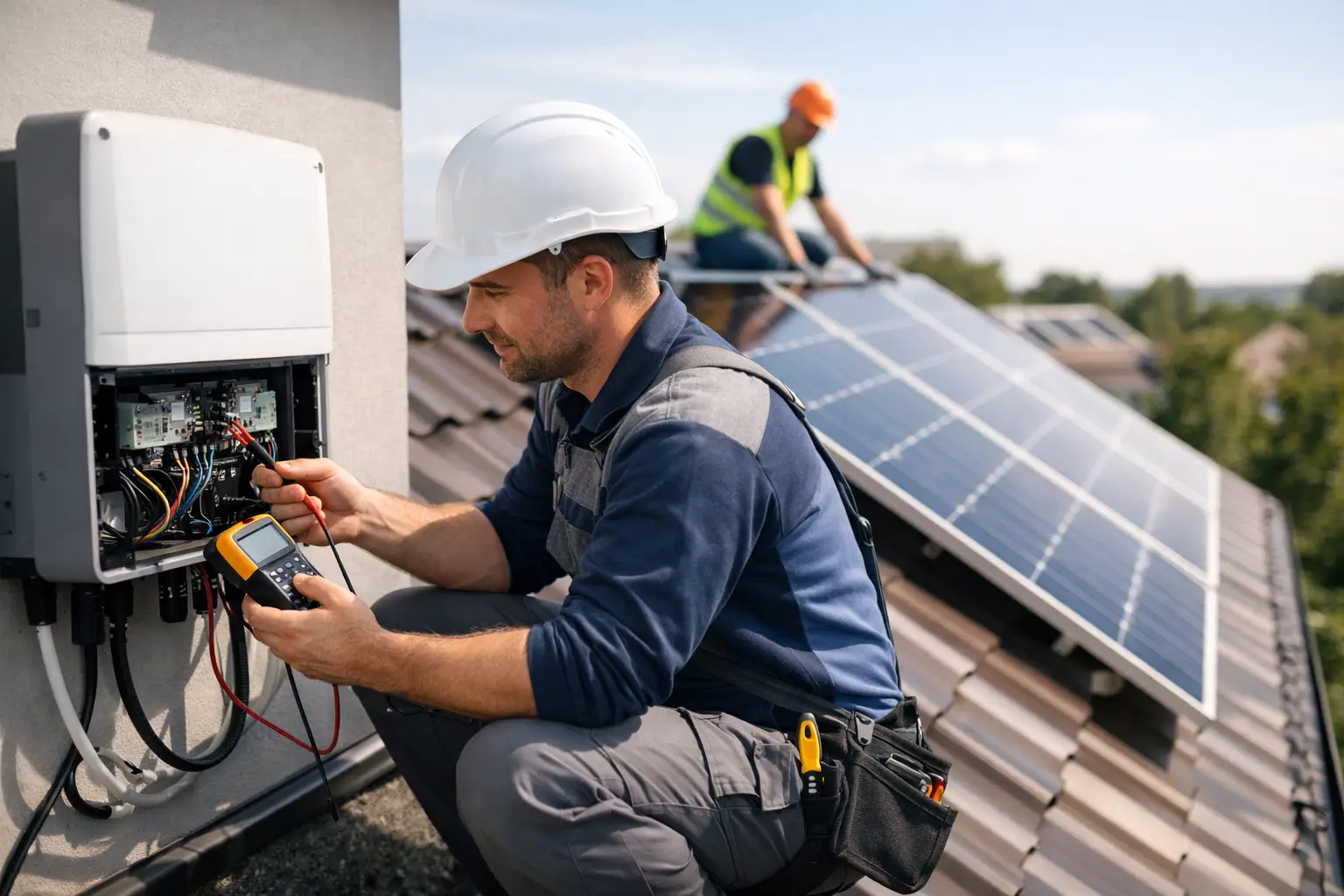
However, it stops there. Opening cabling yourself, dismantling the inverter, or checking connectors is not a good idea. Solar installations work with electrical voltage, even if the system appears to be at a standstill. This requires knowledge, measuring equipment, and safe working methods.
What you should do is quickly document what you see. Note down error codes, take a photo of the message, and report when the problem started. This speeds up the diagnosis and makes an intervention more targeted.
How a professional intervention makes a difference
Resolving a malfunction properly isn’t just about repairing what is broken. It is also about why the problem arose and how to prevent it from happening again.
A technician will therefore not only address the visible defect but also check if other parts have been affected. For a connector problem, for example, they check if there has been heat development. For a defective inverter, they look at load, ventilation, placement, and the general condition of the installation. With recurring failures, it is important to recognize patterns instead of fixing the same symptom every time.
That makes the difference between a quick emergency fix and a sustainable repair. Especially if your installation has been running for several years, you want to know if a one-off intervention is enough or if preventive maintenance is wiser.
Resolve the solar panels malfunction or take a broader look immediately?
That depends on the situation. For a clear, one-off fault, a targeted repair may be sufficient. But if your installer is no longer active, the installation is getting older, or you have had problems before, it is smart to look beyond just the malfunction.
An inspection of the entire installation then provides more value. You gain insight into the general condition, possible wear, and parts that pose a risk in the long term. This prevents you from solving one problem today only to face downtime again within a few months.
For individuals, this primarily means peace of mind. For companies, it is even more about continuity. An installation that runs reliably is simply worth more than one that keeps surprising you.
Monitoring prevents long downtime
Many malfunctions are discovered late. Not because owners are negligent, but because solar installations work quietly and inconspicuously. You simply don’t look at your inverter every day.
That is why monitoring is so important. Not as an extra gadget, but as practical protection for your yield. With active follow-up, you see more quickly when an installation deviates from its normal pattern. This can range from complete failure to subtle production drops, communication problems, or discrepancies at the string level.
The larger the installation, the greater the added value. But even for a home, monitoring can prevent a lot of loss. One timely alert is often the difference between a minor intervention and weeks of missed yield.
Solar Assistance works precisely from that principle: maximum yield, minimum worries. Not waiting until malfunctions pile up, but quickly seeing what is going wrong and intervening purposefully.
When speed really counts
Not every malfunction is equally urgent, but delay is rarely beneficial. Especially during sunny periods, loss of yield adds up quickly. Those who wait weeks for an answer lose not only energy but also confidence in the installation.
A quick response is therefore not a luxury. It provides clarity. Sometimes the problem turns out to be minor. Sometimes a part is actually defective and needs to be replaced. In both cases, you want to know where you stand quickly.
For professional customers, there is an extra layer. They often have multiple buildings, larger capacities, or an internal energy policy. In those cases, downtime is not just annoying, but an operational risk. A single point of contact, clear reporting, and a plan of action then make a big difference.
What makes a good service partner recognizable
If you want to resolve a solar panels malfunction, it is best not to choose based solely on who offers a one-off repair the fastest. More important is whether that partner has experience with existing installations, different brands, and various types of malfunctions.
A good service partner thinks independently. Not from the perspective of selling new panels, but from repair, performance, and lifespan. You notice this in the way they work: first analyze, then explain clearly, and only then repair or advise. You want to know what is defective, what impact that has, and which long-term solution makes the most sense.
Transparency also counts. What is being tested? What is being replaced? Is further follow-up useful? How do you prevent recurrence? These are the questions that matter if you want to protect your investment.
Waiting is often more expensive than intervening
Malfunctions in solar panels are rarely just about technology. It’s about control. About knowing that your installation is doing what it should. About preventing a small fault from growing into a larger problem. And about the reassurance that you don’t have to search for the cause yourself.
If you notice that your installation is deviating, yielding less, or giving error messages, have it looked at quickly. Not out of panic, but out of common sense. A well-functioning installation provides not only power but also peace of mind.