


Solar panels inspection after a storm: what now?
A storm often passes in a few hours, but damage to a solar installation is not always immediately visible. This is precisely why a solar panels inspection after a storm is not unnecessary caution, but a logical step to prevent yield loss, safety risks, and higher repair costs. Especially if there was high wind, hail, flying debris, or a temporary power outage, it pays to check quickly and purposefully.
Many owners first check after bad weather to see if the panels still look tidy. That is understandable, but it doesn’t tell the whole story. An installation may appear intact at first glance, while there may still be micro-cracks in the glass, shifted mounting materials, damaged cabling, or an inverter registering error codes. The real question is not just whether everything is still there, but whether the system is still operating safely and at full efficiency.
Why a solar panels inspection after a storm is wise
Storm damage to solar panels is rarely black and white. Sometimes you immediately see a broken panel or a loosened roof hook. More often, it involves subtler problems that only become noticeable days or weeks later. Think of lower production, moisture ingress in connectors, or an inverter that occasionally fails.
For individuals, this usually means unexpected yield loss and uncertainty about safety on the roof. For companies, the impact can be even greater. There, it’s not just the loss of solar production that counts, but also the chance of downtime, risks to personnel, or damage to a larger technical system. In both cases, the same applies: the sooner an inspection takes place, the smaller the chance that a limited defect grows into an expensive repair.
A quick check is also relevant for insurance. In the event of visible storm impact, it is wise to record the condition early. Not to cause panic, but to gather facts while the traces are still clear.
What damage occurs most often after storm weather?
Not every storm causes the same problems. High winds mainly stress the mounting system and the fastening of cables, while hail is more likely to affect the glass and cell structure. With a combination of wind and driving rain, the focus shifts to seals, connectors, and electrical components.
What regularly occurs is mechanical damage to the panels themselves. This can range from visible cracks to small impact points that are barely visible to the naked eye. The latter are particularly treacherous because they can cause hot spots or accelerated degradation over time.
In addition, we often see problems with the mounting system. A storm doesn’t have to completely tear a panel loose to cause damage. A slight shift in the construction, a loosened clamp, or extra tension on a rail can be enough to affect the stability and lifespan of the installation.
Electrical damage should also not be underestimated. Cables can chafe, connectors can deform, and inverters can register malfunctions after voltage fluctuations or moisture stress. Sometimes the system is still running, but no longer under optimal conditions. Then you lose energy while your installation performs less than it should.
Checking yourself: what can you do safely?
After storm weather, you are welcome to perform an initial check yourself, as long as you do so safely and stay on the ground. Do not climb onto the roof and do not touch any electrical components. A visual check is useful, but only if it can be done without risk.
First, check if any panels have visibly shifted, if glass breakage is visible, and if there are branches, leaves, or other debris on the installation. Also look for loose parts around the roof and for abnormalities in the cabling that are visible from a distance. Inside, you can check the inverter for error messages, warning lights, or a noticeably lower production than normal.
If you have access to monitoring, compare the yield with previous days or a similar period. A lower yield doesn’t necessarily mean storm damage—cloud cover and the season naturally play a role—but a sudden deviation after extreme weather is a signal that deserves further investigation.
If you smell a burning odor, hear crackling, or see a damaged panel with open glass breakage, keeping your distance is the only correct response. In that case, speed is more important than doubt.
When professional inspection is needed
A professional inspection is recommended as soon as there is visible damage, when the inverter reports malfunctions, or if production unexpectedly drops after a storm. Even without clear symptoms, such a check can be wise after hail, heavy gusts of wind, or impact from flying objects.
The big difference compared to your own check is the depth. A specialist doesn’t just look at what is visible but assesses the whole: panels, mounting material, cabling, connectors, inverter, and general electrical safety. This is important because storm damage often spreads across multiple components simultaneously.
For larger installations on commercial roofs, professional inspection is actually the standard. Not only because of the complexity of the system, but also because responsibility, continuity, and reporting carry more weight there. In the event of a defect, you don’t want to guess; you want to know quickly what is damaged, what can safely be put back into service, and what needs to be repaired first.
What a solar panels inspection after a storm looks like in practice
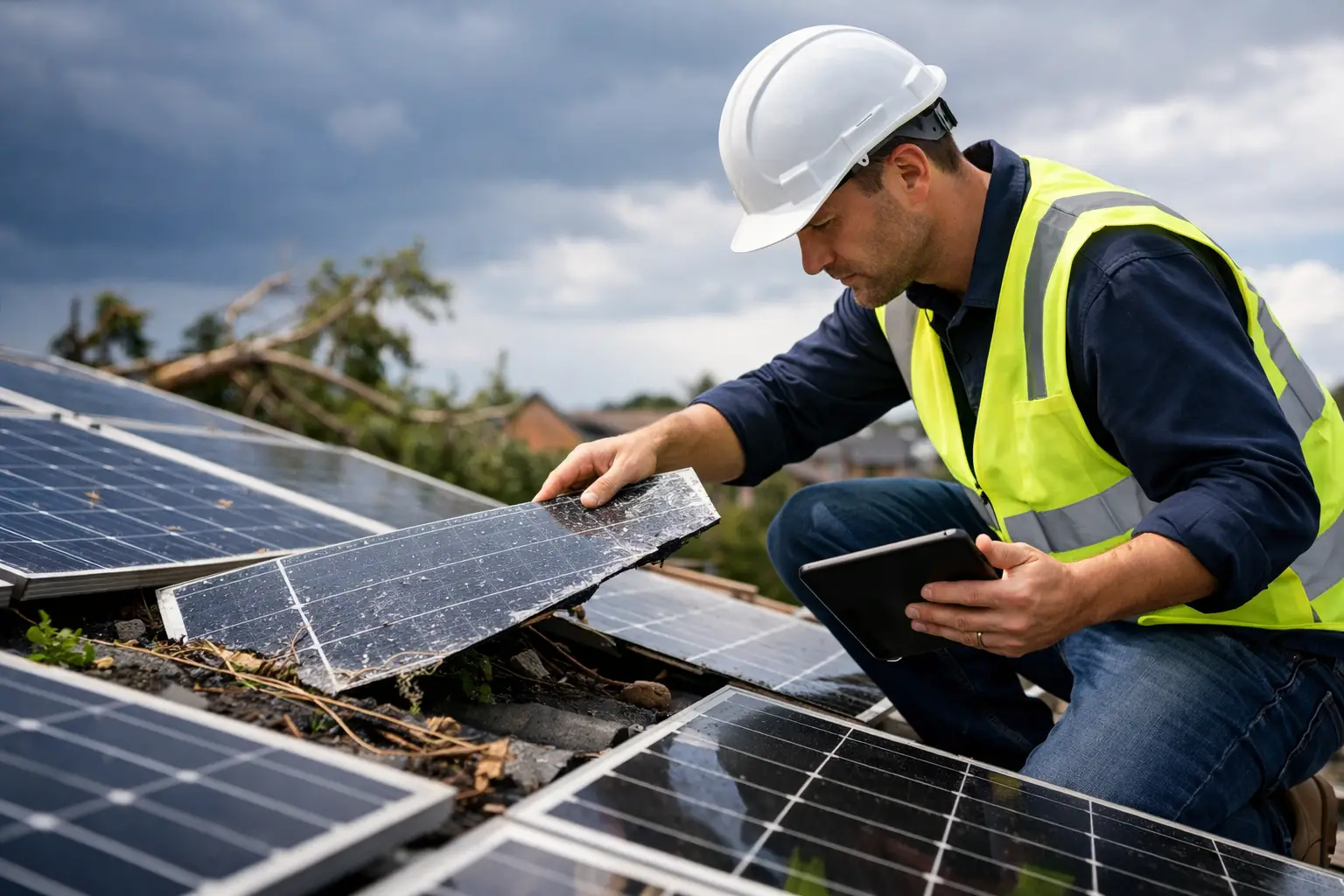
A thorough solar panels inspection after a storm begins with a visual assessment of the entire installation. This includes looking for glass breakage, delamination, frame deformation, shifted panels, and damage to the support structure. The condition of the roof fastening also receives attention, as a problem with the anchoring is not always immediately visible on the panel itself.
This is followed by the technical check. Error codes and performance of the inverter are checked, as are the electrical connections and cabling. Where necessary, measurements are carried out to determine if strings are functioning correctly and if there are deviations in voltage or current.
Depending on the situation, a thermographic check can also be useful. This makes temperature differences visible that indicate damaged cells, poor contacts, or incipient hot spots. This is not a standard step for every small storm, but it is particularly useful when damage is not directly visible and performance still deviates.
A good inspection does not end with findings alone. You also want clarity on the next step: continued use, monitoring, repair, or temporary shutdown. This is exactly where the added value of a service partner lies, who not only identifies the problem but can also intervene quickly.
Wait or act immediately?
Many people postpone a check as long as the installation is still producing power. That seems logical, but it is not always wise. A panel with internal damage can still work while simultaneously deteriorating rapidly. A loose part might just stay in place until the next wind peak. A connector with moisture ingress may initially only cause slight malfunctions and later grow into a safety problem.
This doesn’t mean every storm leads to urgent repairs. It depends on the intensity of the weather, the age of the installation, the quality of the mounting, and the signals you see afterwards. But precisely because it is so situation-dependent, a quick assessment is important. Then you base your decisions on measurements and findings, not on hope.
For installations that are already somewhat older, the sensitivity is often higher. Materials age, rubbers become less flexible, and fastenings have to handle more stress year after year. After storm weather, an older installation can therefore suffer hidden damage more quickly than a recent system.
Yield can be lost even without visible damage
The most underestimated consequence of storm damage is not always direct failure, but a silent drop in performance. A panel with micro-damage or a string with a disrupted connection can still continue to produce, just less efficiently. You often only notice this later on the energy bill or in the monitoring, when the cause is less easily linked to the storm from several weeks ago.
For individuals, this is frustrating because the installation is intended specifically for predictable savings. For companies, it is primarily a management problem. If no one actively checks, deviations sometimes stay under the radar for too long. Therefore, follow-up after extreme weather is not a luxury, but a part of good technical management.
An experienced service partner like Solar Assistance does not view such a situation as a one-off intervention, but as a combination of safety, repair, and yield. That makes the difference between just identifying damage and making your installation perform reliably again.
What you should have ready after a storm
If you have an inspection carried out, it helps to note a few things immediately: when the storm took place, what error messages are visible, whether the yield has deviated since then, and whether any visible damage has been noticed. Photos from the ground can be useful, as can screenshots of monitoring data.
This speeds up the initial assessment and helps to work more purposefully. Especially with urgent interventions, every step that prevents unnecessary delay counts.
A solar installation must not only work on good days. It must also remain reliable after bad weather, when the risks are greater. Those who have it checked quickly are not choosing extra caution, but control over safety, continuity, and yield.